
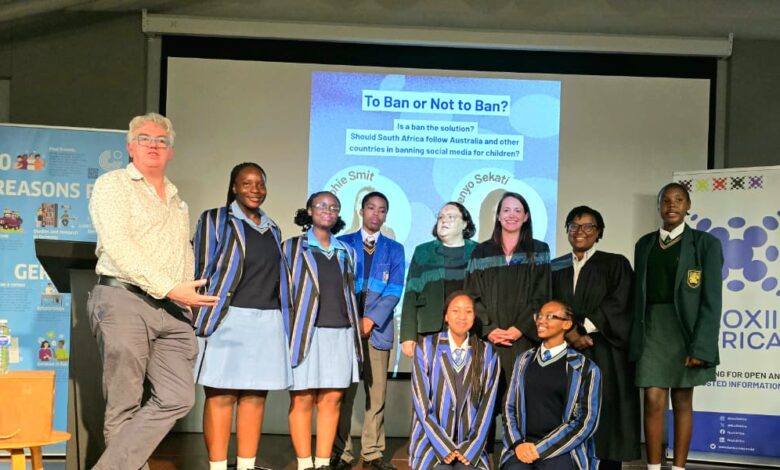
A thought-provoking moot court, hosted by Media Monitoring Africa at the Goethe-Institute today, placed South Africa’s proposed social media ban for children under the spotlight, inviting learners, legal minds, and youth advocates to debate whether such a move would protect children or do more harm than good.
Arguing in favour of the ban, Sophie Smit presented a compelling case grounded in constitutional law, international obligations, and the realities facing South African children online. She said the proposal aimed to protect minors from documented online harms, rather than to criminalise them, placing the best interests of the child at the centre of the argument.
Read more: Culture Summit Africa shows how people-first thinking is reshaping business
Smit highlighted mounting concerns around cyberbullying, mental health struggles, online grooming, sexual exploitation, non-consensual imagery, and the dangers of deepfakes and harmful algorithms.
With 95% of South African children regularly accessing the internet, and 70% reportedly doing so without parental consent, she argued that voluntary platform regulation and digital literacy efforts were no longer enough. “A preventative, age-based ban is proportionate and necessary.” She compared it to restrictions already in place for alcohol, tobacco, and gambling, calling for mandatory age verification, corporate accountability, and penalties for platforms that fail to protect minors.
Countering this stance, Phenyo Sekati argued that banning social media would be impractical, ineffective, and a violation of children’s rights to expression and access to information. She said children are independent rights holders and that international and national frameworks support safe participation, rather than prohibition.
Sekati warned that age verification systems are easily bypassed, potentially exclude marginalised communities, and raise serious privacy concerns. Instead, she advocated for improved digital literacy, better platform accountability, and safety by design, stressing that social media plays a vital role in education, peer engagement, and community building.
Also read: Voices of inclusion rise at the Valuable 500 Africa summit
Web Rangers acted as witnesses, which brought the youth perspective into the courtroom. One learner described social media as a space for creativity, identity exploration, and mental health support, while cautioning that outright bans could push teenagers towards unsafe alternative platforms. She proposed a more balanced approach, recommending restrictions for users under 13 and monitored access for those aged 13 to 17, alongside comprehensive digital literacy education.
Another youth participant raised concerns about harmful online subcultures and poor content moderation, calling for stricter regulation and temporary bans to allow safer systems to be developed.
Delivering the final ruling, Carina du Toit acknowledged the complexity of the issue, noting that social media offers both profound benefits and serious risks. While recognising the need for clear legal age boundaries, she criticised the limited consultation process and the lack of attention given to children’s rights to self-expression and association.
“There are serious reasons both for and against a ban.” She concluded that government needs to develop a comprehensive plan within two years. The ruling, she said, was not about winners or losers, but about learning, balance, and protecting children in a rapidly evolving digital world.
As the debate closed, one thing was clear: The conversation around children, technology, and safety is far from over, and young voices will play a critical role in shaping what comes next.
Follow us on our Whatsapp channel, Facebook, X, Instagram and TikTok for the latest updates and inspiration!