Tent Travels: Jewel of Karoo still sparkles
We never found out why the church has a chimney.
GRAAFF-Reinet’s imposing Groot Kerk, designed by Cape architect J Bissett on similar lines to England’s Salisbury Cathedral, is the only church in South Africa that boasts a chimney.
At least that is what a chatty elderly resident told us on our most recent visited to the ‘Jewel of the Karoo’, so we went to take a look. And, sure enough, there at the back of the church, peeping out from between various church buildings, was the remarked-upon chimney. We stopped to take a photo.
We were spending a pleasant morning shopping and sight-seeing in Graaff-Reinet while staying at the Camdeboo National Park, the fairly recently proclaimed game reserve that almost completely encircles the elegant town.

Bill and I have a great fondness for Graaff-Reinet. The fourth oldest town in South Africa has a lovely setting, in a horseshoe bend in the Sundays River, surrounded by the Camdeboo Plains and Sneeuberg Mountains, but it is not only its natural beauty that attracts our attention.
Shady old trees line the graceful streets and everywhere it is obvious that the people of Graaff-Reinet care about their town and its architectural heritage. Most of the old buildings, private and public, are in wonderful condition, their authenticity marvellously intact. The late Anton Rupert, a renowned South African philanthropist, was born in Graaff-Reinet and was very involved in much of the restoration work.
There are lovely old churches, grand Victorian dwellings adorned with broekie lace, an ornate town hall, fine examples of stately Cape Dutch architecture and delightful examples of the simple, flat-roofed, green-shuttered Karoo-style town houses. Many of the old buildings are now put to use as museums, antique shops and galleries.

By the mid 1800s, because of its strategic geographical position, South Africa’s fourth oldest colonial town had grown into the most important commercial centre in the Cape Colony interior. The opening up of the Kimberley diamond fields and, in 1879, the arrival of the railway line from Port Elizabeth ushered in a period of unprecedented wealth and expansion. Many of the now carefully restored and maintained grand homes and elegant commercial buildings – a number of them National Heritage Sites – date back to that era.
Although we didn’t have too much time to spend in Graaff-Reinet on this visit, we’d explored it pretty thoroughly on previous occasions. On our first visit we’d bought a `package deal’ ticket which covered the entry fee to five museums. The most impressive had been Reinet House, a fine example of a Cape Dutch H-shaped home. This lovely old dwelling and its interesting exhibits had offered us a wonderful glimpse back in time to a more gracious era.

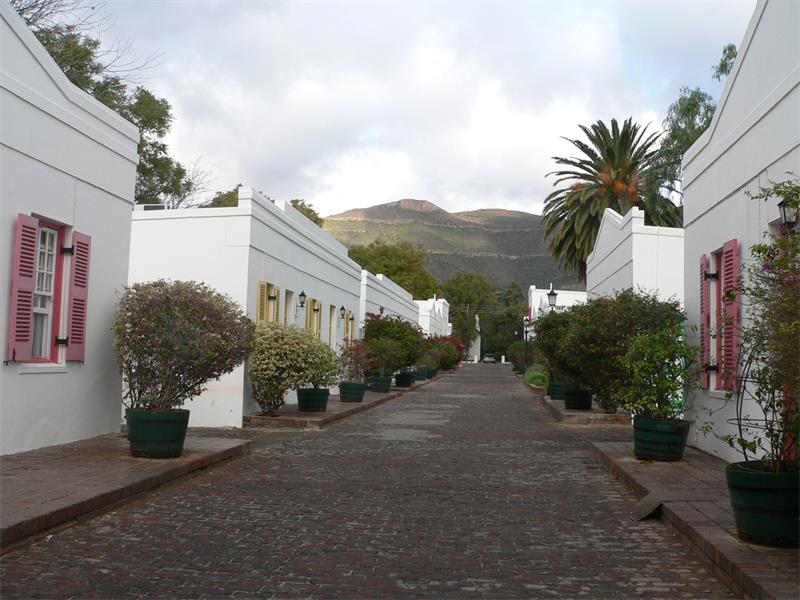
It is thought that Reinet House might have been designed by Louis M Thibault, the architect who designed The Drosty now, together with the adjacent Stretch’s Court, a luxury hotel complex. Stretch’s Court is my favourite place in the town centre. It is named after Captain Charles Lennox Stretch who was appointed government land surveyor at Graaff-Reinet in 1823.
He bought a large piece of ground adjacent to The Drosty, dividing it into allotments in 1858. Many of these were bought by labourers and freed slaves. Their charming cottages have been beautifully restored, their doors, window frames and shutters painted bright rainbow colours.

The War Museum is worth a visit as it tells the story of what the now peaceful town must have endured during the Anglo Boer War. And when you grow footsore and weary, stop for a coffee break at our favourite Graaff-Reinet restaurant, housed in a section of the handsome Graaff-Reinet Club. Built in 1876, it is the second oldest social club in South Africa.
On this visit we were short of time but we did have some to spare to visit the simple, white-washed, `Klein London’ (as in London Missionary Society) Church, now put to use as the Jan Rupert Art Centre. On a previous visit we’d been thrilled to find the art gallery hosting an exhibition featuring the panels by JH Pierneef that once adorned Johannesburg Station. Sadly, these had been moved to Stellenbosch but we did see a very interesting pop art exhibition there.
Of course, a visit to the Jewel of the Karoo would be incomplete without a stroll down Cradock Street to admire all its restored buildings. The longest street in Graaff-Reinet, it is also the town’s second oldest and is something of an architectural showcase.

Finally, we popped into McNaughton`s Bookshop, next to the information centre, and came out with a bag of lovely books. We never visit or pass through Graaff-Reient without stopping at this fine literary emporium. It really is one of the best little book shops in South Africa and a must-do for any visiting book worms.
Karoo people take their reading, culture and history seriously and the region is scattered with beguiling books shops, often tucked away in picturesque corners of the towns and always well stocked with South African literature and non-fiction books. There is something about the Karoo that nurtures readers and writers and the Jewel of the Karoo is no exception.
We still need to find a book that will tell us more about the Groot Kerk’s chimney.