
Turn on the telly – 90 years ago today
On January 27, 1926, John Logie Baird, a Scottish inventor, gave the first public demonstration of a true television system in London.
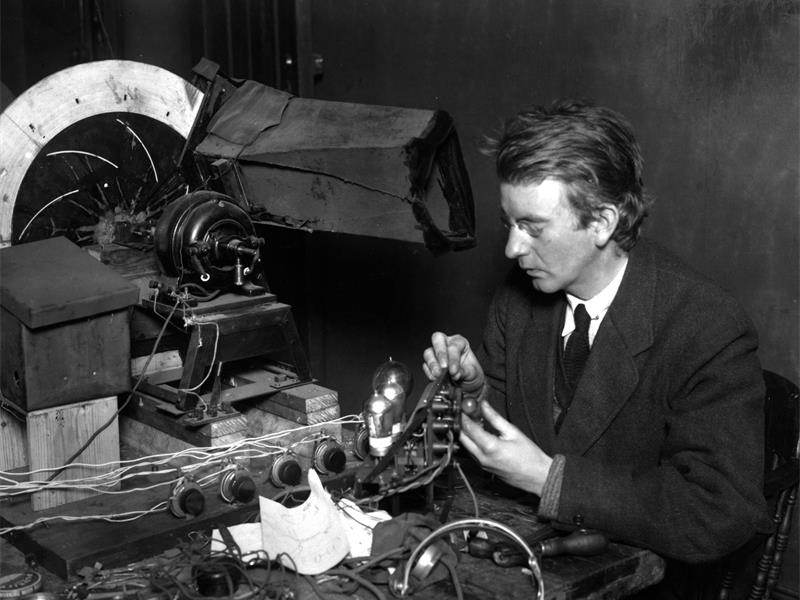
BAIRD’S invention launched a revolution in communication and entertainment.
His pictorial-transmission machine, which he called a ‘televisor’, used mechanical rotating disks to scan moving images into electronic impulses. This information was then transmitted by cable to a screen where it showed up as a low-resolution pattern of light and dark.
Baird’s first television programme showed the heads of two ventriloquist dummies, which he operated in front of the camera apparatus out of view of the audience.
Baird based his television on the work of Paul Nipkow, a German scientist who patented his ideas for a complete television system in 1884. Nipkow likewise used a rotating disk with holes in it to scan images, but he never achieved more than the crudest of shadowy pictures.
Various inventors worked to develop this idea and Baird was the first to achieve easily discernible images.
In 1928, Baird made the first overseas broadcast from London to New York over phone lines and in the same year demonstrated the first colour television.
The first home television receiver was demonstrated in Schenectady, New York, in January 1928 and, by May, a station began occasional broadcasts to the handful of homes in the area that were given the General Electric-built machines.
In 1932, the Radio Corporation of America demonstrated an all-electronic television using a cathode-ray tube in the receiver and the ‘iconoscope’ camera tube developed by Russian-born physicist Vladimir Zworykin. These two inventions greatly improved picture quality.
The British Broadcasting Corporation (BBC) inaugurated regular high-definition public broadcasts in London in 1936.
In delivering the broadcasts, Baird’s television system was in competition with one promoted by Marconi Electric and Musical Industries. Marconi’s television, – which produced a 405-line picture, compared with Baird’s 240 lines – was clearly better and, in early 1937, the BBC adopted the Marconi system exclusively.
Regular television broadcasts began in the United States in 1939 and permanent coloor broadcasts began in 1954.
South Africa, however, had to wait until January 1976 for the square-eyed monster.
Prime minister, Hendrik Verwoerd, had compared television with atomic bombs and poison gas, claiming that: “They are modern things, but that does not mean they are desirable.” The new medium was regarded as the ‘devil’s own box, for disseminating communism and immorality’.
When Neil Armstrong became the first man to set foot on the Moon in 1969, South Africa was one of the few countries unable to watch the event live, prompting one newspaper to remark: “The moon film has proved to be the last straw. The situation is becoming a source of embarrassment for the country.”
Experimental broadcasts in the main cities began on 5 May 1975, before nationwide service commenced on 5 January 1976.
Owing to South Africa’s apartheid policies, the British Actors’ Equity Association started a boycott of programme sales to South Africa. This, combined with a similar boycott by Australia, meant that South African TV was dominated by programming from the United States. Many imported programmes such as as Miami Vice and Beverly Hills, 90210 were dubbed into Afrikaans. In order to accommodate English speakers, the SABC began to simulcast the original soundtrack Radio 2000.
Hugely popular shows in the early days of TV included The Little House on the Prairie, Dallas, CHiPs, Bonanza, Starsky and Hutch, Charlie’s Angels and The Knicky Knacky Knoo Show.
There were local programmes, too. Remember The Villagers – the first South African series to run over three seasons?
American soaps such as Rich Man, Poor Man, Santa Barbara, Days of Our Lives and The Young and the Restless were extremely popular in the 1980s, but so was the massive South African hit soap, Agter Elke Man, which starred Steve Hofmeyr as Bruce Beyers.
One of the SABC’s most successful programmes, ever, was the drama Shaka Zulu, which was shown around the world in the 1980s.
Because of apartheid, though, it had to be marketed by a US distributor.


