Froggy find applauded
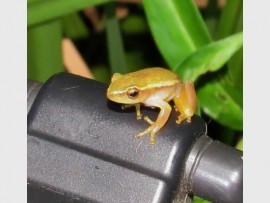
A critically endangered Pickersgill's reed frog was discovered during a South Coast World Wetlands Day celebration.
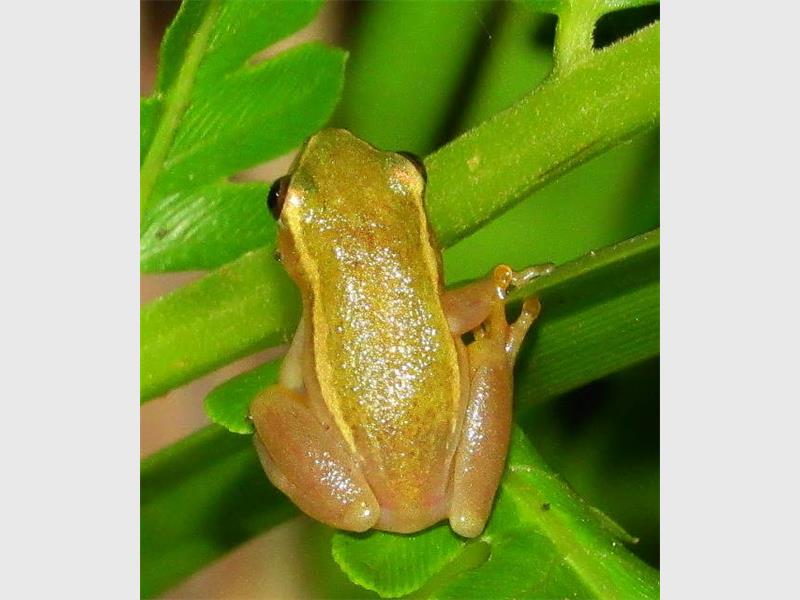
WHILE a Pickersgill’s reed frog might not figure high on the average person’s list of thrilling discoveries, the appearance of this elusive little amphibian is causing great excitement in South Coast green circles.
South Coast Conservancy Forum scribe Peter Vos is pleased to report that reptile and amphibian expert, Nick Evans, found a male Pickersgill’s reed frog (Hyperolius pickersgilli) on Saturday last week.
This was while he was hosting a Pennington Conservancy froggy weekend at the conservancy’s Nkomba Conservation Area, in anticipation of World Wetlands Day, which was celebrated on Tuesday this week. The South African National Biodiversity Institute (Sanbi) describes finding one of these critically endangered little frogs as finding a needle in a haystack as they are small, quiet, secretive and fast.
The Pickersgill’s reed frogs are endemic to a narrow strip of land along the KwaZulu-Natal coastline and there is concern about the fact that their habitat is very fragmented and in decline. However, judging by the widespread, thin cricket-like calls of this little creature and Nick’s subsequent sighting of others in a separate part of the wetland, Nkomba’s status as another, albeit isolated, ‘Pocket of Pickersgill’s’ along our coastline is assured.
As small and insignificant as this and other frog species are, conserving them and protecting their soggy habitats are important for a number of reasons. According to the Endangered Wildlife Trust, frogs are amphibians, the most threatened class of vertebrates on earth and are a crucial link in the food chain as both predator and prey. Frogs consume vast amounts of insects including ones, like mosquitoes, that can spread disease, In short they are biological pest controllers of note.
From the ecological perspective, amphibians are regarded as good ecological indicators and the fact that one third of all these species is threatened should be an important warning to humans that our global environment is in jeopardy. Because frogs ‘drink’ through their skin, they are very susceptible to man-made changes in the environment. Sanbi points out that the Pickersgill’s reed frog’s high degree of sensitivity of habitat requirements means these frogs will respond to very slight changes in the environment. Such responses have and can be used to indicate poor habitat quality, habitat fragmentation, ecosystem stress, pollution and various activities that would affect them and other species.
The discovery of this critically endangered species in the Nkomba Conservation Area highlights the need for the continued care and conservation of our wetlands and other environmentally sensitive areas.
“Nkomba has had a chequered past. It was originally a failed rice paddy, then a forgotten railway siding and more recently, the town dump,” said Peter.
He said the restoration efforts that had been started in 1990 by the Pennington Environmental Group, ably led by the late John Jerman, had recently been assumed and redoubled by Pennington Conservancy under the wing, appropriately, of John’s daughter Carolyn Schwegman. Peter described Nick’s discovery of the fine male Pickersgill’s reed frog as ample reward for the conservancy’s hard work. It was also a very special way of marking World Wetlands Day.
Celebrated on February 2 every year, World Wetlands Day marks the anniversary of the adoption of the Convention on Wetlands, in the Iranian city of Ramsar on the shores of the Caspian Sea, on February 2, 1971.
HAVE YOUR SAY
Like our Facebook page, follow us on Twitter and Instagram
For news straight to your phone, add us on BBM 58F3D7A7 or WhatsApp 082 421 6033