
WITH only two days of our Easter mini-holiday left, we were determined to make the most of them, even if it was time for us to start wending our way homewards.
Our destination that day was Stutterheim, an Eastern Cape town, less than 100km inland from East London. We’d chosen it as an overnight stop on the homeward leg of our journey as Bill had long wanted to see its stationary engine museum. It would also be a short hop from Addo National Park, where we had been staying, so we were looking forward to one of those leisurely meandering sort of days that give a road trip its special sparkle.
The sun was just starting to come up when we left Addo as we wanted to get to Grahamstown before 8am. Bill and I are keen parkrunners and when we are at home we are regular participants of the Uvongo parkrun, from St Micheals to Uvongo.

The parkrun movement is a global one and a really great concept. All over the world, 5km free, timed runs, take place in parklike surroundings every Saturday morning at 8am. They are open to runners and walkers of all ages, fitness levels and physical abilities. Once registered, a parkrunner receives his or her unique bar code, which is scanned every time its owner crosses a parkrun finishing line anywhere in the world. The parkrunner then receives an email with his or her time or can access the results through the internet.
While Uvongo is our home one, Bill and I – and many other parkrunners – enjoy trying out other parkruns. In fact, there are so-called parkrun tourists whose main aim is to take part in as many different ones as possible. They say it is a great way to see new places and meet new people.
We’d heard plenty of good reports about the Grahamstown one and we weren’t disappointed. It is a two-lap course through the botanical gardens and the prettiness of the route more than makes up for the nasty little uphill section. We were not out to break any records so we did it slowly, walking for most of the way and chatting to friendly local parkrunners.
After rewarding ourselves with a quick post parkrun breakfast, we took a drive around the attractive university city. Grahamston is known as the City of Saints because of its many churches and other religious buildings, including the St Michaels and St George Anglican Cathedral.

There was, however, another delightful story, related to us by a Grahamston parkrunner, about how the city earned its nickname. Apparently, back in the 19th century Royal Engineers stationed there sent a request to Cape Town for a vice. When told to source this tool locally, they replied that there was no vice in Grahamstown.
It only took us a couple of hours to reach the attractive town of Stutterheim where we booked into a magical place called the Shire Eco Lodge. We’d read about it and our niece, Kim, had recommended it when we’d seen her at Addo but it was even better than we’d imagined it would be.
After a look – and a bit of retail therapy – at the on-site indigenous bulb nursery there we set up camp in a grassy area alongside a stream and a patch of indigenous forest. What looked like a fairy tale log cabin in a clearing in the forest turned out to be the well-appointed ablution block.
The high standard of the carpentry didn’t quite prepare us for the sight of the quaint but exquisitely crafted hobbit-inspired wooden cabins that served as the eco-lodge’s self-catering accommodation. Great artistry had gone into the crafting of the cabins, with their lovely curves and upswept roofs. They were spread out across a flower-dotted lawn and scattered between them were the prettiest little indigenous garden beds and quite a few newly-planted saplings. It was a scene straight out of Lord of the Rings and we half expected to see a hobbit or two.
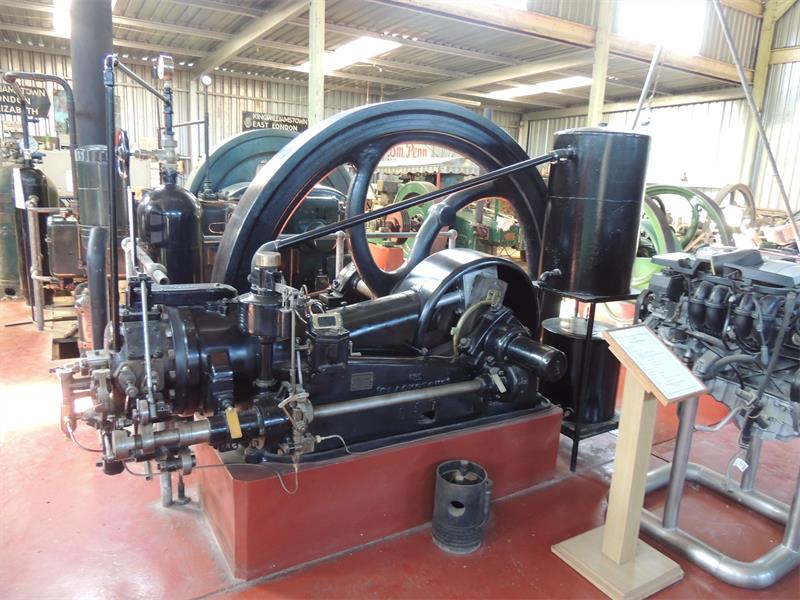
Instead we met Len, one of three dedicated pensioners who, all by themselves and with a very limited budget, keep the amazing Stutterheim Engine Museum chugging along. It was humbling to meet Len. Although he introduced himself as the “spanner boy” of the trio of retired enthusiasts, he was incredibly knowledgeable about the collection of mechanical marvels housed in the museum.
The amazing selection of engines on display included an interesting variety of two, three and five horse motors. These once powered borehole pumps, household generators and milling machines, some in remote corners of South Africa.
Fuelled by petrol, diesel or paraffin, the exhibits ranged from the smaller chaps, through to 12 volt general lighting plants for small municipalities and even a massive jet engine. Most of the exhibits were pretty elderly, some over 100 years old, and in they heyday they had performed such vital functions. It was sad to think how so often, after many years of faithful service, these dependable work horses were discarded and left to die of rust and neglect.

The three curators were all busy people with all sorts of other interests but they made a point of meeting at the museum once or twice a week, giving up their time, patience and plenty of hard work to keep the exhibits in running order and to refurbish the new donations. There was a whole section where various distressed engines/were patiently awaiting the attention of the three mechanical geniuses.Most of the old engines that find their way to the museum, arrive in a pretty battered condition and nursing these old workhorses back to life is not easy.
Most are missing various bits and pieces ans some seem hopeless cases, their workings seized completely. Working on a shoe-string budget the three mechanical geniuses lovingly restore them to almost as good as new. The restoration work often involves patiently puzzling out the workings of the more obscure or unusual engines, some with eccentric generators, magnetos and governors.
The restorers are forever trying to source spare parts and often have to manufacture them, sometimes without any example or workshop manuals. According to Len the engines often seem to have minds of their own and some are, for no good reason, more temperamental than others.
Of the original team that started the museum, some members have died or have moved away for various reasons and the baton has been passed to the present team, all of whose members are over 70 years of age. It would be a tragedy if, when it is the turn of the current team to hand over the baton , there are no younger enthusiasts on hand to receive it.
As Bill pointed out, the incredibly impressive museum is a national treasure that represents more than 100 years of South Africa’s engineering history. It deserves to be well supported and perhaps better appreciated by the powers that be.

It is perhaps time for further education and training colleges and other educational institutions to become involved. For mechanical or electrical engineering students, working under the tutelage of the museum’s three grand masters would be a priceless learning experience.
The museum curators welcome visitors on weekdays from 9am to 4pm daily. To book a visit contact Terry at 043 6831507 or Tom at 043 6832079. If you visit the museum, look out for the donation box and, as the museum is almost totally reliant on donations, please give generously.
What with our inspiring visit to the museum and our stay at the enchanting eco-lodge, Stutterheim and its attractive rural surrounds proved a magical destination. The route next day was lovely, too, initially through quite mountainous terrain. At the attractive town of Cathcart, we found a pie shop that sold excellent examples of these road trip treat, so we stopped there for breakfast,. As we neared the R56 ,the Eastern Cape section of the Drakensberg suddenly came into view. It was a clear day and the ‘Barrier of Spears’ looked magnificent. Turning onto the R56, the scenic route that skirts the moutains, we began to retrace our footsteps along the road we had taken at the start of our holiday.
With hardly any traffic on the road we had plenty of time to enjoy the mountain scenery and it was only when we joined up with the busy N2 at Kokstad that we began to feel that our holiday was drawing to an end.
To receive news links via BBM, add us using the pin 2BABF7D1.
The South Coast Herald is also on Facebook and Twitter – why not join us there?



