Dear Laura
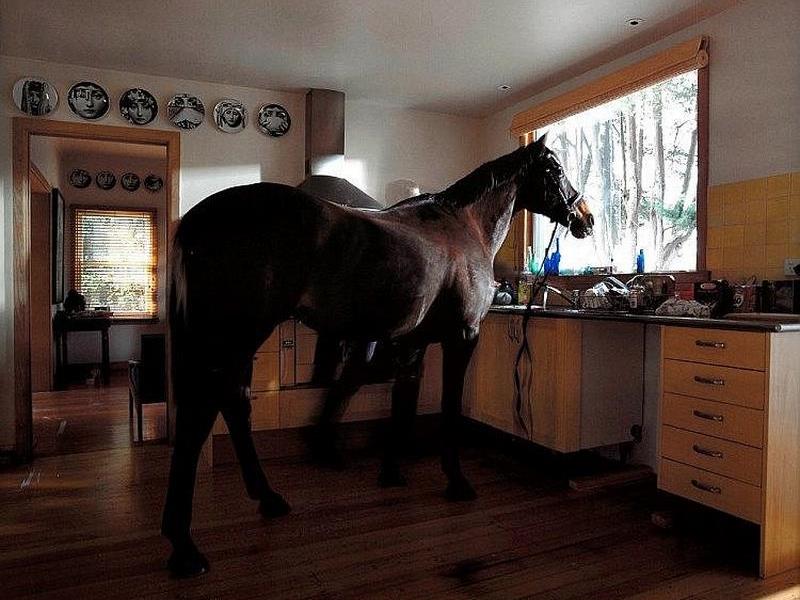
When I said that the whole equestrian team descended on me unexpectedly, that wasn’t quite true. They didn’t bring the horses. It’s not much fun having horses in one’s kitchen!
The kitchen I had at the time of the horse experience was long and narrow, designed for one person to be able to handle everything at the same time. Cupboards and working surfaces on one side, cookers and sink on the other, with precisely one metre of manoeuvring space in between.
The horse came in through the back door, heading for the sink, which was full of tomatoes. I came in through the dining-room door and tried to back him out. It takes a bit of patience to find reverse gear on a horse!
All would have been well, had it not been for the bull terrier. With me pushing from the front, and a dog barking at the back, the horse panicked. Snatching a last mouthful of tomatoes, he turned round. I’ll never fathom out how he managed it in that space. He was no pony. A good seventeen hands – to say nothing of his feet – he was a big horse!
He was now facing outwards with a bull terrier barking at his nose. He responded by trying to kick me with both back feet at the same time, while his front feet were on a mess of squashed tomatoes. He skidded sideways, missed the microwave by inches, and bolted out past the dog, taking a tray of glasses with him. But one must be grateful for small mercies – at least he didn’t lift his tail! Don’t let any horses into your kitchen!
Now for the Yorkshire puddings. I have been told by my friends that I am the only person in the world who knows how to make Yorkshire puddings on the highveld. That is nonsense. For one thing, Jane told me in the first place, and for another, I have told everybody who asked me. So now I’m going to write it down, so you can join in the battle to save the endangered species at high altitudes.
The standard recipe – the one that works in Yorkshire – calls for two tablespoons of flour per egg. This is fine at the coast, but it won’t rise in Johannesburg. The addition of baking powder will make it rise, but the thing you make that way will not be a Yorkshire pudding. The trick is to increase the ratio of egg to flour in proportion to the altitude. At 2 000m it is barely 1:1.
That’s the theory. Now for the practice. Beat two large eggs with a pinch of salt. Blend in two rounded tablespoons of cake flour (that’s 60 ml, using my spoons) and 30 ml of milk. Refrigerate for at least half an hour before using.
Take the roast beef out of the oven and turn up the gas. If enough fat has run out, use that for cooking the puddings, but if it is a very lean joint you will have to use cooking oil. Half a teaspoon per muffin tin is enough. Put it in the oven until it is smoking hot – the batter should sizzle when you pour it in and you’ll have to work fast in order to get a tablespoonful into each compartment before the sizzling stops. Resist the temptation to top them up if you’ve got surplus batter – that’s a sure way to send them flat! Back into the oven, and don’t open the door for at least eight minutes.
Of course, the really correct thing to do is to take the meat out of the roasting tray, pour off a little of the juice to make gravy, heat the rest – still in the roasting tray – and pour the batter into that to cook. That’s a proper Yorkshire pudding, but most people seem to prefer the individual variety.
Love Mom