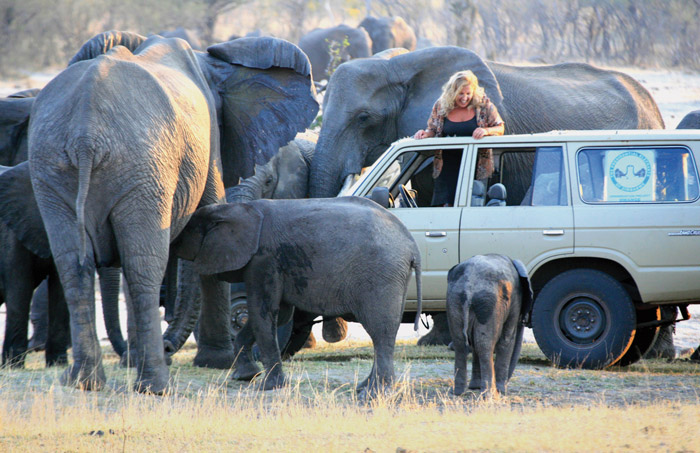
THE woman is Sharon Pincott and her elephants are the Presidential Herd in Zimbabwe, but the connection goes way back.
Sharon gave up her life and career in Australia in 2001 to travel to Zimbabwe to give her full time attention to the conservation of the Presidential Herd in the Hwange Estate in western Zimbabwe.
It was not a good time for Zimbabwe, but the elephants needed her, so she went.
Her self-imposed assignment was to research the Presidential Elephants in their home range on the Hwange Estate, 140 square kilometres of unfenced conservation land.
The Presidential Herd was a project probably unique to Zimbabwe and had been set up by President Robert Mugabe in an earlier and happier time.
For 13 years Sharon struggled against everything that a troubled Zimbabwe could throw at her – shortages of everything, poaching and illegal hunting, and then the land grabs (including in Hwange Estate) and intimidation from a range of government officials who didn’t like what she was doing and thought her a thorough nuisance.
She stuck it out for as long as she could,
In 2014, with huge reluctance, Sharon gave it all up and went back to Australia.
During her time in Zimbabwe she wrote two books about her experiences, ‘The Elephants and I’ and ‘Battle for the President’s Elephants’, both written under the constraints of still being in the country.
Now she has written a third, Elephant Dawn*, without those constraints.
This book is very personal and it’s a sad book, about the failure of a system, and an entire country.
It’s a book one should read, particularly now, when the elephants of Zimbabwe are so much in the news.
And another African icon under threat – the Eastern gorilla, or the mountain gorilla of east-central Africa, is facing extinction with just 5 000 of them left in the wild.
The International Union for the Conservation of Nature reports that war, increased illegal hunting and habitat loss are the main reasons for this.
This means that most of the world’s great apes are now on the critically endangered list. Others are the Western (lowland) gorilla, the Bornean orangutan, the Sumatran orangutan, chimpanzees and bonobos.**.
And definitely not endangered – for many reasons one of the most popular breeds of dogs worldwide is the Labrador, a species renowned for its docility, its extraordinary adaptability as a guide dog and, specifically, its remarkable appetite.
Now scientists are studying Labs to see just why such a high proportion of them really enjoy their food, and the results are interesting.
One of the Labrador’s long extinct ancestors was the St John’s water dog, which years ago Newfoundland fishermen used to retrieve nets in the freezing waters of the North Atlantic.
Working in those icy waters required the intake of more calories than the average dog, so a good appetite was a survival mechanism, and it has apparently been passed on to today’s Labradors.
So, when your beloved Lab demands an extra dog biccie or two you’ll know why.***
Cheers!
*Elephant Dawn, Sharon Pincott, Jacana, Johannesburg, 2016.
**The Daily Maverick.
***The Week: The Best of
the British and Foreign Media.
HAVE YOUR SAY
Like our Facebook page, follow us on Twitter and Instagram
For news straight to your phone, add us on BBM 58F3D7A7 or WhatsApp 082 421 6033