Reading Food Labels
According to the new South African food labelling and advertising regulations (R146), which was passed in March 2010, all labels and advertising of food products in South Africa must be compliant. The following are some of the mandatory information required on food labels in South Africa, according to Gabi Steenkamp, a Registered Dietician who is an expert on the subject:
- An accurate name of the product informing the consumer of exactly what is in the packaging
- The ingredients listed in descending order of mass (weight)
- All allergens must be identified in the prescribed format
- The country of origin
- The batch identification number
- A use by date/Best before date (BB)
- The Typical Nutritional Information Table for all products in the prescribed format.
- Name and address in South Africa of the manufacturer or importer or distributor
- Net contents in metric units
See the full article.
The ingredients list is helpful in identifying sources of the nutritional contents. For instance if animal products are used – like eggs, milk solids, or cheese – you can expect to have significant cholesterol or saturated fats. If Palm or Coconut oil is used you can again expect significant levels of saturated fats. Refined sugar comes in many different guises – things like sucrose, dextrose, glucose, fructose, etc. Notice they usually end in “-ose”.
ALSO READ : Turning the Tide – Dealing with the main lifestyle-related conditions in South Africa (Part 15)
Generally speaking, products that have the longest lists of ingredients are the most processed, and perhaps the least healthy. The foods that are the most nutritious are those that don’t have labels – like fresh fruit and vegetables as obtained straight from the garden. Organic is best but not always readily available or too expensive for most people. Some people try to downplay vegetables and fruits because of the risk of exposure to pesticides and contaminants – but although important, the benefits of plant foods far outweigh the small risks of exposure to these substances. Nevertheless, it is helpful to wash fruit and vegetables before consuming. And yes non-GMO foods are better than those that are genetically modified to withstand herbicides, as these will then have significant traces of glyphosate, a herbicide which is increasingly being found to adversely affect our health.
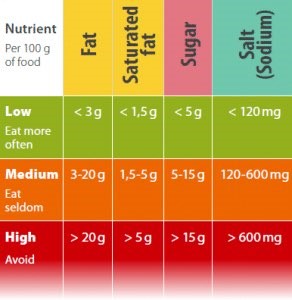
The Typical Nutritional Information Table
. The Heart Foundation has a very good article with useful diagrams – like this one which shows green, orange and red category foods. For instance low fat foods have less than 3 g fat per 100 gm, medium fat foods have between 3-20 g, and high fat foods have more than 20 g fat per 100 gm.
You may be interested to note that most packets of crisps have between 20-38g fat! They also have lots of salt, and very little fibre. Because of the high fat content, they are loaded with kiloJoules, which makes them high energy foods, but with very little nutritional value as they are made of very refined foods, stripped of vitamins and minerals.
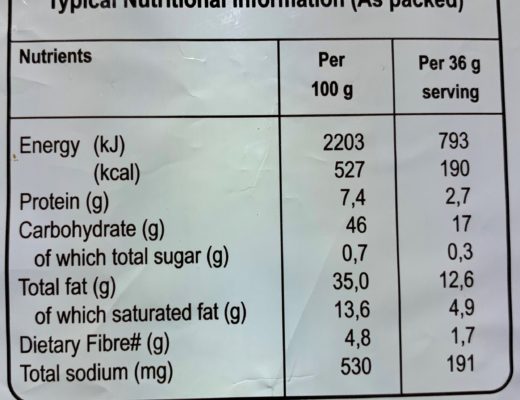
Here is the typical nutritional Information for a packet of crisps my family consumed this last weekend.
Notice the high number of kJ per 100 g. Daily requirements for energy for the typical adult is between 8000 to 9000 kJ. So consuming one 125g packet of those potato chips is almost 1/3 of daily energy requirements for an adult – let alone a young child. It is not difficult to see why people who eat a lot of this kind of food have a problem with weight control.
There is a fair amount of protein from the potatoes (note those who say potatoes are bad for you!).
The carbohydrate from the potatoes contains very little fibre, so is likely to rapidly affect blood sugar with digestion.
Notice the high amount of fat (35 g, which accounts for 60% of the kJ in this packet of chips). But importantly quite a high percentage of that total fat consists of saturated fat, which a mass of scientific evidence shows is associated with atherosclerosis and diabetes.
Although the content of sodium of 530 mg falls into the orange group in the previous table, there is still far too much sodium in just one “food” item particularly for children.
Hopefully this little exercise will encourage you to be more inquisitive about what you are ingesting – and give you pause to look at the nutritional information found on every packet or tin of food items you put into your trolley.
To a week of reflection on the quality of food you provide for your family, and for yourself for that matter.
Dave Glass

Dr David Glass graduated from UCT in 1975. He spent the next 12 years working at a mission hospital in Lesotho, where much of his work involved health education and interventions to improve health, aside from the normal busy clinical work of an under-resourced mission hospital.
He returned to UCT in 1990 to specialise in obstetrics/gynaecology and then moved to the South Coast where he had the privilege of, amongst other things, ushering 7000 babies into the world. He no longer delivers babies but is still very clinically active in gynaecology.
An old passion, preventive health care, has now replaced the obstetrics side of his work. He is eager to share insights he has gathered over the years on how to prevent and reverse so many of the modern scourges of lifestyle – obesity, diabetes, ischaemic heart disease, high blood pressure, arthritis, common cancers, etc.
He is a family man, with a supportive wife, and two grown children, and four beautiful grandchildren. His hobbies include walking, cycling, vegetable gardening, bird-watching, travelling and writing. He is active in community health outreach and deeply involved in church activities. He enjoys teaching and sharing information.
HAVE YOUR SAY
Like the South Coast Herald’s Facebook page, follow us on Twitter and Instagram
To receive our FREE email newsletter, click HERE