Welcome to all,
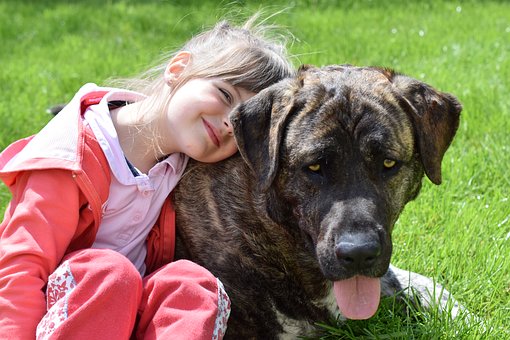
In this article I would like to try and help you understand how dogs are supportive to children who have a disability, with the focus on autism. Although dogs cannot talk, they don’t need to as they show their caring in many other ways.
A dog will offer the most incredible companionship. When a carer or parent is otherwise engaged, the dog will stay with the child, providing comfort and the child will not feel that he is being left alone.
A service dog caring for an autistic child has a full- time job.
Children who are autistic could benefit from the constant companionship of a dog.
Children with autism or Asperger’s disease normally have difficulty in communicating and are sensitive to human touch.
Therapy dogs bring comfort to these children by helping the brain to relax. One scientific study reported that dogs have a positive impact on autistic children as they facilitate the release of the hormone oxytocin in the child’s brain.
This hormone, often referred to as the ‘cuddle hormone’ has a calming and soothing effect on the nervous system and helps the child’s brain to relax. This process is natural and may also help the child’s social interaction and communication skills.
In a previous article I mentioned that dogs can help children to learn. So how does this process occur?
What takes place here is most amazing, the same biological process as described above has a positive impact on the child’s learning skills.
A stressful environment can develop for both the parents and the child if the child shows signs of difficulty in learning and comprehension. The children might struggle to read, and have very little or no social skills.
The trained therapy dog will help the child relax, allowing him to become more comfortable with learning and following basic instructions. A child will not be so stressed or anxious when he has a dog for company, and he will sometimes read aloud to the dog, whereas he would not be comfortable or relaxed doing so in the company of parents or other children. This is how therapy dogs do their job, no talking is necessary, they just need to be there.
When a special needs child has his therapy dog with him, he will be more talkative and a lot more relaxed.
Children with disabilities can have some serious issues with behaviour and emotions. Some of these children are simply frustrated, and this will interfere with their emotional development and learning. Here a therapy dog can help parents to manage the behavioural problems.
Dogs as we have seen are natural stress relievers, they have a calming effect and reduce tension, thereby helping to promote positive behaviour in special needs children. Any children suffering from anxiety or depression can also benefit greatly from dogs as companions.
Children who might be in danger of accidentally self-harming
There are special needs children who exhibit repetitive and restricted behaviour or motion, which could cause them harm. The presence of specially-trained service dogs can be helpful, by directing the child’s attention onto them, thus bringing the child out of the repetitive behaviour.
Autistic children often have the tendency to wander away, they are sometimes escape artists of note and often doors, windows and gates are double locked, but somehow these children seem to disappear even when they are being watched by a parent who is diverted for a moment. These children do not always understand the dangers of traffic, a neighbour’s swimming pool, or a stranger with has bad intentions, so now it is time to put the dog to work.
As we have discussed previously dogs have incredible scenting abilities, and can be trained to learn the specific scent of an individual. Certain dogs are trained in search and rescue, and it is highly recommended that parents of autistic children add one of these specially trained dogs to the family unit – it could save the child’s life.
Service dogs are welcome at most public places and holiday accommodation, but you may be required to produce a certificate stating that the dog is a service dog.
So, no matter where the child disappears the dog can be given the command “Find our boy”. The dog will then use his nose to track the child with the parents in tow.
Autistic children can be prevented from wandering off while out in public. A method known as tethering is extremely effective.
It is a system whereby the dog wears a harness, and attached to the harness are two tether/leashes – one for the child to hold and a primary leash for the parent to hold – NOTE: THE PRIMARY LEASH IS ALWAYS IN THE PARENT’S HAND GIVING THE PARENT COMPLETE CONTROL OF THE SERVICE DOG AT ALL TIMES.
While holding the leash the child will usually feel more secure, and this method has been shown to reduce some children’s attempts to wander off. However, should the child become upset for any reason, or should the child’s attention be drawn to something, he may still dart off. In these cases the leash is attached to something the child is wearing, such as a backpack – the child is now able to walk freely next to his dog, BUT should he attempt his escape the dog will act as an anchor!
THESE AMAZING DOGS LIVE TO SERVE AND ASK FOR VERY LITTLE IN RETURN EXCEPT LOVE
At a later stage we will look into service dogs, trained to assist more types of special needs in children.
With kind regards.
Yvonne Eland
ADIPCBM (UK) with distinction
Specialising in Canine Behaviour and Management
HAVE YOUR SAY
Like the South Coast Herald’s Facebook page, follow us on Twitter and Instagram