A very warm welcome to one and all, I trust you are all well and taking all the necessary precautions to avoid becoming infected with Covid-19.
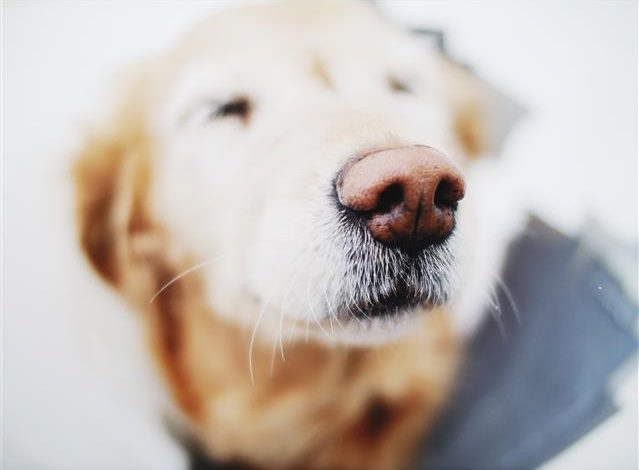
If you have been following my posts, you will be aware that I am quite in awe of the incredible senses that dogs possess in their noses, so on doing some research I was very excited to find a new and exciting scientific discovery regarding a new sense in dogs’ noses – the ability to detect heat.
Have you ever wondered how a dog which is blind, deaf and has impaired sense of smell can still hunt for his daily meal? A dog’s nose is 100 million times more sensitive than human noses, and they can sense weak thermal radiation – the body heat of mammalian prey, as revealed in a new study published in February this year.
The ability to sense weak radiating heat is only known to be evident in a few other animals, such as the black fire beetle, certain snakes, one species of mammal, and the common vampire bat, all of which use this sense to hunt. Most mammals have naked, smooth skin on the tips of their noses around the nostrils, called the rhinarium. Now look at your dog’s nose – the rhinaria are moist, are colder than the ambient temperature and have an abundance of nerves – suggesting an ability to detect not just smell but heat.
Here is how scientists proved it:
Researchers at Lund University took three pet dogs and trained these dogs to choose between a warm (31 degree C) and an ambient temperature object. These objects were placed 1.6 metres away from the dogs. The dogs had to rely totally on the sense of heat detection as they could not see or smell the difference between the two objects. (the scientists themselves could only tell the warm object by touching it).
After training, the dogs were tested in double-blind experiments (neither the dogs nor the scientists knew which object was the heated one). Because the scientists did not know which object was the heated one and which was the ambient temperature one, they could in no way prompt the dogs to pinpoint the heated object.
All three dogs were successful in detecting the weak thermal radiation, reported the scientists. The researchers then took the tests to the next level. Thirteen dogs of various breeds were subjected to brain scans in a functional magnetic resonance imaging scanner at the same time as being presented with objects emitting neutral or weak thermal radiation.
This is where things really became interesting – the left somatosensory cortex (which delivers the input from the nose) in the dogs’ brains was more responsive to the warm thermal stimulus than to the neutral one. A cluster of 14 voxels (3D pixels) was then identified in the region of the left hemispheres, but no such clusters were seen in the right, and none in any part of the dog’s brains in response to the neutral stimulus.
Both these experiments showed that like vampire bats, dogs can sense weak thermal radiation and that a specific region of their brains is activated by this infrared radiation, reported the scientists. It is thought that dogs inherited this remarkable ability from their ancestor, the grey wolf, which possibly uses it to sniff out warm bodies during a hunt.
Researchers have described the dog’s nose and brain as a sophisticated platform for processing a broad range of signals. It is not yet known if the rhinarium of the dog can distinguish patterns of hot and cold objects at a distance, so these skills might not be useful for long distance hunting. Studies into this fascinating world of the dog’s nose is ongoing. Tis story may help you to understand the reason for the double-blind experiment.
THE STORY OF CLEVER HANS
Clever Hans was a horse belonging to Wilhelm von Osten in Germany way back in the early 1900s. Wilhelm believed he had taught his horse to do maths. He would write arithmetic problems on a chalk board and Clever Hans would tap out the answer with his hoof.
If Wilhelm wrote 5+3= Clever Hans would trap his hoof against the floor eight times. The news of Clever Hans spread far and wide and eventually a group of scientists convened to study the horse. After watching a demonstration, they assigned a young student, Oskar Pfugnst, to determine the extent of Hans’s cleverness.
Oskar asked Wilhelm to read the question rather than write it down; he blindfolded Hans and asked Wilhelm to read him the question, then the blindfold was removed; Hans was shown a card with the question written on it that Wilhelm himself hadn’t seen, and so on.
Oskar discovered that Hans could only answer the problems correctly if Wilhelm knew the answer. If Wilhelm did not know the answer, neither did Clever Hans. In other words, Wilhelm was somehow cuing the horse, either intentionally or unintentionally. It was Oskar’s task to find out how.
As it turned out Hans could answer the questions correctly as long as he could see Wilhelm, but if Wilhelm was hidden from view either behind a wall or even just standing outside Hans’s periphery vision, Hans was unable to answer.
Other scientists were then brought in to ask questions. Wilhelm was present during these tests, and Hans answered the questions correctly. Oskar began to focus on Wilhelm and finally hit on the answer to the mystery: whenever a question was asked of Hans, by Wilhelm or anyone else, Wilhelm would lower hi eyebrows and Hans would tap his hoof on the floor. As he completed the correct number of taps, Wilhelm would raise his eyebrows.
Oskar then tested his theory with Hans. Without saying a word to Hans, he lowered his eyebrows and Hans began tapping his hoof on the floor – as soon as Oskar raised his eyebrows, Hans stopped tapping. The mystery of the clever horse had been solved!
The moral of this story is that things are not always as they seem. No matter how ‘obvious’ something appears, all other explanations need to be systematically ruled out. And in this case a seemingly complex behaviour had a very simple explanation. Caution was to become a cornerstone of the study of animal learning.
Kind Regards
Yvonne Eland ADIPCBM (UK) WITH DISTINCTION
Specialising in Canine Behaviour and Management
HAVE YOUR SAY
Like the South Coast Herald’s Facebook page, follow us on Twitter and Instagram