Book: Legends of the Tide – A true story of a forgotten fishing community
The story of Durban, one of the world's busiest port cities, with its spicy fusion of Indian, Zulu and British cultures will remain incomplete until more communities claim their history.

About the book: The Roots of the Durban Fishing Industry
Legends of the Tide is the true story of a forgotten fishing community who lived and worked in the heart of Durban’s harbour and later on its postcard beached for 100 years.
YOU MAY BE INTERESTED IN: Butthead’s Beat: Sardines to the rescue!
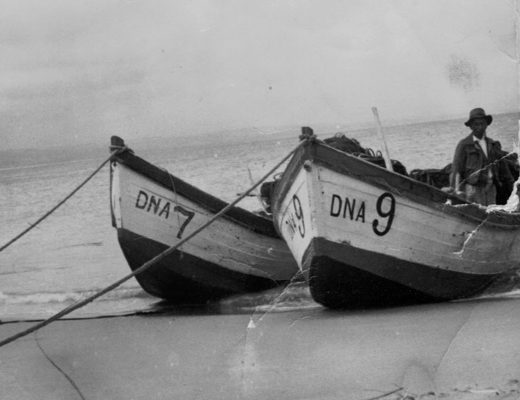
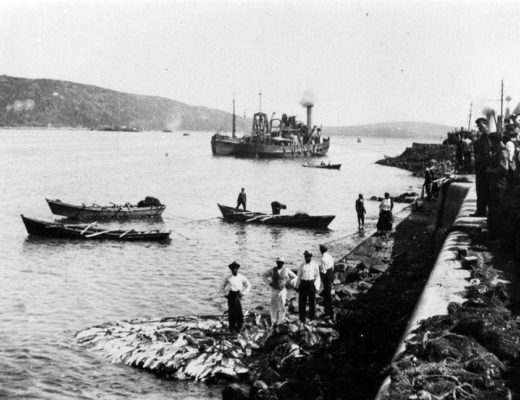
They pioneered seine-fishing in South Africa in 1865 and pioneered the Durban fishing industry.
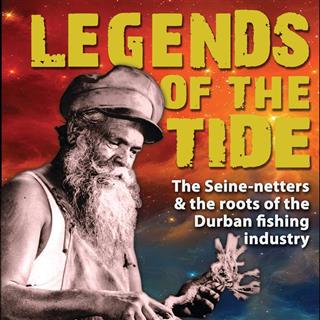
They gave Durban a taste for fish curry, sardine fever and shad culture. They conducted a daring rescue in 1917 when six fishermen in a single boat rescued 175 people from drowning when the Umgeni River burst its banks. Upon their stage world class sporting heroes strutted their stuff, colourful characters roamed the beaches and impressive schools and temples were raised. Eventually, under the Group Areas Act they were forcibly moved further and further from the fishing grounds they loved so much.
The story of Durban, one of the world’s busiest port cities, with its spicy fusion of Indian, Zulu and British cultures will remain incomplete until more communities claim their history. Legends of the Tide throws one more puzzle piece on the table – one more perspective to help create a better picture.
Foreword by Kumi Naidoo, International Director of Greenpeace.
A snippet taken from the book, Legends of the Tide:
Shark Fever
Durban experienced ‘Shark Fever’ decades before the popularity of its eponymous rugby team. Sharks, spotted in sheer numbers in Durban’s waters since the early 1800s, inspired awe and fear in equal measure. The shape of the Bay, the depth and temperature of the water, the annual sardine migration and the whaling industry on the Bluff, all contributed to ‘the infestation of sharks.’
Durban’s first recorded shark attack occurred in 1897 when a young boy, who was picking fish during the sardine run, was taken by a shark.
Anti-shark sentiment ran high from the 1920s due to the many tragedies reported. During this period over 30 shark attacks off Durban’s beaches and 33 along the South Coast beaches, were recorded.
Shark infestation
The high incidence of shark attacks impacted on the tourism industry. Municipalities lost much-needed revenues, therefore the authorities officially and publicly declared an infestation of sharks in the waters of Natal.
Between 1928-1932, the authorities embarked on a radical strategy to curb the attacks: they encouraged the establishment of a shark-fishing industry in Durban and actively promoted shark fishing as a sport. They even considered offering a royalty on all sharks landed and destroyed.
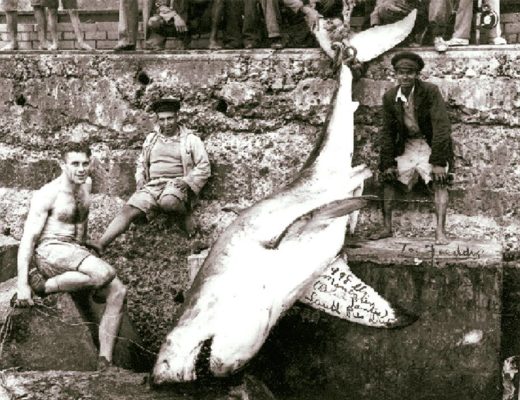
Shark fishing became a glamour sport in Durban on weekends between April and September, attracting large crowds of spectators, who came to watch rugged, muscular men battling the great predators of the sea.
Lefty Schmidt
Lefty Schmidt was regarded as the ace among this pack of men. He landed the most number of sharks, bagging in the process, several of the biggest ones.
Once, in 1948, Neelan (co-author of ‘Legends of the Tide’) saw him battle a 200kg shark for over two hours on the South Pier.
Lefty Schmidt’s unique technique is best described by Len Jones, in his book “Encounter with sharks, dolphins and big fish”:
“While a helper held the rod, he walked backwards with the bait (3-4kg of whale meat tied, with twine, around the hook) and placed it on the edge of the pier 20 metres from the rod tip. Retracing his steps, he took hold of the line (a 10-meter long steel cable trace), and carefully laid out another double length behind the first.
“He then walked back to the baited hook and took hold of the handgrip which was tied to the cable. The handgrip was a link of dog chain bound with old style linen insulation tape.
“Then he began to swing the bait around his head, gathering momentum with each revolution until, about the fifth or sixth swing, he released his grip and the bait sailed through the air for thirty or forty metres (clearing the dolosses and the rocks) where its 200 gram sinker dragged it to the seabed…
“Once the bait was taken… the hook was driven home with three or four hard strikes – using the shoulder and not the arm.
“As in any form of angling, once the fish is hooked, it’s show time!”
Red Coat the Bait King
Red Coat, who was often seen assisting the shark fishermen, was related to the pioneering Padavatan family. He was Fireman Mariemuthoo’s father-in-law.
Everyone regarded Red Coat as the undisputed Bait King. Red Coat supplied the shark fishermen with whale meat and whale skin bait.
He also supplied other fishermen with a variety of bait – from prawns, stick worms, rock worms, red bait, sea-lice, cracker shrimp and mussel to live fish and crayfish or sardine. These were always neatly parcelled. The live bait was packaged in small containers.
Alf Downward, a former resident of the Fynnlands – Bluff area, now retired to Pretoria, remembers fondly his old friend Red Coat Naidoo.
“Nobody was quite sure how the name came to be. Even those in the village where he lived did know his right name, or how the name Red Coat came about,” said Alf Downward. “We were very close. When I came to know him he was already middle aged. He ran a business of sorts and one might call him a tour agent around the bay. He had several boats, which he would hire for five shillings a day. If a rowboat trip around the bay was required, he would send out his own oarsman, for whom a special fee was charged. But mostly, Whites hired his boats for line fishing in the Bay or to go out rowing on their own.
David “The Paymaster” Naidoo
David was an extremely likeable and colourful character who eked out his living from the pier. David served all the fishermen on the pier, including the shark fishermen, subsistence fishermen, and the Seine-netters. He was also a manager of a football club, a referee and a cricket player.
Joe Mara wrote:
“He was exceptionally polite and trustworthy. He would buy up big quantities of fish and at times, when short of cash, he’d jot the amount owing to each angler in a well-worn note book. The fish were taken across by ferry and sold at the Indian market in the centre of the city.
“David would return in the afternoon, usually laden with the anglers’ order of such items as cigarettes, sweets and parcels of bunny chow. Then David, with the pretence of great importance, would shout ‘OK boys, the Paymaster has arrived. I now want all my workers to come and get their pay.’
“Early each morning, without fail, David would arrive on the pier pushing a wheel barrow stacked high with empty sacks into which he loaded the fish.
“One day in 1966, David was in one of the drainage holes with his back to the seaward side, fishing for crayfish, when a freak wave crashed over the parapet and washed him off the pier into the Channel. Anglers rushed to his aid but by the time they pulled him out it was too late. He was dead at the age of 49. At a later stage, a sum of money was collected from sympathetic anglers and presented to his widow.”
Shark teeth and shark meat
Durban was home to a variety of sharks. These included the Zambezi (which was known to make its way up river in flood times); the Ragged Tooth (or Ridge Back), the Hammer-Head, the Tiger Shark and the Great White (or Blue Pointer).
In 1929 Periyasamy Govender (Neelan’s father) had a memorable encounter with a shark. While hauling a net full of shad from his boat off Back Beach, the haulers noticed something huge thrashing wildly. They abandoned the net in knee deep water and scampered for the shore. Periyasamy spotted a fairly large shark trapped in the net. If it was left unchecked it would, in no time at all, rip the expensive net apart. The haul of shad would also be lost.
Grabbing hold of an oar, he bludgeoned the shark – effectively stunning it. The net was quickly hauled and the shark killed on land.
Periyasamy claimed the prized teeth of the fearsome creature. These, he later distributed to the young girls in the family to be turned into jewellery for the day they became women.
Neelan’s wife, Vasagee, received one of these teeth. The tooth, encased in a locket, was part of her bridal trousseau. Several teeth still remain in the family’s possession to this day.
There is a record of a gourmet dish among the Seine-netters called “pal sora” (Tamil), made using suckling sharks. The meat was first boiled in ginger and garlic, before being broken down into small, coarse pieces, and then braised in oil and spice. This was the only form of shark meat consumed by the local population.
The shark industry processed body parts for various products, including perfumes, soap, and even ‘crab sticks’ and ‘fish fingers.’
The Natal Shark Board
Shark fishing did not prove effective in abating the problem of shark attacks. A spate of shark attacks on beaches south of Durban in 1958 prompted coastal resorts to install gill nets and other protective barriers at a distance of 250 to 400 metres from the shoreline. However, the local authorities complained of the financial burden and in 1964 the Provincial Government created the Natal Anti-Shark Measures Board (now the Natal Sharks Board) to supervise the installation and maintenance of the net.
This proved successful in that no more shark attacks were reported, and more coastal towns adopted this strategy. In fact, it was so ‘successful’ that it drove the sharks in Durban almost to the edge of extinction. The Natal Shark Board statistics of 1971 recorded that 1000 sharks were removed from the nets within a period of 10 days!
Four decades later people realised that the shark population was severely depleted due to the nets. Numerous sharks in prime condition had died after being ensnared in the nets. During this period, the Great White too was hunted almost out of existence in the waters off South Africa and Australia.
Currently, a concerted effort is underway to save sharks from extinction by altering public perception of sharks ‘killing machines’ and ‘monsters of the deep’ to ‘beautiful creatures of the sea.’
Today the Sharks Board, according to its official brochures, “services a combination of shark nets and recently-deployed drum lines, spread at intervals along 320 km of coastline in KwaZulu-Natal, thereby providing protection against shark attack at 38 localities. It employs about 170 staff members, most of who put out to sea on 15 boats to service the equipment.
extract from “Legends of the Tide” pp 192-199
“Legends of the Tide: The Seine-netters and the roots of the Durban fishing industry” traces the roots of the Durban fishing industry from 1865 to present day challenges. This is the group of fishermen who chose not to renew their indenture contract but rather to become subsistence fishermen on Salisbury Island. They gave Durban a taste for shad and sardines, reared sportsmen and heroes. Eventually, Group Areas Act and not the sea destroyed the life they had built. Stories of shark fishing, whaling, angling, sardine fever, education, sport, culture, etc.
AVE YOUR SAY
Like our Facebook page, follow us on Twitter and Instagram
For news straight to your phone, add us on WhatsApp 082 421 6033