Learn more about the narina trogon in this week’s birding column
In buoyant flight, they are highly maneuverable and can easily twist and turn.
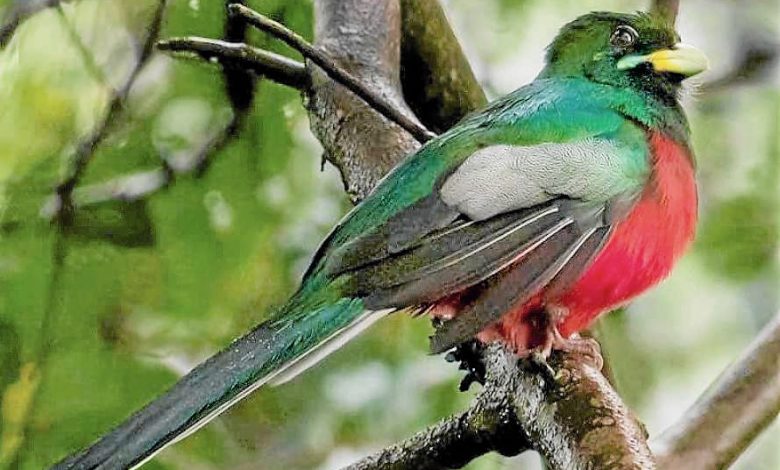
AN uncommon to fairly common resident confined to coastal regions and adjacent interior, from Knysna through the East Coast and Lowveld of South Africa.
They like evergreen and riverine forests, dense woodland, moist thornveld, coastal bush, valley bushveld and wattle plantations where they feed on insects, fruit and chameleons.
These trogons are usually solitary or in pairs. In breeding season groups of up to 12 males sing and display for up to two hours before individuals disperse into their territories.
They perch motionless for long periods, usually on high branches. The tail is sometimes slowly raised and lowered.
They are hard to see when greenback towards the observer. They forage by sallying out off perches catching prey on leaves and branches or in the air.
ALSO READ: The purple crested turaco slides into this week’s bird of the week column
The call is a series of 10 to 15 paired hooting notes with a slight growling quality hroo – hoo – hroo – hoo – hroo – hoo. The male also has a low chattering display call and a loud hiss when alarmed.
In breeding, they are monogamous, mating taking place from October to January. The nest is a natural hole a tree or dead stump with no material added. Four to six glossy white eggs are laid. The incubation period is 16 to 17 days and they are nestling for about 25 days.
The isZulu name is umJenenengu and in Afrikaans die bosloerie.
DID YOU KNOW?
Click on the words highlighted in red to read more on this and related topics.
To receive news links via WhatsApp or Telegram, send an invite to 061 694 6047.
The South Coast Sun is also on Facebook, Twitter, Instagram – why not join us there?
Do you have more information pertaining to this story?
Feel free to let us know by commenting on our Facebook page or you can contact our newsroom on 031 903 2341 and speak to a journalist.
(Comments posted on this issue may be used for publication in the Sun)