Russia awards medals to ex-Toti WW2 seaman
Stan was fortunate not to see any fighting during the war and he was relieved when it ended.
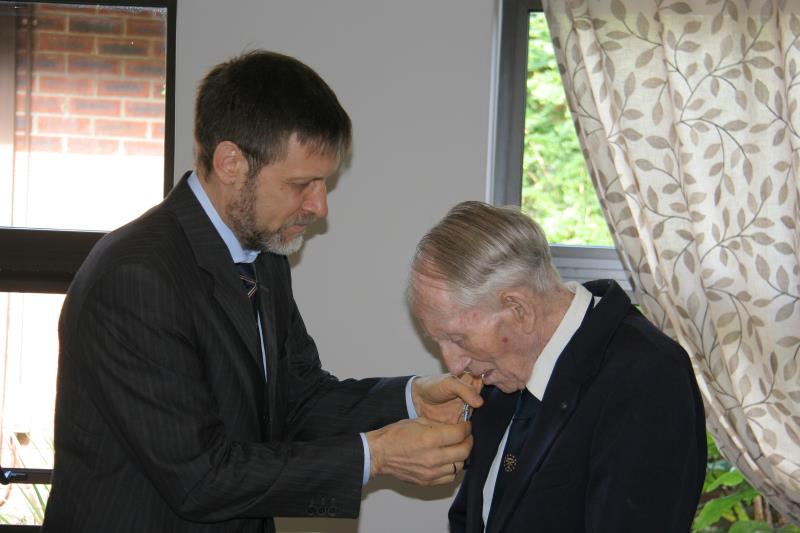
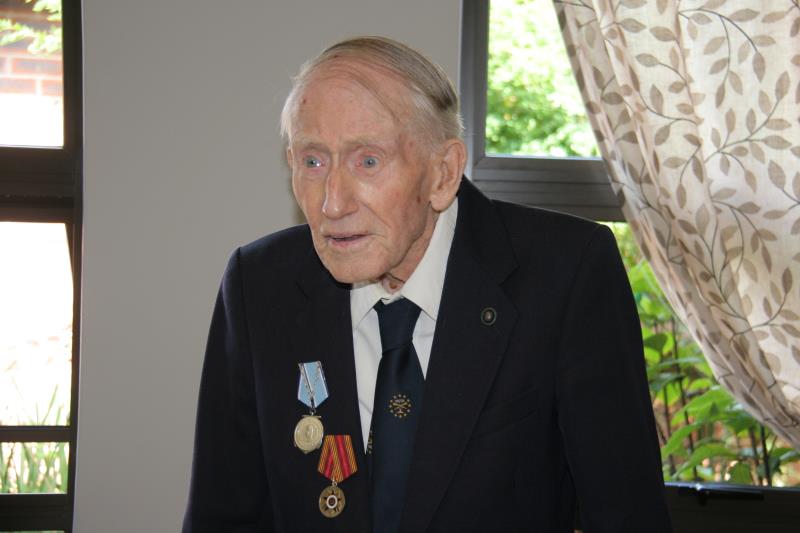
Honoured by the Russian Federation for the part he played in the Arctic convoys that brought material aid to Russia during World War II, ex-Toti resident, Stan Colvin (95) recalled the time they were sitting ducks for the German Luftwaffe.
He joined the merchant navy as a 22-year-old in August 1941.
His first trip was on board the ‘Llanstephan Castle’.
Arctic convoys were ocean-going convoys which sailed from the United Kingdom, Iceland and North America to northern ports in the Soviet Union.
Stan’s convoy, which sailed on 21 August and was the first Arctic convoy, was bound for Arkhangelsk (Archangel).
“We had to move quickly through the White Sea, as it was known to freeze over during winter,” he said.
“During the night a reconnaissance plane spotted us and we knew we were in for it the next day. Fortunately a fog surrounded us and we were able to sail safely to Glasgow and it prevented the Luftwaffe from bombing us. It was a miracle.”
In presenting Stan with two medals by decree of the president – one for his part in the Arctic convoys and one for the 70th anniversary of its victory in the war – the Ambassador of the Russian Federation to the Republic of South Africa, His Excellency M Petrarov extended his gratitude to the veteran and said they will never forget the good deeds done for them during the war.
The ceremony took place at the Umdoni Retirement Centre, where Stan and his wife, Pam now reside.
Pam was president of Toti Women’s Institute for seven years.
Stan was born in a small village, Cotherstone in Yorkshire, but lived in Manchester before immigrating to South Africa in 1962, where he worked for Sapref.
“I actually visited South Africa during the war when we collected wounded soldiers to return home. Once I saw the climate, I had to return.”
Stan also visited Italy, North Africa and Canada with the wartime convoys, under the rank of fourth engineer.
It was during one of these North African trips he recalls a humorous memory of the war.
“Our ship could only go 14 knots, so that was the speed of the convoy. Off the Portugese coast, we suddenly realised we had lost the convoy. Surrounded by U-boats, we expected a torpedo at any minute.” The crew spent a nervous day and night alone at sea, expecting the next minute to be their last.
“At daybreak there was the convoy in front of us. One of the ships messaged us ‘welcome back, can we help you in any way?’, which was a little late. To this day I don’t know how it happened.”
Stan was fortunate not to see any fighting during the war and he was relieved when it ended.
“We were at sea when the war ended,” he recalled.
“The captain brought out champagne and we all had a glass. We were on our way to Buenos Aires to pick up frozen meat to deliver to our soldiers in Germany and France. When we got to port, the captain ordered our ship to be repainted from the wartime grey to a lovely lavender colour, so that was also part of the celebrations.”