Bird of the week: African Stonechat
Flight action is jerky and usually quite tame near humans.
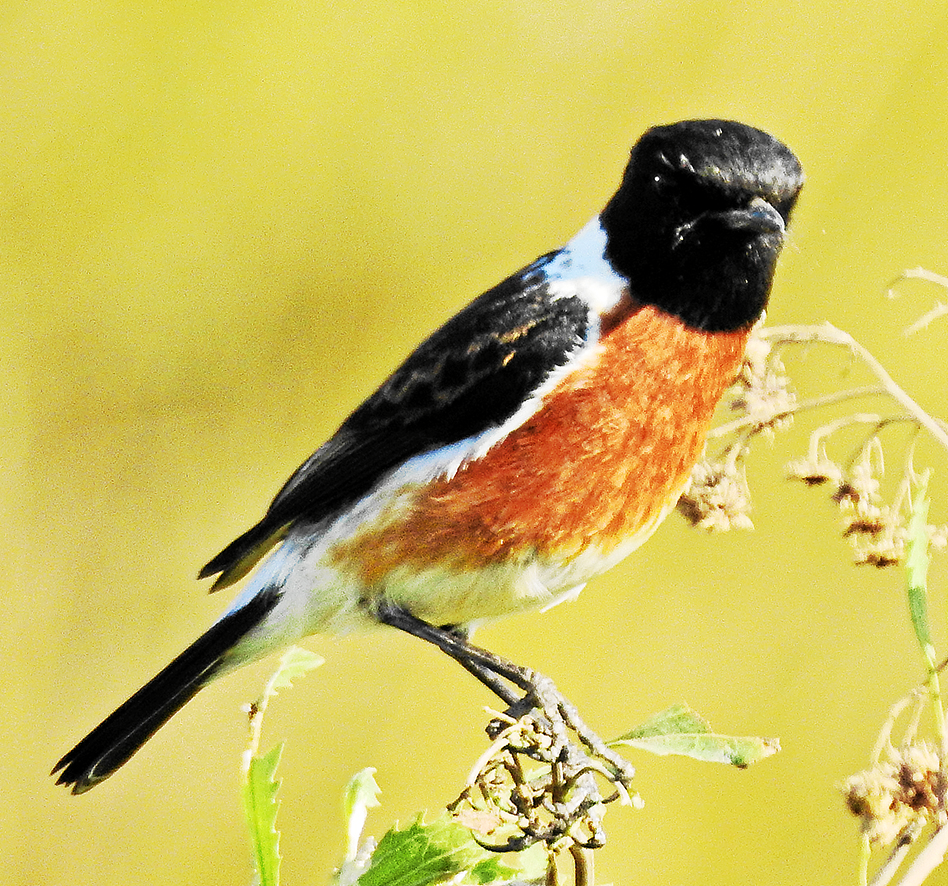
Very common in highveld and montane areas and fairly common resident elsewhere in South Africa.
They like alpine grassland, lush grassy slopes and hills, edges of vleis, canefields, fallow land, road verges, irrigated fields and pastures as well as riverine scrub.
Usually in pairs or solitary they perch on top of bush , weed, stump, fence or telephone lines. Dropping to the ground to catch insects, hopping then returning to their perch while flicking their wings and tail. Flight action is jerky and usually quite tame near humans.
These chats have a sharp repeated alarm call seep – chak – chak and a canary like song sweep – twiddle dee, sweep – twiddle – tree- deeee repeated many times with short pauses in between.
Breeding takes place from August to October. The nest is a cup of grass, neatly lined with finer material and hair on the ground, well-hidden under dense clump of grass or reeds. Three to four bluish green eggs, speckled with rusty red spots, are laid. The incubation is 14 to 15 days and they are nestling for between 13 to 16 days.
The Zulu name is isiChegu and in Afrikaans die Gewone Bontrokkie.