
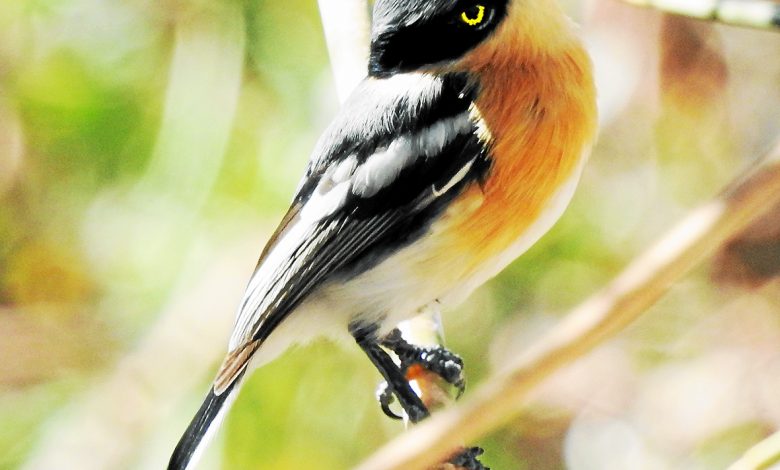
Distribution is over the dry Western parts Southern Africa where they are common residents.
Usually found in pairs or family groups. They like acacia savanna, riverine bush and thickets around waterholes. Foraging for insects in the lower or middle layers of bushes or trees, seldom higher than five metres.
They perform wing snapping displays in flight across open spaces, between thickets bouncing at each snap. They usually become tame around human settlements.
In breeding season they sing for long periods. The song being up to 40 somewhat mournful loud piping notes falling somewhat towards the end peep peep peep etc. Breeding takes place from July until March, possibly any month according to rainfall.
The nest is a small strong cup of plant fiber bound with spider web and the outside is decorated with small bits of bark.
Usually two spotted creamy white or greenish white eggs are laid. Incubation lasts 17 days and they are nestlings for a further 17 days. The fledgling are dependent on parents for six weeks after leaving the nest.
There is no tribal name and in Afrikaans die priritbosbontrokkie.