Durban non-profit initiates rock-art monitoring project
African Conservation Trust has partnered with the government to preserve history.
KWAZULU-NATAL is home to globally significant, historically valuable rock-art sites, and a Durban organisation has partnered with the government to assist in the preservation of the ancient images.
Although rock-art pieces are scattered across the province, the Ukhahlamba Drakensberg Park World Heritage Site holds the highest concentration, which are found across 600 locations. The unusual Drakensberg images make use of a unique, shaded polychrome technique. Considering the sites’ importance, a government partnership programme with the African Conservation Trust (ACT) trains local communities to monitor, protect and preserve the rock-art sites.
ALSO READ: ALSO READ: Celebrating South Africans diverse cultural heritage through the tradition of sharing meals
ACT, a broad-based environmental and public-benefit organisation (PBO), founded in 2 000, has conservation-sector experience. The trust drew on its extensive network and established a community to implement the Rock Art Monitoring Project. Training in the correct methodology was provided by the KZN Amafa and Research Institute, and funding for the employment of the custodians was sourced from the Industrial Development Corporation’s (IDC) Social Employment Fund (SEF).
Chairman of ACT Carl Grossmann says, “We were lucky enough to be selected in 2022 as one of 28 strategic implementing partners (SIPs) of the IDC’s SEF programme. The SEF is part of the Presidential Employment Stimulus and is a mass-employment project, where participants work for the common good.”
The conservation organisation currently employs 3 000 participants countrywide through the programme. Grossmann says, “We operate mainly in KZN, in the Drakensberg, and our projects focus on two traditional authorities – the amaZizi and the amaNgwane – which lie between Cathedral Peak and Royal Natal National Park, which is part of the world heritage site. These areas from the lower mountain range to the escarpment and the Lesotho border hold roughly 130 known rock-art sites which form a valuable part of our national heritage.”
ALSO READ: LISTEN: NPO removes barriers for the disabled through sport
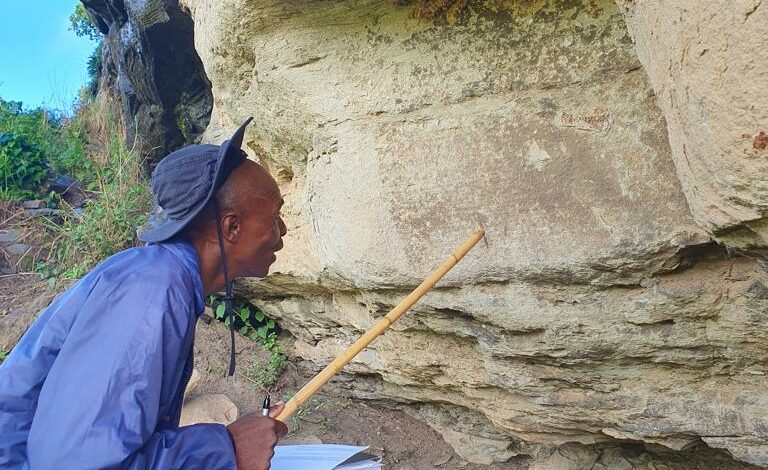
Since the rock-art sites within the traditional authorities fall outside of the formally protected areas, the surrounding communities are critical to the images’ long-term survival and preservation. “Community members visit each location to complete an assessment form, recording the site’s state and any required management interventions. Grass growing into the shelter, plants damaging the rock face in the wind, and graffiti are noted and reported to our provincial heritage agency, which is the KZN Amafa and Research Institute,” says Grossmann.
The training for 25 custodians was provided by Amafa, and a visitation roster was drawn up to ensure each location is assessed one to three times annually. ACT currently employs about 250 people within both areas. A second project dealing with soil-erosion rehabilitation is underway, in addition to the rock-art monitoring activities.
“There are soil erosion dongas or gullies in the Drakensberg area, which is a key watershed and catchment area for KZN and Gauteng. Any work we can do in lowering the silt levels in the rivers and dams is for the common good. Some erosion gullies are massive, as much as 10m deep, in places,” says the chairman of the PBO.
The communities in the amaZizi and amaNgwane districts received prior training in building effective stone-wall anti-erosion barriers in the gullies. The teams have been re-employed in the SEF project, to continue with this work.
DID YOU KNOW?
Click on the words highlighted in red to read more on this and related topics. To receive news links via WhatsApp or Telegram, send an invite to 061 694 6047.

Do you have more information pertaining to this story? Feel free to let us know by commenting on our Facebook page or you can contact our newsroom at 031 903 2341 and speak to a journalist.
(Comments posted on this issue may be used for publication in the Sun)