
How the production of newspapers has changed over the years
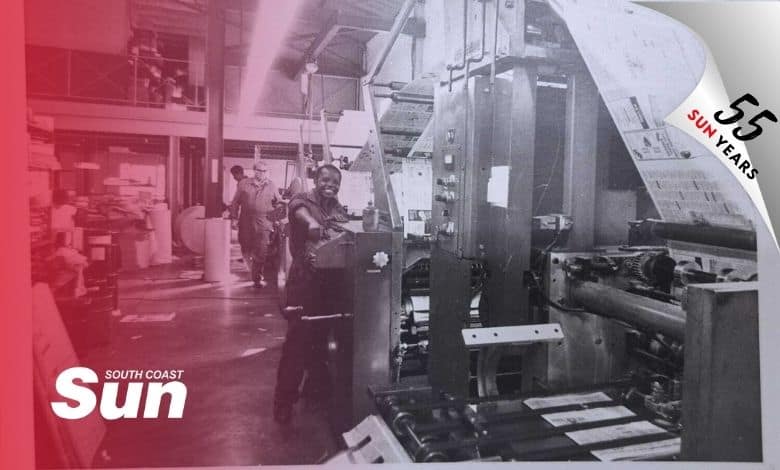
Getting the South Coast SUN onto the streets back in 1971 was a time-consuming nightmare.
Visualise the following: a South Coast SUN editorial office without mobile phones, computers, digital cameras, email, or the internet.
Unimaginable! Not long ago – 55 years ago, in fact – journalists had to manage without technology. There were only typewriters, landline telephones, cameras that used rolls of film and later that first miracle: fax machines.
Also read: South Coast SUN celebrates 50th birthday in Doonside
Enormous task to produce a newspaper in 1971
Getting the South Coast SUN onto the streets was a time-consuming nightmare. Layout artists sat at glass-topped tables, armed with a sharp blade, an ‘NT-cutter’. Articles were printed onto a special paper known as ‘PMT’ and laid out on a table.
Once the editor had assigned the articles to their respective pages, the layout artists would run them through a wax machine, cut them out, and paste them onto the page, a laborious process colloquially known as ‘spit-and-paste’. The articles and photographs were all assembled according to a page layout plan.
Explaining the subsequent steps would leave readers breathless, but, in short, printing plates were created and mounted onto the printing press. In those early years, everything was strictly black and white.
The introduction of colour to newspapers was a truly breathtaking moment. In the early days, newspapers were printed using hand-operated presses and movable metal type, a method rooted in the printing technology developed by Johannes Gutenberg in the 15th century.
Also read: From the archives: The birth of South Coast Sun
Lead-based printing
When I started working as a journalist on December 3, 1975, there was still a lead-based printing machine in the factory. Naturally, the lead had to be melted – which made the top surface of the printing machine quite hot, the perfect spot to warm my meat pie every day – into a metal frame to form words, lines and pages. These printers were exceptionally skilled, mastering this type of printing was truly an art form.
Special oil-based printing ink was spread evenly over the metal type using leather pads or cushions and a sheet of damp paper was carefully placed on top of the inked characters. The frame was slid beneath a heavy platen and a large lever was operated to press the paper firmly against the metal type, creating the impression.
The printed sheet was then removed and hung up to dry before the other side could be printed. This method was slow and labour-intensive. A printer could only produce a few dozen to a few hundred pages per day. This did not change until the 19th century, with the invention of steam-powered and high-speed printing press systems.
Gutenberg invents movable printing press
Gutenberg invented the movable-type printing press around 1440 in Mainz, Germany, which laid the technological foundation for mass communication, books and eventually newspapers.
Today, the printing press churns out thousands of copies of the South Coast SUN in a matter of minutes.
Newspapers survive technology changes
The fact that the newspaper has survived these radical technological changes demonstrates the resilience of community newspapers.
With the arrival of television in 1976, it was predicted that this would spell the end for community newspapers. That did not happen. Fifty-five years later, the South Coast SUN is still here, serving the community.
With the advent of social media, it was once again proclaimed that the death bell would toll for community newspapers. We have survived wax machines, black-and-white photography, typewriters and television.
When the Father of the Community Press, Oscar Henry Frewin, launched his first newspaper in 1903, he said that instead of one great flame that quickly disappears, he wanted to light a torch that would always stay alight in the community.
Today, we can also say, ‘The SUN will always shine…’
For more South Coast Sun news, follow us on Facebook, Twitter, and Instagram. You can also check out our videos on our YouTube channel or follow us on TikTok.
Subscribe to our free weekly newsletter and get news delivered straight to your inbox.

Do you have more information pertaining to this story? Feel free to let us know by commenting on our Facebook page or you can contact our newsroom on 031 903 2341 and speak to a journalist.