
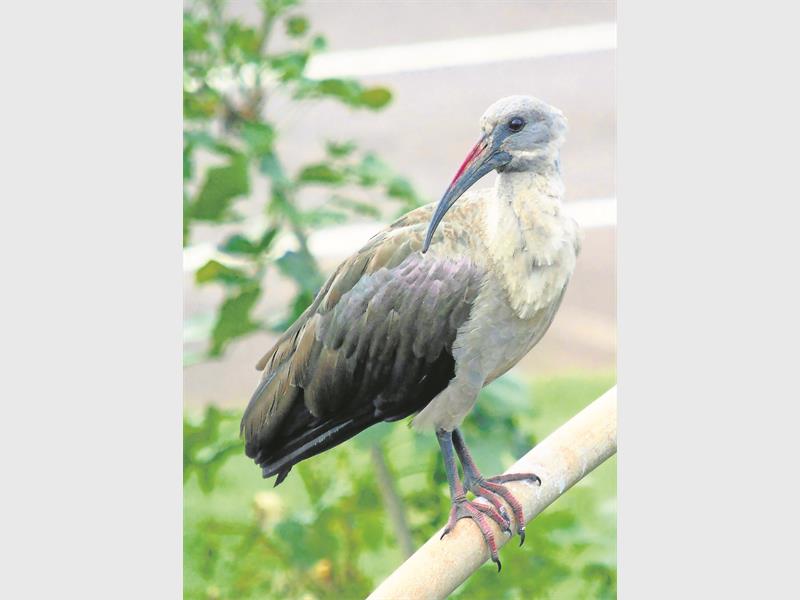
THE hadeda ibis is a common resident found over most of South Africa, except the dry western parts.
Known for its very loud, raucous call ‘haaa ha-hadeda’, which it usually gives in flight, this bird is often found in large gardens, playing fields, grassland, savannas, forest edges and shores of inland waters.
LISTEN:
Hadedas are gregarious and found in flocks of five to 20 birds, even up to 100 birds when not breeding.
When disturbed, they take off with loud calls, their flight being somewhat jerky with irregular wing beats.
They roost in trees or on power pylons, and are highly vocal when leaving roost in the morning.
Hadedas forage on the ground, probing with their long bills or picking from the surface. They feed mainly on insects, spiders, snails, earthworms and small reptiles.
Breeding season is from July to January. The nest is a flimsy platform of sticks lined with grass and lichens usually three to six metres above the ground on the horizontal branch of a tree.
They lay two to four dull, olive green coloured eggs.
Incubation is 25 to 28 days, and nestlings remain for 35 to 37 days and are independent by 49 days.
The Zulu name is iNkankane and in Afrikaans, it’s also known as the hadeda.
DID YOU KNOW?
Click on the words highlighted in red to read more on this and related topics.
To receive news links via WhatsApp, send an invite to 061 694 6047
The South Coast Sun is also on Facebook, Twitter, Instagram and Pinterest – why not join us there?
Do you have more information pertaining to this story?
Feel free to let us know by commenting on our Facebook page or you can contact our newsroom on 031 903 2341 and speak to a journalist.
(Comments posted on this issue may be used for publication in the Sun)