
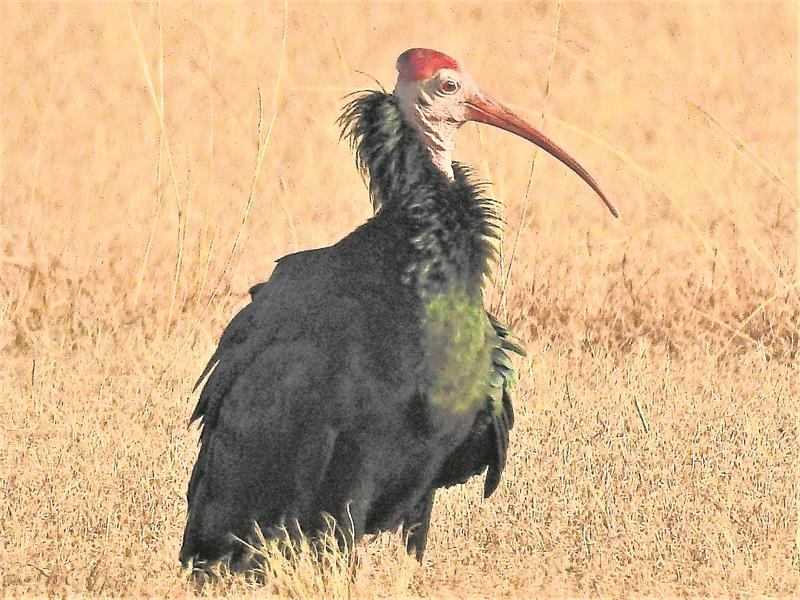
THE bald ibis is distributed across the KZN Midlands, Lesotho and the eastern escarpment through Swaziland to north of the Blyde River Canyon.
Bald Ibis are uncommon residents with a vulnerable population of less than 5,000 birds.
Usually silent and shy, they do have a piping ‘ek-ek-ek-ek’ call, as well as other growls and moans.
The bald ibis forages by turning and probing over leaves and dung. Insects, snails, worms, frogs, small mammals and birds are its main food source. Its flight is buoyant with much gliding and they soar well.
They are gregarious, being found in flocks up to 100 birds. Breeding takes place in mountainous or highly desecrated areas. The nest is made from a platform of sticks on a cliff edge or in a riverine gorge, even a waterfall face.
https://www.instagram.com/p/BTOKpL-AmKt/?tagged=baldibis
One to three pale blue eggs are laid with the incubation period lasting 27 to 31 days and nestlings remain for 40 to 45 days. Young birds are dependant on their parents for about two months.
The bird’s Zulu name is umXwagele and in Afrikaans, kalkoenibis.
BY: BRUCE MUNRO
DID YOU KNOW?
Click on the words highlighted in red to read more on this and related topics.
To receive news links via WhatsApp, send an invite to 061 694 6047
The South Coast Sun is also on Facebook, Twitter, Instagram and Pinterest – why not join us there?
Do you have more information pertaining to this story?
Feel free to let us know by commenting on our Facebook page or you can contact our newsroom on 031 903 2341 and speak to a journalist.
(Comments posted on this issue may be used for publication in the Sun)