
Ward councillor outlines plans to tackle Springs’ electricity and sewage crises
Ward councillor Mike du Toit outlines the challenges behind Springs’ sewage and power issues and shares plans to improve service delivery.
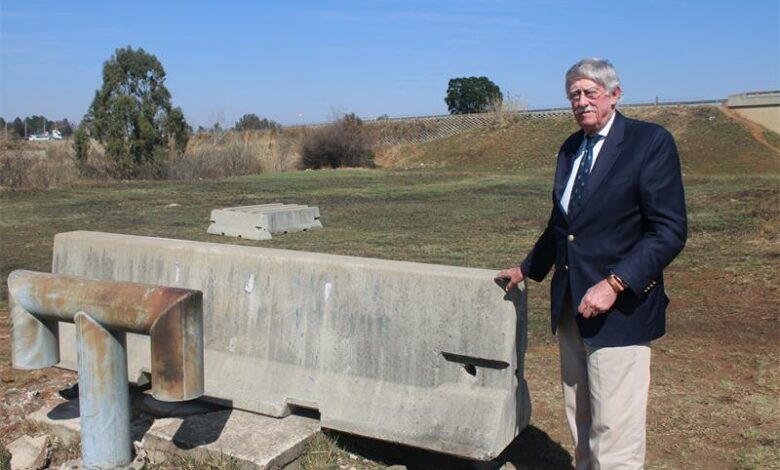
From power cuts caused by cable theft to overflowing sewage affecting households, residents in Springs continue to grapple with serious service delivery setbacks.
Ward councillor Mike du Toit says these issues remain the most pressing obstacles to reliable service delivery and has shared the main reasons behind them, as well as plans to resolve them.
As previously reported by this publication, there are areas in Springs experiencing sewage problems. Du Toit said that Grung Road, Daggafontein, the south-west side of Selcourt, and Fryer Road are the areas most affected, even calling Fryer Road the “sewage capital of Springs.”
Du Toit said that in his Integrated Development Plan (IDP), sewage and energy problems are the top priorities.
“I’m very concerned about the sewage situation, not just in Springs but in Ekurhuleni. Seven of our 19 water treatment plants are operating well over capacity.
“I am talking to the department about it, and we are making progress. It has attracted enough attention to show that it’s a serious problem,” he said.
“He explained that the main cause is the pump station in Fryer Road, located in front of the water treatment plant. “When that pump station is not coping, sewage comes out through the drains. If it is not addressed, it can start spreading to Broom Road.
“However, this has seldom happened in the last two years, as it is often brought under control. The problem is that we are not addressing the root causes.
“It goes back to the water treatment plants; they need to be scaled up. That is going to cost millions. We are fighting for this in council and oversight committees to get funds allocated to get these plants sorted out,” Du Toit explained.
He said that although immediate interventions are in place while a long-term solution is being developed, they remain insufficient, as the larger issue lies with the reticulation system, which requires upgrading.
“The water plant is operating at 229 per cent of its capacity, and the reticulation system has not been upgraded to cope with the population increase. The by-laws are not being enforced regarding buildings in town.
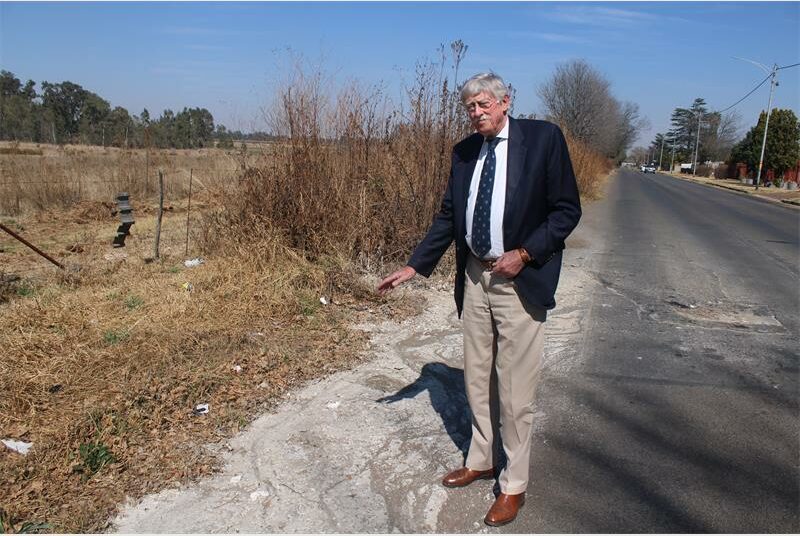
“These were office blocks, and they are now being used to house people. Some houses in Grung Road were designed for four or five people, yet in some cases, they are housing about 20,” he said.
He added that before developing more housing, the sewage system needs to be upgraded. He cited the Daggafontein Mega City project, a large housing development within the CoE, which is planned to deliver over 16 000 housing units.
“They approve plans for new housing, yet we still have issues with the water plant operating beyond capacity. The sewage plan must be prioritised first,” he said.
Du Toit also mentioned Sharon Park Estate (Hlanganani), where residents sometimes redirect stormwater into drains, causing sewage overflow in their yards. He urged the community living in high-lying areas to allow stormwater to flow down to lower ground and into drains.
“Some people have built walls which prevent stormwater from flowing to low ground. This causes water to back up in their yards,” he said.
ALSO CHECK: Springs SAPS warns against fake social media posts about police vehicles
He also addressed cable theft, which causes power outages and increased crime in the Springs area, and discussed interventions in place to tackle the issue.
“We worked with the Energy Department and private security companies to bring high-voltage cable theft under control. A company was contracted using advanced technology to protect the cables, and it was not much of a problem for a period. The issue arose when that contract expired and the CoE has not issued a new one,” Du Toit said.
He explained that issuing a new contract is handled by supply chain management, which is often slow.
“Their human capital is controlled externally. For example, if they want a truck fixed, they must go through workshops and supply chains. Civil authorities do not control their assets directly. Therefore, I cannot hold them accountable because they are not fully in charge,” he said.
Du Toit said that to address these problems, the treasury has given the municipality an option to restructure the service departments. This process has already started with the water and energy departments, as they are the two critical areas.
“These two departments are being formed into businesses within the municipality. The idea is that they will manage their own operations like a business, making them more efficient.
“The problem with how Ekurhuleni is run is that procurement is all done centrally, such as repairs. They are busy reorganising those departments, and I hope this will improve service delivery,” he shared.
To reduce cable theft, Du Toit contacted Sanral to install cement blocks in manholes that thieves used to access tunnels.
He said councillors, together with the municipality, are doing their best to respond swiftly to residents’ service delivery concerns.
“Some people think that as a councillor, my job is to give instructions. That is not true. I listen to grievances and then persuade the municipality to take action.
“We are working through the chamber to explore public-private partnerships where we can bring the right industries to partner with the municipality. We have to allocate funds to fix our infrastructure,” he said.
He concluded by outlining plans to alleviate the electricity problem.
“We have two large solar farms being built, one in Rietfontein and another planned for Daggafontein behind Nuffield. That is 70 MVA coming from solar, which will ease the energy problem,” Du Toit said.