
No cases of Coronavirus in eMalahleni
Hospital management takes all suspect cases seriously and works closely with the NICD and the Department of Health
Life Healthcare can confirm that none of its patients have been diagnosed with the novel Coronavirus.
As standard procedure and as per the National Institute of Communicable Diseases’ (NICD) and World Health Organization guidelines, patients who have traveled to the affected area, lately, are tested for the virus.
In the event that a suspect case in confirmed, the hospital follows all required procedures as per the NICD as well as Life Healthcare’s infection prevention protocols.
Hospital management takes all suspect cases seriously and works closely with the NICD and the Department of Health.
What is 2019-nCoV?
Human coronaviruses are common throughout the world.
The name corona refers to a crown because these viruses have crown-like spikes on their surface when viewed under an electron microscope.
There are many different coronaviruses identified in animals but only a small number of these can cause disease in humans.
Some coronaviruses such as 229E, NL63, OC43 and HKU1 are common causes of illness, including respiratory illness, in humans throughout the world.
Sometimes coronaviruses infecting animals can evolve to cause disease in humans and become a new (novel) coronavirus for humans.
Examples of this are the Middle East Respiratory Syndrome Coronavirus (MERS-CoV), first reported from Saudi Arabia in 2012, and the Severe Acute Respiratory Syndrome Coronavirus (SARS-CoV), first recognized in China in 2002.
On January 9, 2020 the World Health Organization reported that a new coronavirus was identified in China associated with an outbreak of pneumonia in Wuhan City, Hubei Province.
This virus is the 2019-nCoV.
The majority of the case-patients initially identified were dealers and vendors at a seafood, poultry and live wildlife market (Huanan Seafood Wholesale Market) in Jianghan District of Hubei Province.
This suggests that the novel coronavirus has a possible zoonotic origin.
The specific source of the virus is not yet known.
Who is at most risk for 2019-nCoV?
Currently travellers to Wuhan, China and other affected areas of China are at greatest risk of infection with 2019-nCoV.
Infections in travellers outside China have not resulted in outbreaks in other countries.
What is the risk of 2019-nCoV infection in humans in South Africa?
There have been no cases of 2019-nCoV reported in South Africa. Active surveillance is in place to identify an imported case should one occur.
People who develop symptoms of respiratory illness including cough, fever and shortness of breath within 14 days of travel to countries where coronavirus is known to be circulating should seek medical care early and share information about travel history with their doctors.
How is 2019-nCoV transmitted?
While the first cases probably involved exposure to an animal source, the virus now seems to be spreading from person-to-person.
It is thought to happen mainly via respiratory droplets produced when an infected person coughs or sneezes, similar to how influenza and other respiratory pathogens spread.
Thus far the majority of cases have occurred in people with close physical contact to cases and healthcare workers caring for patients with 2019-nCoV.
What are the signs and symptoms of 2019-nCoV infection in humans?
Current symptoms reported for patients with 2019-nCoV have included mild to severe respiratory illness with fever, cough, and difficulty breathing.
The complete clinical picture with regard to 2019-nCoV is still not fully diagnosed by a laboratory test, polymerase chain reaction molecular test, on a respiratory tract sample (e.g. sample from nose, throat or chest).
How is 2019-nCoV infection treated?
Treatment is supportive (e.g. provide oxygen for patients with shortness of breath or treatment for fever).
There is no specific antiviral treatment available.
Antibiotics do not treat viral infections.
However, antibiotics may be required if bacterial secondary infection develops.
How can 2019-nCoV infection in humans be prevented?
Currently there is no vaccine for 2019-nCoV.
Officials in China have intensified efforts to contain the spread of the virus.
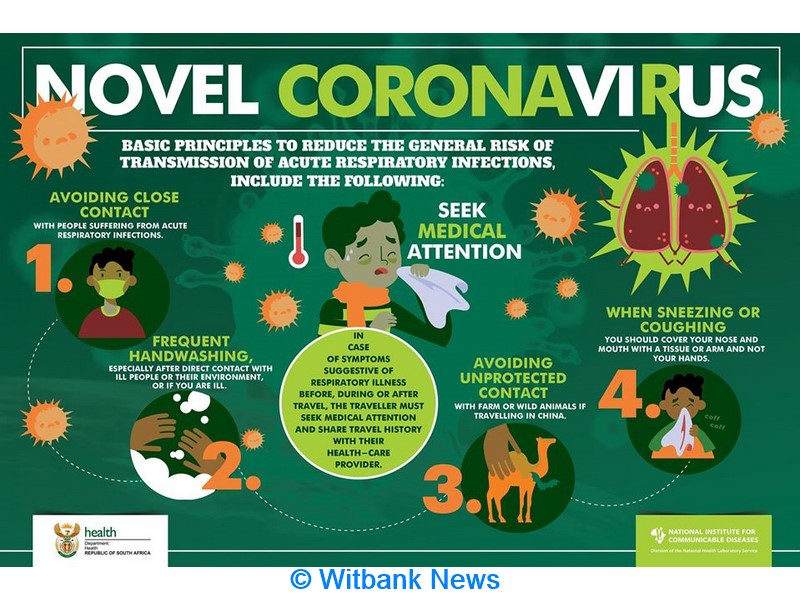
There are no specific measures currently recommended to prevent 2019-nCoV but the following can provide protection against infection with coronaviruses and many other viruses that are more common in South Africa:
• Wash your hands often with soap and water for at least 20 seconds. If soap and water are not available, use an alcohol-based hand sanitiser.
• Avoid touching your eyes, nose, and mouth with unwashed hands.
• Avoid close contact with people who are sick.
• Stay home when you are sick and try and keep distance from others at home.
• Cover your cough or sneeze with a flexed elbow or a tissue, then throw the tissue in the bin.
• Clean and disinfect frequently touched objects and surfaces.
• Avoid contact with farm or wild animals (alive or dead), animal markets, and products that come from animals (such as uncooked meat).
Source: Centre for Respiratory Disease and Meningitis.