
Why South Africa’s biggest problem is not leadership failure but character failure
Communities are tired of seeing their municipalities collapse into chaos whilst their leaders draw large salaries and enjoy life to the full.
South Africans are tired and frustrated – tired of bad roads to travel on, tired of reading about the latest corruption scandal, tired of hearing the same promises during every election, tired of all the inquiries into corruption and how nothing seems to change.
They are tired of seeing their municipalities collapse into chaos whilst their leaders draw large salaries and enjoy life to the full, with all the trappings and benefits of high office, including bodyguards, cars, and positions.
While many can list the problems, most eventually lose interest, lack the time, or lack the patience to investigate their root causes.
Yes, there is a leadership crisis in South Africa, but it is more than that; it is a character crisis disguised as a matter of good, honest, reliable, and competent leadership. Leadership demonstrates the true character of the individual leading an organisation.
We are sick and tired of leaders who care about nothing but themselves.
Every human being has a character, and most of our leaders today have very bad characters.
They are corrupt, they tell the nation a pack of lies just to get to power, they are too proud for others to get to know them and to hear them out.
They are not leaders but selfish and crooked individuals.
The current political landscape is characterised by record levels of structural unemployment, widespread and deep-seated corruption within government and state-owned enterprises, and wealth inequality arguably unmatched globally.
As a direct result of these challenges, South Africa is facing unprecedented levels of poverty and resultant strain on public services. Official unemployment figures have soared to 32% and rising, with the broader unemployment rate (including those who have stopped looking for work) as high as 43%.
Youth unemployment rates are the worst of all, with approximately 60% of 15 to 24-year-olds out of work.
Corruption in the public sector continues to worsen, with South Africa scoring a woeful 41 out of 100 on the Transparency International Corruption Perceptions Index (CPI).
This places South Africa below the average for all countries covered by Transparency International and highlights a deep-seated accountability crisis.
The crisis of leaders of bad character already becomes manifest in public offices before they take their seats in Parliament, in the mayor’s office or in the chambers of the municipal council.
Leadership in our modern world is often perceived as a sum of skills any good leader should master.
A seemingly endless list of skills is required to lead strategic thinking, effective communication, management, political savvy, networking, public speaking, negotiation – and many more.
History, however, teaches us that in the hands of someone without good character, such skills can quickly become poison.
A leader of poor character who also possesses the best skills will become a poisonous character.
For example, a leader of poor character who communicates effectively becomes a manipulator; a leader of poor character who is strategic becomes a sophisticated looter; and a leader of poor character who has charm and charisma becomes a demagogue. Competence alone is never enough. Character determines how one uses competence.
This is perhaps the greatest lesson that many societies have learned too late.
We often assume that intelligence guarantees wisdom. It does not. We assume education guarantees integrity. It does not. We assume experience guarantees maturity. It does not. We assume race or political party guarantees good ethical behaviour. It does not. Character remains the decisive variable.
READ MORE The leader who serves – or the leader who consumes?
Over a cup of coffee, Reverend Maans van Zyl digs into time management failures
— WitbankNews (@WitbankN) April 2, 2026
Read more here: https://t.co/2S8UUlTTuV#WitbankNews #emalahleni #ReverendMaans pic.twitter.com/n7h7iF0ccO
Over a cup of coffee, Reverend Maans van Zyl looks into how important it is to show up on time
— WitbankNews (@WitbankN) March 16, 2026
Read more here: https://t.co/0iApukq6iE pic.twitter.com/7CVRplSBWx
Over a cup of coffee, Reverend Maans van Zyl looks at how leadership can servehttps://t.co/ntUpAiWJsG #reverendmaans #witbanknews #witbank #opinionpiece pic.twitter.com/AhRa3RLkvF
— WitbankNews (@WitbankN) April 13, 2026
The quality of a leader is that of the person leading
It is said that the great leaders of the past, the leaders of the time of the ancient Greeks and great Roman statesmen, the authors of the Scripture, the leadership gurus and experts of the current generation are all saying the same thing. Why is it, then, that on repeated occasions citizens allow themselves to be led by the apparently incompetent leader?
The answer to this question largely depends on the nature of humans.
People tend to be drawn to leaders who are confident, have great charm and make great promises.
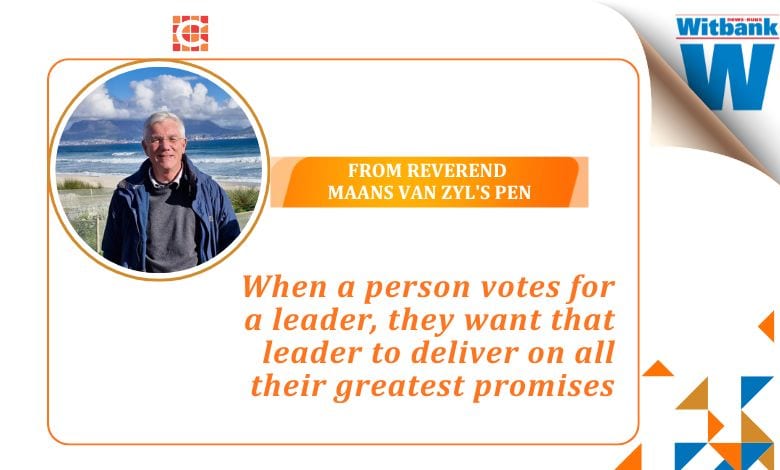
When a person votes for a leader, they want that leader to deliver on all their greatest promises.
And so it is with the performance of any leader. If the leader is unable to deliver on all their greatest promises, then we need to look at the amount of reality rather than the mere rhetoric of that leader. In short, we are searching for great charisma in a leader rather than great character.
And so we tend to look at the very visible leadership qualities that any leader may possess rather than the less visible, less obvious qualities that that same leader also possesses. We are fooled by great, powerful, moving speeches.
We are fooled by a leader who appears strong, only to discover that the leader lacks wisdom and cannot lead effectively.
That apparently so confident and so very sure leader will expose himself or herself for what he or she really is when it counts most.
And that means the leader will be exposed for their incompetence. Invisible leadership qualities such as honesty, humility, accountability, diligence, self-discipline, stewardship, and integrity receive little attention because they are not newsworthy; therefore, they are the qualities that determine whether an institution will survive or collapse. The Auditor-General’s reports on the financial and performance administration of all 278 municipalities for the past number of years paint a dismal picture.
Year in and year out, a significant number of municipalities struggle with the very basics of financial management, with frequent instances of irregular expenditure, governance failures, inadequate controls, and a constant decline in the quality of services delivered to residents and ratepayers.
In the process, billions of rand are squandered through inefficiency, waste and mismanagement.
The result is that municipalities’ financial and other resources are not being utilised to deliver quality services and infrastructure to residents and to create and sustain economic opportunities. Instead, the focus is on how to utilise these resources to sustain the status quo and to meet the promises made by previous leadership.
The problem is not merely technical. The problem is moral. No accounting system, no governance framework, no policy document can compensate for dishonesty. Greed can never be eliminated. Every institution hits a point where it is revealed to be governed by an incentive structure, i.e. by the character of its leaders.
What happens when no one is around?
What can a person do with power? What happens to public resources when they become accessible?
When personal gain conflicts with public responsibilities, a nation’s character is revealed. Whether a nation rises or falls is determined by its leaders.
Greed illustrates this point. Most people are familiar with the concept of greed in relation to money and wealth.
However, greed is a far more complex issue than simply wanting more money. Greed is the refusal to recognise limits or to give up in pursuit of desires. It is the belief that one’s desires are more important than others’ needs.
Greed manifests itself in many different forms, perhaps most egregiously in the transformation of leadership into consumption. It is the refusal to recognise limits. It is the belief that one’s own desires are to be placed above those of others. It is the transformation of leadership to consumption.
The greedy leader is not one who enters office asking how he or she can serve.
Instead, he or she enters asking how the position can serve him or her. The answer can be financial. It can also be to increase status, to gain influence, to acquire power, or even simply to avoid accountability.
The form of the greedy leader’s consumption can change, but the underlying motivation to serve himself or herself remains the same. Thus, corruption is not simply a matter of whether something is legal. It is a leadership issue.
And before it becomes a leadership problem, it is a character problem. The opposite of greed is not poverty. The opposite of greed is stewardship. Stewards understand that what has been entrusted to them does not ultimately belong to them. Good leaders think like stewards. They understand that public office is borrowed. Authority is temporary. Power is limited. Resources belong to the people. Institutions must outlive personalities.
Future generations matter
The steward asks: “What responsibility accompanies this privilege?” The greedy leader asks, “What privilege accompanies this responsibility?”
That difference changes everything. One builds. The other consumes. One leaves stronger institutions. The other leaves weaker institutions. One creates opportunity. The other extracts value. One serves the future. The other mortgages the future.
The distinction sounds simple.
Yet entire nations rise and fall on this principle. South Africa’s future will not ultimately be determined by speeches, slogans, conferences, manifestos, or election posters. It will be determined by character.
The character of leaders.
The character of institutions. The character of voters. The character of citizens.
An efficient democracy is ruled by the people, but the leadership culture of a democracy is exactly what that democracy deserves again. If a democracy repeatedly rewards a leadership culture of entitlement, that culture will keep growing. If a democracy repeatedly rewards corruption, that corruption will keep spreading.
And if a democracy repeatedly rewards excuses, then there will be more of them. And if a democracy repeatedly rewards good performance, then performance will improve.
And if a democracy repeatedly rewards integrity, then integrity will become a highly valued good.
Elections matter because, in them, the culture of a society’s leadership is time and again rewarded by voters for what they value.
If they value something, then it will be granted to them in elections. Thus, the real issue for voters in elections is not choosing between political parties; rather, it is learning to value human character.
Does the leader demonstrate humility?
Does the leader welcome accountability?
Does the leader produce measurable results?
Does the leader accept responsibility for failure?
Does the leader leave institutions stronger than he found them?
Does the leader live according to the standards expected of others?
These questions matter far more than slogans. The future of South Africa depends on citizens becoming more demanding in these areas. Not cynical. Not angry. Not hopeless. Demanding. Demanding honesty. Demanding competence. Demanding accountability. Demanding integrity. Demanding results. Most importantly, demanding character.
Because leadership is never ultimately about power.
Leadership is about responsibility. And responsibility without character eventually becomes exploitation.
The real crisis beneath South Africa’s visible crises is therefore not fundamentally economic, political, administrative, or even institutional. It is moral. The encouraging reality is that moral problems can be addressed.
Character can be cultivated. Integrity can be taught. Accountability can be strengthened. Communities can rebuild trust. Institutions can recover. Leadership can improve. But only when we correctly diagnose the disease.
South Africa’s deepest need is not simply better leaders. South Africa needs better character in leadership. And perhaps even more importantly, citizens who insist upon it.
Faith reflection: The character question
In Jesus’ evaluation of leaders, a leader’s success is never gauged by how successful they appear. Instead, He asks whether they have any good fruit. The great saying about this, A tree is known by its fruit, or rather, by the way of its fruit, is Matthew 7:16-20.
The biblical test for a leader is astoundingly practical. What comes after the leader? Truth or deception? Service or self-interest? Integrity or corruption? Justice or exploitation? Growth or decline? It is against this kind of leadership that Jesus walked and taught.
He rejected the model of leadership that was based on status, privilege, power, and domination. Instead, He taught that, “Whoever wants to become great among you must be your servant” (Matthew 20:26). Jesus did not redefine greatness. What He did was to define the way to greatness.
It is not by seeking power, wealth, and prestige. It is by serving others, by laying down one’s life for the good of others, and by developing the best character possible.
In the end, leadership is not revealed by titles, positions, or promises. Leadership is revealed by fruit. And fruit always tells the truth.
This column is the opinion of the writer and does not represent the views of Witbank News.
Your city, your story, as it happens. Stay in the loop with WITBANK NEWS.
Find us on our website, Facebook, X, Instagram or TikTok
Got a tip? Email: info@witbanknews.co.za