
When everyone talks about leadership, what does real leadership cost?
When everyone talks about leadership, what does real leadership cost?
Every election cycle has a familiar pattern. Suddenly, everyone is talking about leadership.
The campaign speeches are filled with promises. The posters have catchy slogans. The social media posts are full of confident declarations about vision, change, and progress.
Leadership is the ‘in’ thing. But when the euphoria wears off, and the votes are counted, reality sets in. There are tough decisions to be made.
There are institutions to guide.
There are problems to tackle that take courage. And then it becomes clear: talking about leadership is cheap – but real leadership is not.
So what is the ‘expensive’ part of leadership?
What are the elements of real leadership that cannot be faked, borrowed, or manufactured for a campaign season? Let us explore what history, social science, and real-world experience have to say.
1. Real leadership costs courage – especially when it is unpopular. The first non-negotiable element of leadership is courage. Not the kind of courage that is demonstrated after a speech, but the courage to take actions that will incur costs, criticism, push back, or even sacrifice. To lead is to take a position before there is universal agreement. It is to act when the outcome is uncertain. It is to speak when it would be easier and more convenient to remain silent. History shows us that real leadership often comes at a personal cost, a reputational cost, a political cost, and at times an actual cost. When a leader takes a morally or strategically sound position, it almost always engenders a response. The response can take the form of opposition, loss of support, and even public backlash. In other words, leadership costs something because it can result in a loss for the leader. Anyone can promise change if it will elicit applause. Leadership manifests itself when applause is absent, but the commitment remains.
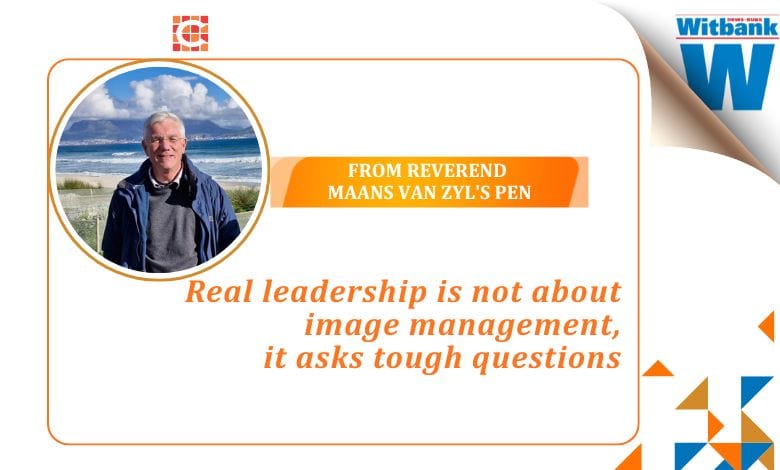
2. True leadership is moral accountability. Leadership is not about influence; it is about accountability. Leadership involves taking ownership for whole systems, outcomes and decisions – and that includes failures. That is hard because it involves confronting uncomfortable truths, acknowledging past mistakes, and forcing changes even when they are inconvenient and politically difficult. Real leadership is not about image management. It asks tough questions:
• Are we part of the problem?
• What needs to shift in our model?
• What do we need to fix before we can move on? This is not about PR. It is about reform. And reform always costs something – emotionally, institutionally and practically.
3. Real leadership demands sustained effort, not symbolic gestures. Another costly aspect of leadership is steadfastness. Real change does not come from a single announcement. Change happens through years of consistent, adaptive engagement. True reform is arduous; it requires uncompromising commitment over generations. Pasted text. This is the most significant distinction between the noise of campaigns and the reality of leaders. Campaigns produce waves. Leaders produce tides – currents one often does not see but feels, nonetheless. The effort to create sustained change is costly because it takes years, it requires discipline, and it is often tedious and unrewarding.
4. Real leadership invests resources – not just words. Promises cost nothing. Leadership does. All serious change initiatives require the investment of resources: time, money, expertise, reorganisation of the institution, and human energy. Leaders must mobilise people, align systems, and commit tangible resources. This is why real leadership cannot be limited to rhetoric. It must include the construction of structures, the development of programmes, and the implementation of measures. When organisations or governments set out to achieve serious reform, they encounter tough trade-offs. Resources must be reallocated. Priorities must be revised. Some winners will lose while others will gain. These trade-offs are costly – politically, economically, and socially. But without them, leadership is just a lot of words.
5. Real leadership deals with complexity, not simplistic solutions. Election campaigning encourages simplicity. Real life is more complicated. Leadership concerns complex systems in which social, economic, cultural, and institutional factors interact. Problems are interrelated. Solutions have knock-on effects. Gains in one area can create challenges in another. So real leaders think systemically. They consider long-term effects. They anticipate opposition. They balance conflicting demands. It takes intelligence and experience – a lifetime of learning – to understand the theory and practice of complexity management. Slogans that oversimplify the challenges to leadership cost nothing to deliver. A serious understanding of the challenges to leadership takes a lifetime.
6. Real leadership is for the future, not for the present. Yet another cost of leadership is the time horizon. Campaign thinking is oriented toward immediate approval. Leadership must be focused on the long term – on the welfare of the community or organisation in decades to come. This means making decisions that will only confer benefit upon the community or organisation long after the leader has departed. Spending money on education, social or economic well-being, or ensuring the stability and integrity of institutions is rarely popular in the short term. Yet all of these expenditures contribute to a better future for the community. Leadership, then, demands a willingness to pursue the long term at the expense of popularity in the short term. That does not come cheap.
7. Real leadership renews communities – and that is never easy. The costliest aspect of leadership is the renewal process itself. When leadership is successful, it changes the way things work. It alters the dynamics between people. It challenges established practice. It realigns the way power operates. It raises the bar. Renewal creates discomfort because it changes the status quo. Even beneficial change can create fear, pushback, and conflict. Leaders have to guide communities through this discomfort – keeping them directed while keeping them together. This emotional, social burden is one of the weightiest aspects of leadership. It cannot be outsourced.
So what is the real DNA of leadership? If we strip away the rhetoric, what do we find? The hallmarks of leadership are the costly things: Courage in the face of pushback; Moral obligation to tough truths; Commitment over time; Investment of time, money, and energy; Engagement with complexity; A focus on future generations; The willingness to guide change against opposition.
These are not ‘trendy’ attributes. They are costly. Why does this matter during election season? When leadership becomes a campaign issue, voters and citizens need to ask an important question: What is the difference between posturing and leading?
Not who talks the most about leadership. Who exhibits the costly elements of leadership? Does the candidate take responsibility? Does the leader show courage when it’s unpopular? Is there commitment over time? Are there tangible investments? Is there a demonstrated depth of understanding? Is the focus long-term? If not, then leadership is merely branding.
A final word of caution, every election cycle reminds us how easy it is for people to throw around the word ‘leadership’. The health of communities, institutions and nations is not determined by how often the word is tossed around. But whether it is exercised in its costly form. Leadership is not about visibility, charm or slogans. It is about sacrifice, responsibility and endurance. Talk is cheap. Leadership never is.
Read more here: Coffee with Reverend Maans – the moral compass for a nation in need
Over a cup of coffee, Reverend Maans van Zyl looks at building a prosperous country
— WitbankNews (@WitbankN) May 19, 2026
Read more here: https://t.co/oD44YlP00c#witbanknews #witbank #localnews pic.twitter.com/Ttc2Lm4Wh9
Your city, your story, as it happens. Stay in the loop with WITBANK NEWS.
Find us on our website, Facebook, X, Instagram or TikTok