
Port ponders chaining dolosse
Dislodged dolosse at Richards Bay harbor may have to be chained down to weather heavy storms
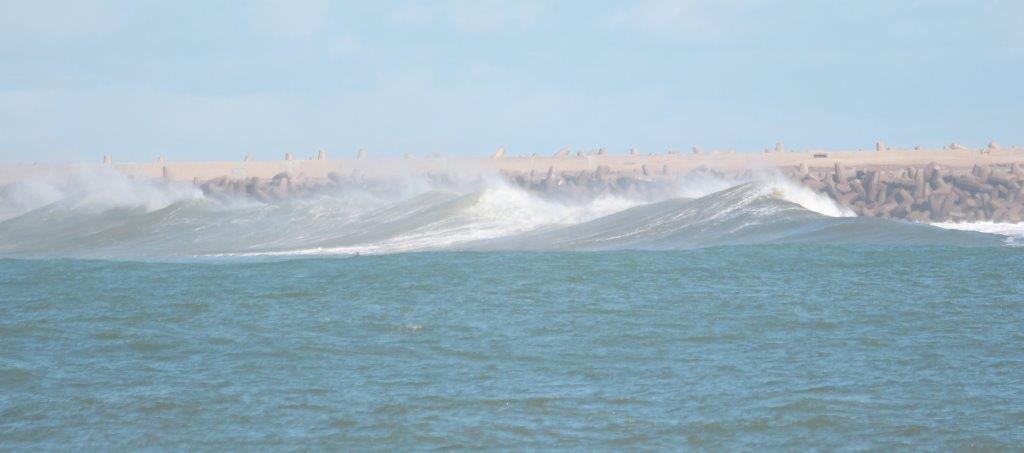
THE Transnet National Ports Authority (TNPA) is thinking long and hard about chaining down dislodged dolosse protecting the harbour’s breakwater after a hefty storm and super tide collided and bashed the barriers of 20-ton blocks in March.
After extensive research conducted by the Council for Scientific and Industrial Research (CSIR) at its Stellenbosch Coastal Laboratory, scientists discovered the most viable and affordable option to place the ‘knuckle bones’ back in position is to secure them using chains.
‘We tested three scenarios,’ said CSIR civil engineer Kishan Tulsi.
‘We tested how long the breakwater would last if no repairs were made.
‘Then we tested rearranging the existing dolosse around the roundhead and tying them together in clusters with chains to increase their robustness against elements.
‘Lastly, we tested replacing the roundhead with a concrete caisson head which is an extremely robust structure, but which would be expensive to construct.
‘Chaining the existing dolosse into clusters would make the breakwater strong enough to weather storms of up to a one-in-15-year storm condition.’
Tulsi explained this comparatively cheap method extends the breakwater’s lifespan by another 15 years.
TNPA’s Infrastructure and Engineering Department is currently mulling over the surprisingly simply, but effective idea.
‘TNPA expects to make a decision as soon as possible regarding which breakwater option it would pursue in the Port of Richards Bay,’ said TNPA spokesperson Nkululeko Molefe.
‘In the meantime, to protect the ports against storms and super tides, TNPA conducts annual breakwater monitoring in contract with CSIR, which entails photographic surveys via helicopter as well as laser scanning and bathymetric surveys.
‘This ensures the authority is always aware of the state of its breakwater structures.
‘Scientists at the CSIR monitor wave data, predict storm situations and advise TNPA accordingly.’
DID YOU KNOW?
Like our Facebook page and follow us on Twitter.
For news straight to your phone invite us:
BBM – 25A0BF5A or 2B7993C8