The lost grave at Newark beach
Renowned local historian DR JC VAN DER WALT continues his fascinating series on Graves in the Zululand Region
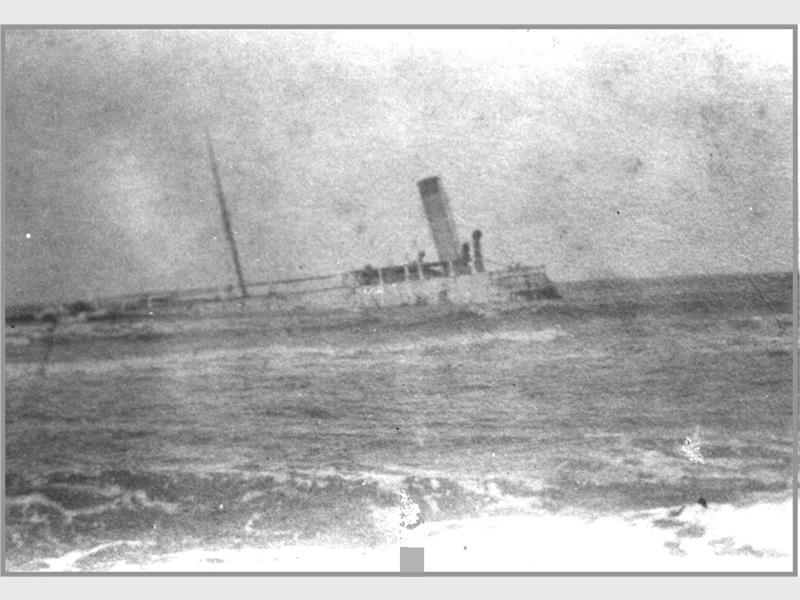
THE British steamship, ‘Newark Castle’, stranded and sank in the mouth of Richards Bay’s uMhlathuze lagoon, close to today’s northern breakwater, during the night of 12 March 1908.
A lifeboat capsized in the surf and three people drowned: Horne and a ship’s boy, Mansell, drowned after a struggle.
Major Boyes, thinking that he was rescuing his wife, actually saved the life of a beautiful French governess.
His wife drowned and she was ‘temporarily’ buried at today’s Newark beach, adjacent to Alkantstrand.
During the construction of the Richards Bay Harbour, the RB6 Consortium decided not to remove the wreck.
Instead her ‘grave’ was deepened by dredging. The top of the wreck may be seen from the Dolphin lookout point during low tide.
How it happened
Captain WH Smith testified that at 10am on 12 March 1908, the Newark Castle departed from the Bluff Lighthouse, Durban.
Between 3pm and 4pm, the vessel was off the Tugela River, but no bearings were taken to ascertain the distance of the vessel from the shore, as ought to have been done.
Chief Officer Whitfield, holder of an additional Master’s Certificate, relieved the Second Officer. The wind was light and the sea was moderate.
Nielsen the Master, was on the lower bridge watching the coast from time to time. There was no haze.
He was looking for Point Durnford, a familiar landmark – a patch of bush with two stretches of sand on either side.
They stood out from the rest of the surroundings. When this patch was abeam of the vessel, the shore was at least three miles east of the vessel. This is a safe distance in 12 fathoms of water.
A passenger, Major-General Dalton, testified that the Master explained the position to him on the chart. The vessel was then two miles north of Point Durnford.
At 5.50pm the Newark Castle struck something twice, perhaps a reef, and sprung a serious leak.
Soundings of the wells were taken and the whole ship was dry except for the engine room compartment.
But it was leaking fast.
Distress signal
As she began to list and the vessel was in immediate danger of capsizing, all hands were ordered to take to the life boats.
The vessel was abandoned at 6.30pm on 12 March 1908.
The strong wind and current carried the ship towards Richards Bay.
At 8pm the Third Officer was able to board the vessel again. He fired the first signals of distress, but had to leave her after 20 minutes.
Eventually she sank just south of the existing north break water of Richards Bay Harbour.
The officers were charged but later found not guilty of misconduct or negligence.
Sadly, Major Boyes never returned to Richards Bay to retrieve the remains of his wife. Her grave is now lost in the shifting sands of the beach at Alkantstrand.