
Green group raises voices for dolphins
Concerned citizens protest over dolphins kept in captivity and those that die after being stranded in shark nets
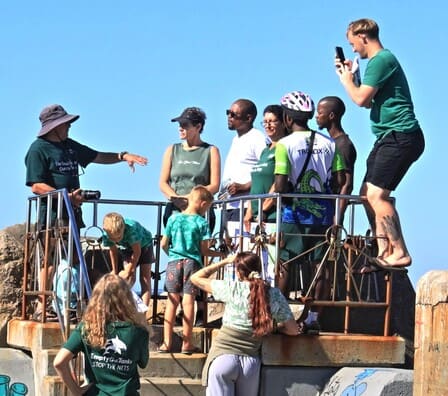
Few in number but filled with enthusiasm, a group of environmentally-concerned individuals met at Alkantstrand on Sunday to create awareness on cruelty to marine mammals.
Arriving at the dolphin viewing platform bearing banners saying ‘Empty the Tanks’ and ‘Stop the Nets’, they were protesting about dolphins kept in captivity in order to perform for humans, and those that die after being stranded in shark nets.
ALSO READ: Shedding light on awareness, conservation efforts into Richards Bay’s endangered humpback dolphins
The march was led by local environmentalist Jackie Smit, who has established her Last Leaf Foundation.
“Through educational talks, community projects, awareness campaigns, and youth engagement, we aim to help create a future where people and wildlife can thrive together,” she said.
“We celebrated Mother’s Day by speaking up for God’s creatures. Children, including those from Global Christian Academy where we have a Roots & Shoots group, made posters, wore green and we spoke out for our dolphins.
“We want dolphin shows to come to an end, and ask the public to not support these; we must empty the cages so they can swim free in the ocean.
“Also, KZN is the only coast in South Africa that has shark nets installed, unnecessarily killing sharks as well as bycatch that includes dolphins, rays and turtles.”
ALSO READ: Richards Bay dolphin death triggers reaction
The group heard an informative talk by local dolphin ambassador Dave Savides on the local endangered humpback dolphin project, as he shared insights on their vulnerability and the misinformation that surrounds ‘shark attack’ fears.
However, Dr Shanan Atkins, who heads the local research, said people also need to see the bigger picture.
“Globally, fishing practices and pollution are among the biggest threats to dolphins. Shark nets are part of that conversation, but so are the seafood choices we make, the fishing practices we tolerate, and the plastic, chemical and noise pollution our daily lives contribute to.
“We must consider the materials we all consume, and how their production, transportation, use and disposal may affect dolphins.”
Don’t have the ZO app? Download it to your Android or Apple device here:


HAVE YOUR SAY
Like our Facebook page and follow us on Twitter.
For news straight to your phone invite us:
WhatsApp – 060 784 2695
Instagram – zululand_observer
TikTok – @zululand_observer