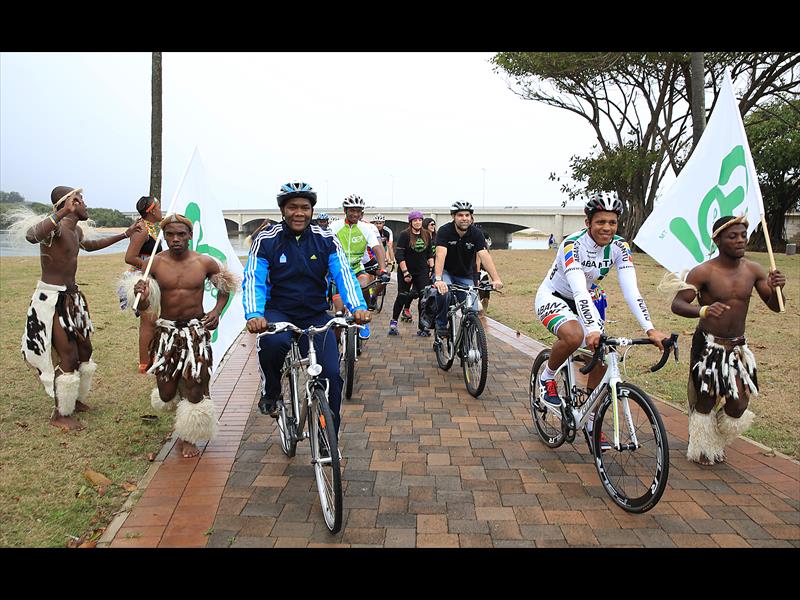
MAYOR James Nxumalo put his pedal to the metal last week as he rode along the beachfront ride-and-walk route with pro cyclists and roller derby skaters to the launch of the Non-Motorised Transport network at the Green Hub, which forms part of the GO!Durban IRPTN.
“This is a city for people, not a city for cars”, was the message given by Nxumalo, echoing the vision of Curitiba, a city in Brazil that reduced car traffic by 30 per cent. “As the population grows and the economy stabilises, we see more people being absorbed by the economy and many purchasing and driving cars. He reaffirmed the city’s “commitment for the development of public transport infrastructure plans to harness people power to propel themselves forward. We encourage people to use these modes of transport which will significantly impact on reducing our greenhouse gas emissions.”
Many cities that have improved their transportation infrastructure by creating sustainable integrated rapid public transport networks have included a Non-Motorised Transport component. This includes all transport that is “human powered” like walking, and cycling, and variants such as roller skates, skateboards, push scooters and hand carts, as well as wheelchair travel, but also includes “animal powered” such as horse and carriage drawn transport.
“Our situation however in South Africa differs from the other NMT’s in that it includes the provision of safe, manageable and accessible lanes and routes for citizens to reach public transport infrastructure,” Nxumalo said.
The City’s vibrant dedicated infrastructural plan for the NMT network will include sidewalks, off-road paths, safe crossings, pedestrian bridges and cycle areas, for recreational and commuting purposes. The focus, however, will be on commuter-based use, that enables and empowers people to walk and cycle throughout the city, and are designed to help protect them from fatalities caused by motorised vehicles or negotiating unsafe pathways to access the public transport network.
“The full potential of NMT networks is often lost in the focus on the recreational and environmental benefits,” said Nxumalo, “But we believe the city’s NMT is a basic infrastructural right for all our citizens. There are some people living in our city who are unable to access public transport safely because of the lack of this basic infrastructure. Today we celebrate the beginning of the roll out of this plan through GO!Durban, our Integrated Rapid Public Transport Network.”
The vision of the NMT is to have a safe, functional and attractive environment for NMT users that gives all its people good access to opportunities, and improved quality of life, stimulates economic growth and creates a sustainable city for the future.
Part of the NMT’s foundation was developed in the years leading up to the Soccer World Cup in 2010 with the massive upgrade of the beachfront. The idea of “connecting” people and communities that was created by the City for the international event included walkway routes such as the Green Walk Cycle Circuit, Walk all the Way System and Connect to Rail and these will be expanded upon through the new IRPTN.
Further infrastructure investment kickstarted by COP17 in 2011, enabled the city to develop routes that connected cycling and pedestrian lanes along the beachfront promenade from uShaka to the uMngeni River Bird Park. This included the widening of the M4 bridge over the uMngeni and these lanes will gradually be extended to link up to Burman Bush, Botanic Gardens and Bulwer Park. The city has also mapped out a number of “spines” to link the ICC and Durban beachfront to the Botanic Gardens and Wilson’s Wharf.
“Through GO!Durban we will continue our endeavours to empower our youth and future generations, not only with a city that creates economic opportunity and prosperity, but also strives to create a healthier lifestyle for all. It is time that Durbanites take back the streets.” said the Mayor.