
Food prices are still too high and force most South Africans to cut nutritious food from their household grocery baskets

Picture: iStock


The household food basket for November shows that food prices decreased slightly, but they are still too high for low-income consumers to feed their families nutritious food after paying for transport and electricity.
The Pietermaritzburg Economic Justice and Dignity group compiles the household food basket with the help of women who live in low-income communities doing a survey of the prices of 44 basic food items from 47 supermarkets and 32 butcheries in Johannesburg, Durban, Cape Town, Pietermaritzburg, Mtubatuba (northern KwaZulu-Natal) and Springbok (Northern Cape).
The November survey shows that the average cost of the household food basket was R5 413.53 in November, which was R27.07 (-0.5%) less than in October, but R52.49 (1.0%) more than in November 2024.
ALSO READ: Household food basket costing more again, forcing low-income consumers to buy less
Prices of items in household food basket
In November, the prices of 17 food items in the household food basket increased, while the prices of 27 food items decreased, as this graphic shows:
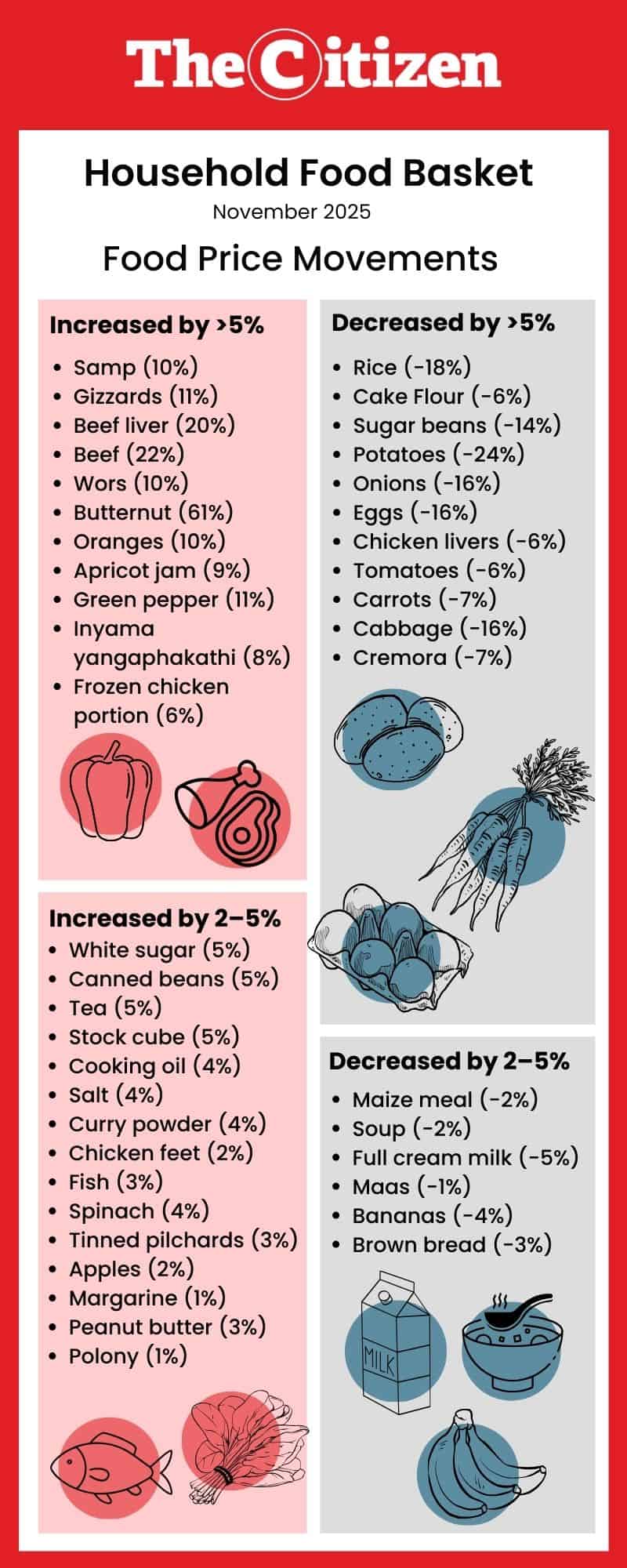
Food items in the household food basket which cost more than 5% more in November 2025 include:
- salt (5%),
- potatoes (9%),
- stock cubes (5%),
- bananas (12%), and
- oranges (22%).
Food items in the household food basket that cost between 2% and 5% more include:
- frozen chicken portions (2%),
- chicken feet (3%),
- beef (2%),
- tomatoes (2%),
- peanut butter (4%), and
- apricot jam (3%).
Food items in the household food basket which cost less by 5% or more include:
- sugar beans (-7%),
- onions (-8%),
- carrots (-13%), and
- cabbage (-11%).
Food items in the basket which decreased in price by between 2% and 5% include:
- rice (-2%),
- cake flour (-3%),
- samp (-3%),
- soup (-3%),
- eggs (-2%),
- chicken gizzards (-2%),
- beef tripe (-3%),
- fish (-2%),
- butternut (-4%),
- polony (-3%), and
- brown bread (-2%).
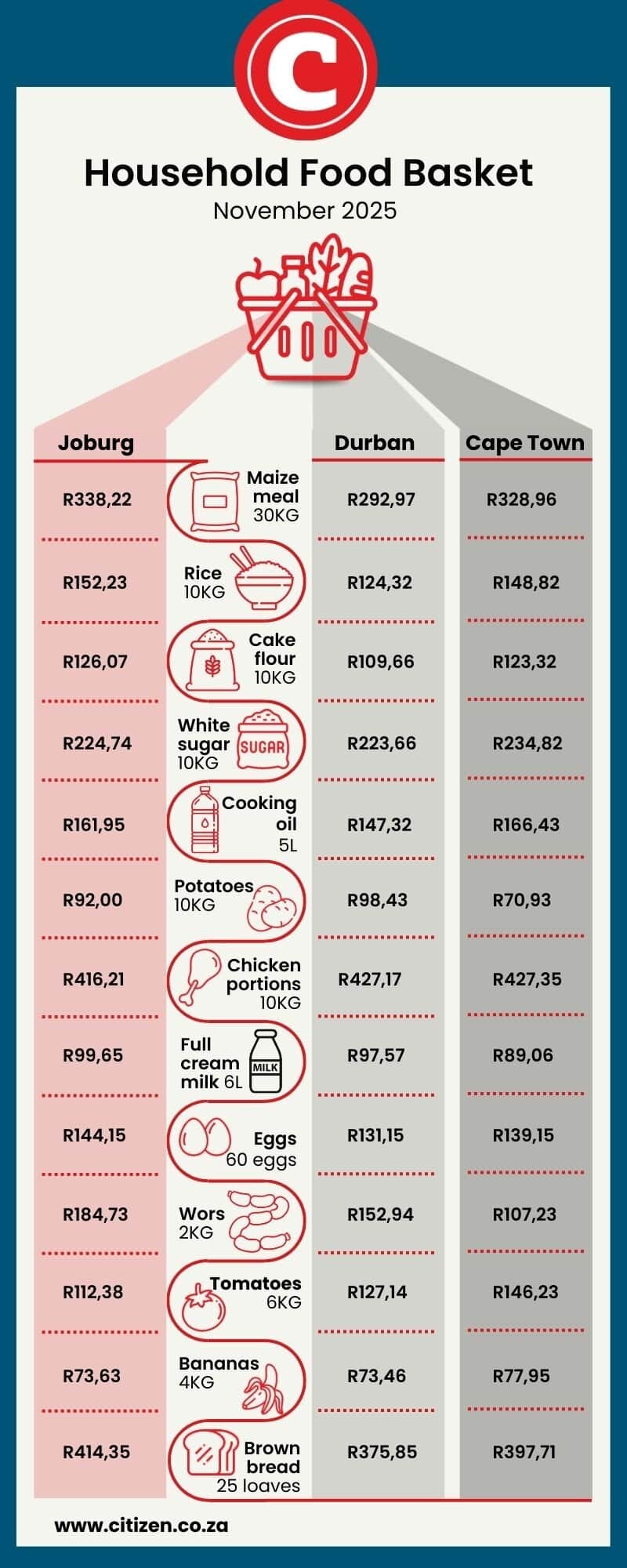
The household food basket also saw price variations between regions, with the household food baskets in Springbok, Mtubatuba and Mthatha costing more, while the household food baskets cost less in Johannesburg, Durban, Cape Town and Pietermaritzburg.
This graphic shows the differences in the big centres:
ALSO READ: Ramaphosa blames food prices on the ‘high margins’ of supermarket retailers
How low-income consumers struggle to buy food
Despite these decreases, workers earning the national minimum wage of R28.79 per hour, R230.32 per 8-hour day and R4 836.72 for an average 21-day working month still find it difficult to feed their families.
In November, with 20 working days, the maximum national minimum wage for a general worker was R4 606.40. This amount is used to support the entire family, which means a family of four for the average black South African worker.
Dispersed in a worker’s family of four, the wage is R1 151.60 per person, far below the upper-bound poverty line of R1 634 per person per month, while the average cost of a basic nutritional food basket for a family of four is R3 699.52.
Mervyn Abrhams, programme coordinator for the group, says according to their calculations, using Pietermaritzburg-based figures for electricity and transport and the average figure for a minimum nutritional basket of food for a family of four, puts electricity and transport, taking up 60.4% of a worker’s wage (R2 781.85 of R4 606.40).
ALSO READ: Competition Commission’s report shows shocking price increases in SA over past five years
South Africans have little money left for food
Workers only buy food after paying for transport and electricity, leaving only R1 824.55 for food and everything else. In November, the group calculates that workers’ families may underspend on food by a minimum of 50.7%.
This graphic shows the size of the problem:
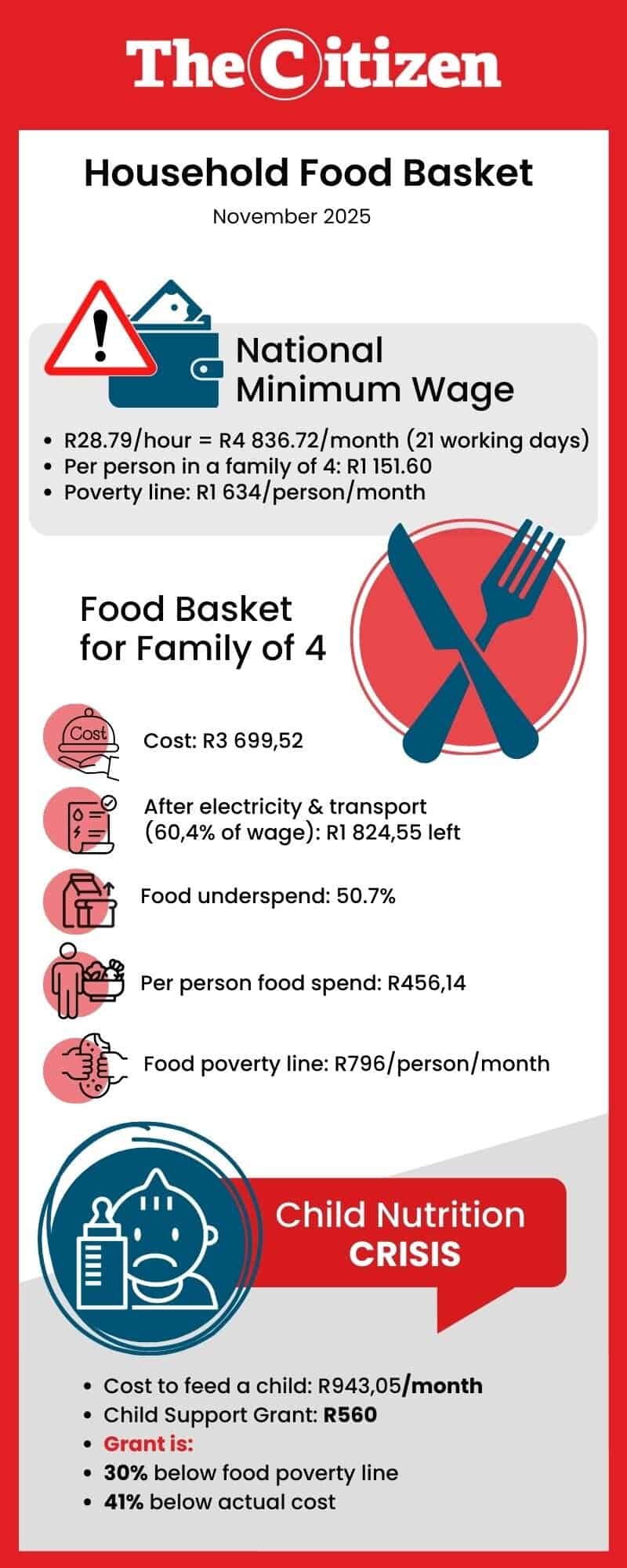
Abrahams says in this scenario, there is no possibility of a worker being able to afford enough nutritious food for her family. If the entire R1 824.55 that is left of her wages all went to buy food for a family of four, it would provide R456.14 per person per month, again far below the food poverty line of R796 per person per month.
It is even worse for a family with children, Abrahams says. In November, the average monthly cost to feed a child a basic nutritious diet was R943.05, while the average cost to feed a child a basic nutritious diet decreased by R1.99 (-0.2%) compared to October.
The child support grant is R560, which is 30% below the food poverty line of R796 and 41% below the average monthly cost to feed a child a basic, nutritious diet. This makes it clear that most of the children in our country don’t eat enough nutritious food, which affects their growth and development.