
The South African Red Cross Society is a member organisation of the International Federation of the Red Cross and Red Crescent Societies (IFRC), which is the largest volunteer-driven organisation in the world.
The Red Cross Society has 100 million members and a presence in 189 countries.
In August, 2007, the South African government recognised the South African Red Cross Society as an official auxiliary to the government in humanitarian aid.
Humanitarian services in South African can be traced back to the late 1800s.
The South African Red Cross Society (SARCS) was established in 1921 and admitted into the IFRC in 1929.
The Red Cross Society is guided by seven fundamental principles which are humanity, impartiality, universality, neutrality, independence, voluntary service and unity.
- Mission:
The mission of SARCS is to render services to prevent and alleviate human suffering and to foster human dignity in all communities, by addressing the basic needs of the people in accordance with the fundamental principles of the Red Cross Red Crescent Movement.
The four core programmes of the SARCS are:
- Health and care.
- Humanitarian values.
- Disaster management.
- Organisational development.
Disaster management:
Disaster management is a multi-sectorial, multi-disciplinary process that reduces the impact of a disaster by issuing necessary logistics to the victims of disasters.
The activities are done through two types of assessments, namely: rapid assessment – which is then followed by an in-depth assessment, to reduce the impact of the disaster and to implement effective measures in resolving the issues at hand.
Disaster risk management requires specialist input and support due to hazardous conditions which may prompt loss and an understanding of vulnerable factors that increase the severity of the impact.
Thus the programming is facilitated by experienced staff and volunteers in consultation with government, local authorities and communities.
Disaster risk management is thus carried out to lessen the impact of the disaster.
Despite being called upon by authorities, the South African Red Cross Society is not remunerated for its services.
SARCS relies on funding from individual donors to support the disaster relief programming.
How SARCS plans for and acts when there is a disaster:
- Disaster preparedness:
This is the action taken to minimise the negative effects of disasters through effective precautionary measures.
The education of communities and the public on disaster mitigation ensures adequate, timely, appropriate and efficient response to disaster situations.
- Disaster response:
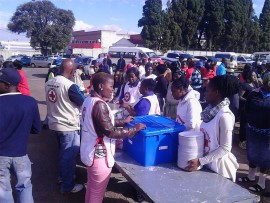
The society responds by conducting assessments in the affected communities and provides basic needs to the victims.
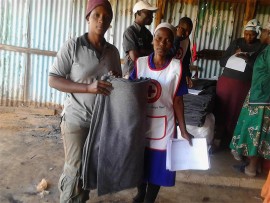
The relief items usually include water, hot meals, food parcels, hygiene packs, blankets and clothing.
Recently the society managed camps for victims of xenophobic violence in enumerating and recording the population in the camps and distributing aid in line with the mandate to help the most vulnerable.
- Restoring family links:
The programme helps people re-establish contact with immediate family members after separation due to armed conflict, natural disaster, migration and other humanitarian crises.
SARCS has been involved in various national disasters, as mentioned above the xenophobic attacks, tornados, floods, and internationally in the Malawian and Mozambique floods.
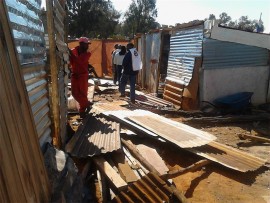
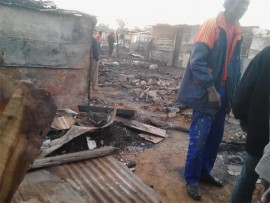
Locally the Germiston branch responds to calls within the informal settlements especially during the winter months when informal shelters are ravaged by fires.
How you can help the Red Cross Disaster Team:
The aftermath of disasters renders communities shattered, helpless and impoverished for months, and even years.
The outcomes of disasters can vary from damage and loss of property, damage to infrastructure, poverty, deaths, injury and diseases, to health and hygiene issues from which many never recover.
SARCS assists these communities long after the disaster has dissipated.
Please help SARCS to serve the most vulnerable communities by:
- Donating blankets or funds to purchase blankets.
- Donating non-perishable food, clothing and toiletries.
- Render skills and resources such as transport.
- Provide financial support to the disaster victims.
The Germiston branch of SARCS has a large catchment area, which includes many informal settlements with great needs in times of disaster.
Call Barbara Jensen on 011 873-9009 or 011 873-9130 for further information about how to help SARCS help others.
Other Germiston Red Cross articles:
Red Cross thrilled with donation
World Red Cross Day celebrated