Lehlohonolo Sekgobela aims to be a symbol of change as he shares his story of how he overcame drugs.
Now a change agent, Sekgobela carries an empty box of matches every day as a reminder that he cannot go back to using drugs.
The father of two children, who resides in Brakpan, said he has made plenty of bad decisions over the 10 years of his active addiction that left him hopeless and broken.
He started experimenting with drugs at a tender age and got worse when he started his tertiary education.
ALSO READ: Meet Brunice, a young, female engineering metallurgist
“I smoked dagga and drank alcohol in high school, but the habit got worse when I was in my first year of tertiary education in 2009. I started trying ecstasy with my friends at res. We went on to smoke crystal meth, cocaine, Cat and rock, and it became an ongoing thing.” said Sekgobela.
“There was nothing bad about it at the time because I thought it was cool to use drugs with my friends. Eventually, I found myself regularly going to Midrand to buy cocaine. I then realised this is becoming a habit.
“In the same year, my mother died and everything took a turn. I started selling ecstasy at tertiary and res because it was in demand and I was making extra pocket money.
“That season alone, a lot of guys in my circle started falling, and I am talking fatalities. Some died and some were arrested at res by police who were doing random searches.”
Sekgobela said he used drugs as a coping mechanism.“I deregistered at school because I was now known for selling drugs. I went back home to stay with my grandfather in Thembisa. I was known as a popular ‘cheese boy’ who came to the neighbourhood with expensive drugs.
“At the time, ecstasy and crystal meth were not known in Thembisa. That is when things started to get very bad because I was no longer going to school, always in the neighbourhood, partying, drinking and selling drugs,” he said.
Gradually, the fall started for Sekgobela. He started stealing items from home to feed his addiction.
“I remember selling my grandfather’s television, a lawnmower and toolboxes just to get a quick fix. This started to damage the relationship I had with my family. I was always on the front page of family meetings. I would spend weeks without coming home to a point where I would live on the streets,” said Sekgobela.
His aunt took him to Hands of Compassion rehab centre, which falls under Rhema Bible Church in Lanseria.
“I spent six months doing a religious programme at the centre. I was clean, sober and gained a lot of weight. Everyone in my family was happy to see me in that state.\
“The mistake I made was to go back to the environment I came from. I moved back to Thembisa and in less than eight months I relapsed.
“I became a hardcore drug salesman. I would go to West Street in Kempton Park to buy drugs and sell them in Thembisa. The problem at the time is that I also got high off my own supply to a point that I went out of stock. I was not the most reliable guy, not trusted by anyone in my community.”
But mercy came to his rescue when he was admitted at Gauteng Department of Social Development’s Witpoort Treatment Centre in Brakpan.
“I told my family I needed help, and this was during the time Covid-19 had started. I remember no rehabilitation centre was willing to take me at that moment. I was praying every day for Witpoort Treatment Centre to take me,” said Sekgobela.
“Getting into the centre was a blessing.”
He said his addiction counsellors (social workers) at Witpoort were phenomenal and helped him a lot.
Sekgobela is now a member of the Intsikelelo Youth Development Foundation, an organisation that assist other addicts to overcome drug addiction. He is also a committee member of the Local Drug Action Committee (LDAC) in Kwa-Thema.
He has attained a certificate in Community House Building, an NQF Level 2 qualification accredited by SETA through the department’s Xilembeni Project Centre of Excellence in Bapsfontein.
“I humbled myself and it felt great to work with my hands again,” he said.
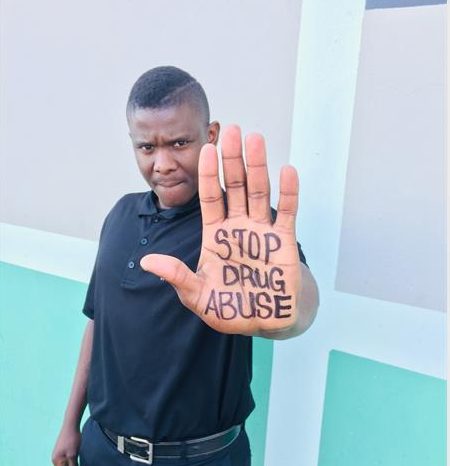
Baring a message of ‘Stop Drug Abuse’ on his hand, Sekgobela is now a year and a half sober and said young people should seek the higher power on their road to recovery because they cannot go through a process of recovery without a spiritual connection.
There are over 90 clinics, of which nine are open 24/7 and 18 open 12 hours a day from Monday to Saturday. There are social development offices as well as rehab centres to provide further healthcare services. Germiston City Clinic is also available at the corner of Queen and Cross streets, Germiston, or simply contact them on 011 999 0567 for assistance.
Contact the newsroom by emailing: Marietta Lombard (Editor) germistoncitynews@caxton.co.za, or (Journalists) Busi Vilakazi busiv@caxton.co.za