
OPINION – When enforcement works — but governance doesn’t
Msukaligwa’s signage removals raise questions about municipal priorities, communication, and service delivery.

Enforcement action raises public questions
Recent enforcement action by the Msukaligwa Local Municipality to remove illegal advertising boards along Kerk Street has sparked an uncomfortable debate in Ermelo – not about whether laws should be enforced, but about how governance priorities are perceived and executed.
By law, the municipality is correct that advertising signage falls under regulated planning and safety requirements.
Municipal servitudes exist for legitimate reasons, and business owners carry the legal responsibility to ensure their signage complies with applicable by-laws.
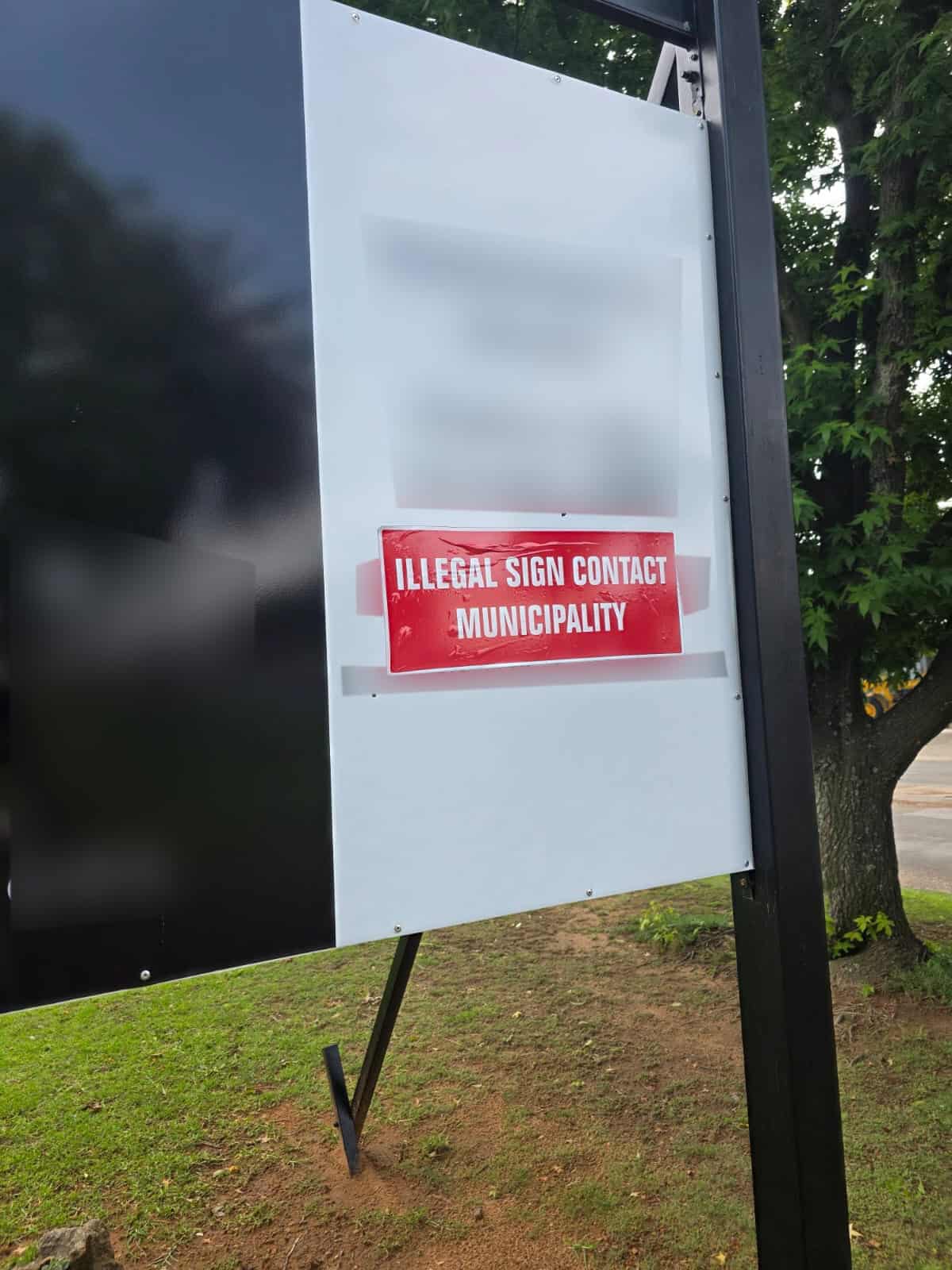
The municipality maintains that a three-month notification period was provided through the placement of red stickers on non-compliant signage, suggesting that procedural steps were taken.
However, questions remain as to whether this approach constituted effective communication.
While not necessarily mandated, a more practical and constructive method may have been to engage businesses directly while officials were on-site placing the notices, or at the very least, to ensure that the stickers included clear contact details to assist business owners in achieving compliance.
Service delivery concerns overshadow signage enforcement
The signage removals have unfolded against a backdrop of deeper structural concerns.
Just days after residents witnessed municipal teams dismantling advertising boards, two separate issues again highlighted service delivery anxieties.
The first was a road accident at the intersection of Theunissen and Generaal Hertzog streets on February 9, caused by missing traffic signage—an incident that residents believe reflects an ongoing pattern of municipal responses being reactive rather than preventative.
The second was the release of findings from the Auditor-General of South Africa showing that the municipality received a qualified audit opinion for the third consecutive year.
Audit reveals troubling trends
According to statements released by the Freedom Front Plus, the recent audit findings reveal troubling trends: water losses stand at 66%, electricity losses at 61%, and approximately 72% of municipal accounts remain uncollected, alongside ongoing financial and governance challenges.
The statistics cited raise legitimate questions about municipal capacity and oversight that cannot easily be dismissed.
The municipality must also recognise that the local economy is driven by the very businesses operating within the town.

Protecting and supporting economic activity should therefore remain central to governance priorities.
Addressing excessive water and electricity losses, together with improving revenue collection rates, would have a far greater and more sustainable financial impact than enforcement measures focused on signage compliance.
LEES OOK: Ouditverslag wys op groot verliese en swak invordering by Msukaligwa
While lawful advertising fees add to municipal income, revenue from signage permits is minimal compared with the massive losses caused by failing infrastructure and poor revenue recovery.
Reactive responses vs preventative action
The recent and swift replacement of the missing stop sign following the accident at the Theunissen and Generaal Hertzog intersection demonstrates that the municipality can respond effectively when needed.
Unfortunately, the reaction also reinforces a public perception that maintenance is often addressed only when issues arise, rather than proactively.
Municipal governance is not a single, unified function. As highlighted by Patriotic Alliance Member of Parliament Juliette Basson, different departments carry distinct mandates.
Planning officials responsible for signage enforcement do not manage roads, sewage or water infrastructure.
This administrative reality is both accurate and necessary within structured local government.
However, while departmental mandates may be separated internally, residents experience service delivery as a single collective outcome.
When infrastructure fails, financial concerns mount and communication channels appear ineffective, visible enforcement actions – even lawful ones – risk being interpreted as misplaced priorities.
Trust and transparency essential for governance
Communication appears to be one of the municipality’s most pressing vulnerabilities.
Several business owners said they tried to comply with signage regulations after seeing the notices, but could not obtain clear guidance.
Many visited the municipal offices seeking assistance, only to find that staff were unable to direct them to the appropriate department.
While the signage enforcement division clearly carried out its work, other sections of the municipality were unable to provide the necessary support that you would assume would be in place before such an operation.
Some people even approached the Msukaligwa Fire and Rescue Services in a last-ditch effort to find answers, yet still received none.
Ward 7 councillor JJ Scholtz of the Democratic Alliance has also raised concerns about whether all signage by-laws have been properly promulgated and gazetted, a matter reportedly referred to the municipality’s legal department for verification.
These uncertainties erode public trust. Enforcement requires not only authority but accessibility, clarity and consistency.
Residents and businesses must be able to comply with regulations through transparent and functional administrative processes.
At its core, this issue reflects a broader governance dilemma: enforcement is essential, but trust is indispensable.
When residents perceive enforcement to be more efficient than service delivery, dissatisfaction inevitably grows, regardless of the legal correctness of municipal actions.
The municipality now stands at a critical crossroads. By improving communication, streamlining compliance and showing equal urgency across departments, it can start rebuilding public confidence.
Residents, too, carry responsibilities. Compliance with municipal by-laws, protection of public infrastructure and co-operation with authorities remain vital for sustainable local governance.
The recent signage removal operation is therefore not simply about signage. It is a reminder that effective governance requires more than enforcement. It demands balance, transparency, and above all, credibility.
Until those elements align, tensions between municipal authority and public confidence are likely to persist.