Dr S’thembile sets new frontiers in medical field
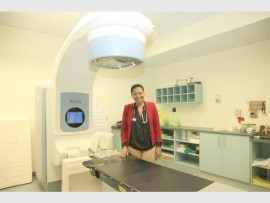
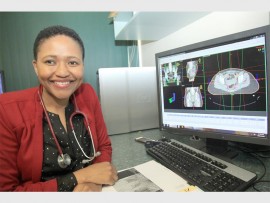
At the age of 31, Dr Ngidi, recently made history when she graduated from the Colleges of Medicine South Africa as KwaZulu-Natal’s first ever black female oncologist – and only the country’s second.
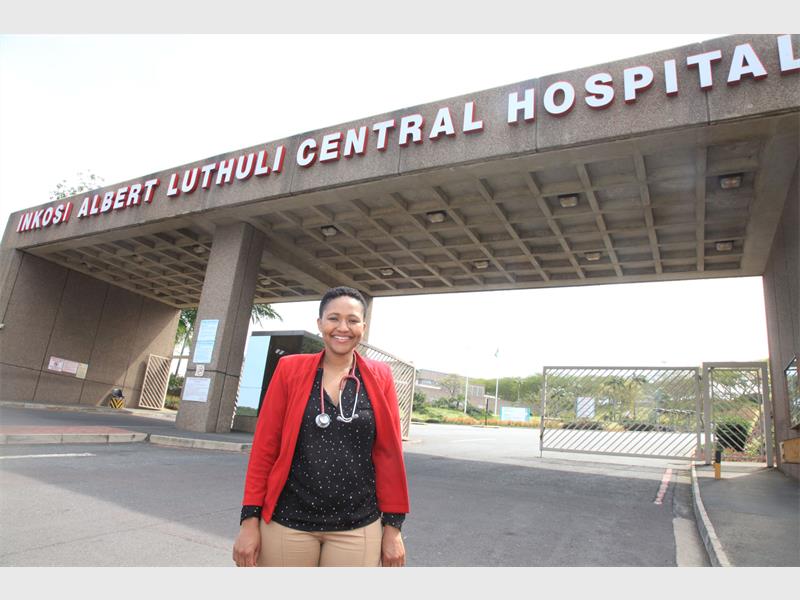
AS a sickly child, Dr S’thembile Ngidi used to marvel at how doctors could put a smile on the face of an ailing child in a few easy steps. It had such a profound impact on the asthmatic little girl that she made up her mind well before her teens that she wanted to pursue a career in medicine.
At the age of 31, Dr Ngidi recently made history when she graduated from the Colleges of Medicine South Africa as KwaZulu-Natal’s first ever black female oncologist – and only the country’s second. The daughter of a nurse and a farmer, the Inkosi Albert Luthuli Central Hospital employee was born in Port Shepstone and grew up in Gamalakhe Township.
“My parents are very strict. As much as I grew up in a township, I was restricted to being indoors. I had to be home by a certain time. In order to watch TV, I had to earn that privilege by getting certain marks at school. My father had a tuckshop and we used to work there on weekends, and he’d say, ‘that money is for your school fees’,” she recalled.
Dr Ngidi was born in 1984 and matriculated in 2001 at the age of 17. A bookworm and self-confessed nerd, she got four distinctions in matric. She then pursued her medical studies at the University of KwaZulu-Natal’s Nelson Mandela School of Medicine in the period of 2002 to 2006.
After doing her two-year internship, followed by one year of community service on her way to becoming a doctor, she then worked as a medical officer at the ARV clinic at KwaMashu Polyclinic in 2010. She obtained a medical officer post in oncology later that year.
In 2012, she got a registrar post at Inkosi Albert Luthuli Central Hospital in radiation oncology. Today, she credits the KwaZulu-Natal Department of Health for changing her life by awarding her a bursary to pursue her studies. “I had academic colours in high school. After I was approached by the university to study, I applied for a bursary with the Department of Health. That was a huge relief for us. I got sponsored to fulfill my dreams.
“Even with the student protests that we’ve been seeing, I always encourage people to apply for bursaries in the Health Department because opportunities do exist in the various spheres of the health sector. I’m a specialist today because I got a helping hand from the department. I believe that people need to know that those opportunities do exist.”
The mother of two is an advocate of healthy lifestyles and regular health screening as strategies to mitigate the impact of non-communicable diseases, such as cancer.
“It concerns me that too many people tend to come too late to get a health check-up. Some are embarrassed to seek health care. They feel embarrassed sometimes due to stigma. So, what we always preach is that, if you feel a lump, don’t waste any time. Don’t just think it’s something small that will go away. Come forward, get it checked. We need to de-stigmatise disease and accelerate health education. It’s something that all of us, including the media, need to do.
“If you’re not feeling well, go to your nearest clinic and seek assistance. We have a very good referral system as a department. If cancer is treated early, it can actually be cured. You just need to come early, and your life can be saved.”
She attributes her success to nothing less than sheer hard work and the importance of devising a plan and sticking to it. “It’s always good to know from the word go what you want in your life, because then you can chart your life. I picked my subjects carefully, and made sure I performed at a certain level, and made sure I got the points I needed to get into medicine, and exceeded that just to get in.
“An important thing which my parents taught me was that you can accomplish any goal, so long as you put your mind to it. I don’t believe in impossible. I thought to myself, ‘There’s no black female oncologist in KZN. That’s where I want to be’.”
Dr Ngidi lists among her hobbies hiking, running, attending concerts and food and wine festivals and watching theatre productions.
“I need to breathe a little bit, and live. As doctors, we don’t have much of a social life outside of work. I try to get my nose out of medical textbooks and articles once in a while and be less serious about life do something relaxing and fun. I’ve got quite an inquiring mind and I love to read to explore.”
Although still basking in her glory, Dr Ngidi has already set her sights on completing her Masters in radiation oncology next year and furthering her studies. She hopes her life story will inspire others who might want to follow in her footsteps.
Her message to them is: “Don’t be afraid. Decide what you want to do, have a plan and align things in such a way that you can get there. Nothing comes easy. You need to be prepared to work for it. If you want be a doctor, study hard, and pick the right subjects. You must have goals and dreams. For me, that’s the essence of life,” she says.
Congratulating her, the KwaZulu-Natal MEC for Health, Dr Sibongiseni Dhlomo, said “Educating a girl child is such an investment for the country but for Dr Ngidi, it is even more special. She is the first female oncologist in the province and second in the country. Our province will be placed in a unique position with this achievement. Speaking to Dr Ngidi, you cannot miss her passion for improving the quality of life of South Africans, particularly those of children. As the Department of Health and KZN government, we are proud of her achievements and we would do anything to support and to see her dream achieved.”