
Chirping with Kloof Conservancy – the Woolly-necked Stork
The local non-profit organisation highlights one of the Upper Highway's easily recognisable residents, the Woolly-necked Stork.
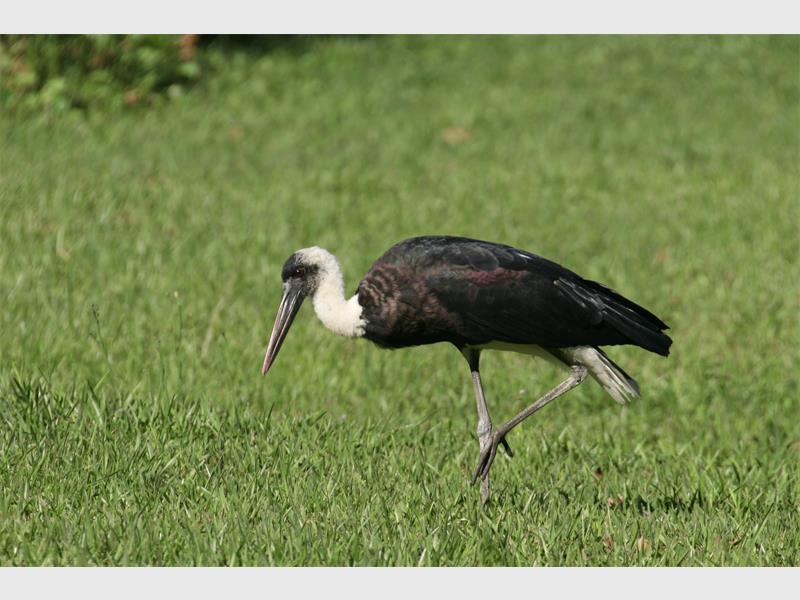
Description
The Woolly-necked Stork is a fairly large bird and adults are usually 85cm tall. It is predominantly black, except for the woolly white neck and white lower belly. The upper parts are a shiny dark green. Juvenile birds are very similar but their colours are dull.
Behaviour
They are usually alone and can be seen walking slowly and methodically on the edges of ponds where they hunt for prey. As with many other bird species, they are often attracted to termite emergencies. Although not very gregarious, they can occasionally gather in groups at the water’s edge or on trees. Woolly-necked storks can be often seen standing motionless for long periods.
Diet
They are mainly carnivorous as their diet consists of fish, frogs, toads, snakes, lizards, large insects and larvae, crabs, molluscs and marine invertebrates. They forage by slowly walking through water or vegetation, stabbing at prey with their long beaks.
Breeding
They are monogamous and usually build a single nest but groups of eight to 10 birds may form a small colony. Both the male and the female build the nest which consists of a platform of sticks and a central bowl that is often lined with twigs, green leaves and grass. They do like to keep out of harm’s way, so the nests are usually placed higher than 10m above the ground.
ALSO READ: Chirping with Kloof Conservancy: The Trumpeter Hornbill
Egg-laying season is from August to December and the female lays between two to four eggs during this period. Both partners incubate the eggs for a period between 30 to 31 days. Both parents also feed and look after the chicks, which start move out the nest after about 55 to 65 days. They become fully independent after about four months.
Distribution
They are found in many parts of the world from India and Sri Lanka to the Philippines, as well as in sub-Saharan Africa. In South Africa they are found on the Eastern section from Limpopo Province to KwaZulu-Natal.
Habitat
They enjoy living close to wetlands, including estuaries and mangrove swamps, where they find most of their food. They have also become accustomed to using areas modified by humans such a golf courses and sports fields.
Threat
Not threatened globally, although they are near-threatened in South Africa due to low population numbers that is largely caused by habitat destruction.
Interesting facts
Like most stork species, they perform noisy bill-clattering courtship displays. They can also make very noisy calls when at the nest and the scientific name Episcopus means bishop and is derived from the black skullcap typically found on these birds.
ALSO READ: Chirping with Kloof Conservancy – The African Crowned Eagle
Local information
Apart from an occasional migrant bird, these birds were hardly ever seen in the Upper Highway area until a few years ago. Since about 2008, the numbers have steadily increased and there are now a number of permanent resident birds in the area. We are not sure why this has occurred, but it may be related to the availability of food as it is plentiful in our area.
Many residents have taken to feeding the birds and some birds even enter homes to collect food scraps. As a general rule, we strongly advise that wildlife, including birds, should not be fed. Feeding of wildlife by humans alters the animal’s behaviour and may also upset the natural eco-system that the animal is part of. In the specific case of Woolly-necked Storks, there have been well documented cases where the offspring have been unhealthy and even perished as result of being fed processed meat, particularly polony.
There are a number of nest sites in the area and an easy one to spot is in a pine tree at the intersection of Alamein Avenue and Buckingham Road in Kloof. The birds have nested at this site for more than four years now and are likely to nest again as soon as the breeding season begins.
Visit www.kloofconservancy.org.za or follow the NPO on Facebook at www.facebook.com/KloofConservancy
Caxton Local Media Covid-19 reporting
Dear reader,
As your local news provider, we have the duty of keeping you factually informed on Covid-19 developments. As you may have noticed, mis- and disinformation (also known as “fake news”) is circulating online. Caxton Local Media is determined to filter through the masses of information doing the rounds and to separate truth from untruth in order to keep you adequately informed. Local newsrooms follow a strict pre-publication fact-checking protocol. A national task team has been established to assist in bringing you credible news reports on Covid-19.
Readers with any comments or queries may contact National Group Editor Irma Green (irma@caxton.co.za) or Legal Adviser Helene Eloff (helene@caxton.co.za)

Do you want to receive alerts regarding this and other Highway community news via Telegram? Send us a Telegram message (not an SMS) with your name and surname (ONLY) to 060 532 5409.
You can also join the conversation on Facebook, Twitter and Instagram.
PLEASE NOTE: If you have signed up for our news alerts you need to save the Telegram number as a contact to your phone, otherwise you will not receive our alerts.
Here’s where you can download Telegram on Android or Apple.