Chirping with Kloof Conservancy – Grey-headed Bushshrike
Find out more about this feathered Highway resident below.
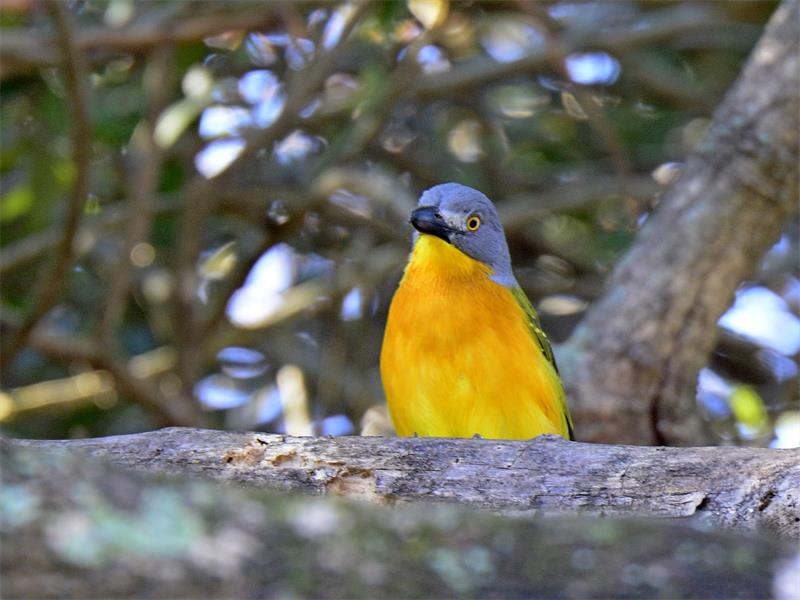
THE Grey-headed Bushshrike is a very beautiful Highway resident species that is more often heard than seen. If you are lucky enough to spot it, you will be well rewarded.
ALSO READ: Chirping with Kloof Conservancy – Black Saw-wing
Description
It is relatively large for a shrike, at 26cm and weighs about 77g. As the name suggests, it has a distinctive grey head but it is the striking yellow and rich orange colours on the chest that will catch your eye. The wings are also an attractive olive green. The eyes are striking, large and yellow while the bill is very strong and bulky.Males and females are very similar with the females being just a bit duller.
The Grey-headed Bushshrike can be confused with the Orange-breasted Bushshrike, which is much smaller and does not have a full grey head. The bill of the Orange-breasted Bushshrike is also not as ‘heavy’ as that of the Grey-headed Bushshrike.
Distribution
It is found in the lusher parts of South Africa along the eastern section from Gqeberha northwards but also in the Northwest and Gauteng provinces.
Habitat
The preferred habitat of the Grey-headed bushshrike is in well wooded areas so in the Highway area you will find it along the riverine forests and in gardens with lots of trees.
Feeding
The Grey-headed Bushshrike feeds mainly on insects and other invertebrates.
It will feed up in a tree or down on the ground so that gives it many hunting opportunities and as a result it has a varied diet and it will opportunistically take lizards, snakes and even other small birds.
Breeding
The Grey-headed Bushshrike is a monogamous species and pairs for life. They tend to build their nest away from other shrikes.
Nest building is done by both adults with the female doing the finer detail.
The preferred spot for building a nest is on a fork or a branch of a deciduous tree, preferably a thornless one. The female lays between two to four eggs, which take between 15 to 21 days to hatch.
Predators and threats
The Grey-headed Bushshrike is listed by the The International Union for Conservation of Nature (IUCN) as a species for which there is ‘least concern’ and it is not subject to any significant threats other than the destruction of riverine forests for human habitation.
Local information
As the Grey-headed Bushshrike loves forests and trees, look for it in your garden (if it’s well wooded) or take a walk along one of our many riverine forests.
Interesting facts
The Grey-headed Bushshrike has a very distinctive call. The call is a low-pitched, long and very mournful ‘whhoooooooo’, which it can repeat up to 50 times in succession so it is hard to miss once the bird starts calling. In Afrikaans the bird is known as the ‘Spookvoel’ or ghostbird because of its spooky call.
Caxton Local Media Covid-19 reporting
Dear reader, As your local news provider, we have the duty of keeping you factually informed on Covid-19 developments. As you may have noticed, mis- and disinformation (also known as “fake news”) is circulating online. Caxton Local Media is determined to filter through the masses of information doing the rounds and to separate truth from untruth in order to keep you adequately informed. Local newsrooms follow a strict pre-publication fact-checking protocol. A national task team has been established to assist in bringing you credible news reports on Covid-19. Readers with any comments or queries may contact National Group Editor Irma Green (irma@caxton.co.za) or Legal Adviser Helene Eloff (helene@caxton.co.za).
At the time of going to press, the contents of this feature mirrored South Africa’s lockdown regulations.
 Do you want to receive alerts regarding this and other Highway community news via Telegram? Send us a Telegram message (not an SMS) with your name and surname (ONLY) to 060 532 5409. You can also join the conversation on Facebook, Twitter and Instagram. PLEASE NOTE: If you have signed up for our news alerts you need to save the Telegram number as a contact to your phone, otherwise you will not receive our alerts. Here’s where you can download Telegram on Android or Apple.