Step aboard Durban’s maritime past at Port Natal Maritime Museum
Nestled in the heart of Port Natal stands the Durban Maritime Museum, a portal to centuries of seafaring adventure, trade, and the relentless spirit of exploration that shaped both city and country. Explore the rich maritime heritage at the Port Natal Maritime Museum, and let the stories of the sea captivate your imagination.
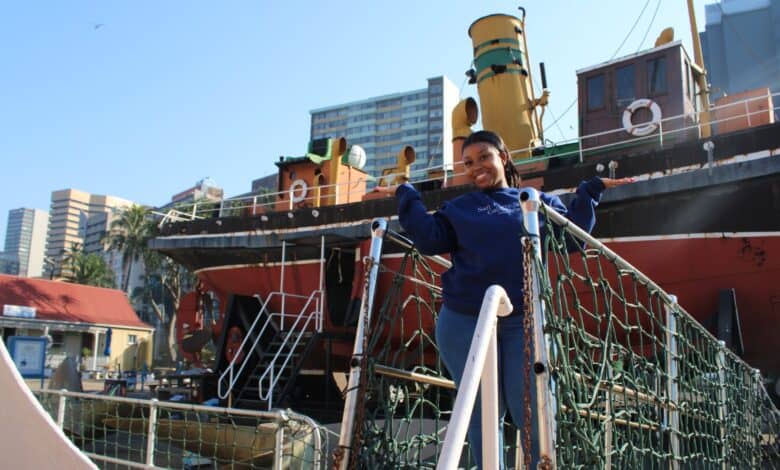
WITH its panoramic view of Durban Harbour, the Port Natal Maritime Museum offers a captivating journey into the maritime history that has shaped the local culture and economy of eThekwini.
Situated near the Victoria Embankment, the museum is a collection of multi-ton floating vessels, including the tug boats Ulundi and the JR More, and the Britania Room which tells a tale of the life at sea. As you enter the gates of the museum, at the cost of R10, you are greeted by the majestic JR More, a steam-powered tug.

Before you can get to the anchored floating vessel, you are welcomed by the statue of Durban’s Lady in White, aka Perla Siedle Gibson. Immortalised into history, the Lady in White was a living legend known to allied soldiers as the motherly figure who bid them farewell before setting sail for war. She would sing songs like Land of Hope and Glory and It’s a long way to Tipperary”, from April 1940 to August 1945.
Gibson’s statue stands in between the now land-based Ulundi, the oldest surviving pilot tug in South Africa which began its service in 1927 in Algoa, and the JR More. These vessels are not just displays; they are stories waiting to be discovered, each with its own unique history and contribution to maritime heritage.
Also Read: The Old House Museum: A house where time stood still

Inside the JR More you are transported back to the yesteryears of life at sea. The main deck leads you onto a winding path of the crew’s quarters, the mess room, control room and the well-preserved towing engine room. Further exploration reveals the humble living quarters of the crew — compact yet functional spaces that hint at the camaraderie and endurance of life at sea. The crew’s quarters still have the narrow bunks that are tucked against the walls, while lockers and benches provide meagre storage and seating. The small kitchen space is equipped with coal-fired stoves, battered pots, and crockery evocative of hearty meals prepared for a hungry crew.
Adjoining the galley is the mess room, where simple wooden tables and benches suggest late-night card games, shared meals, and laughter echoing against the steel planking. Descending further down the narrow and steep staircase, visitors encounter the cargo hold — a space once teeming with ropes, tools, and supplies essential for harbour work. A dedicated corner is set aside as the engineer’s workshop, complete with vintage tools, spare parts, and diagrams pinned to the bulkheads.
Also Read: Watch: Discover the wonders of the Durban Natural Science Museum

These displays blend historical facts with personal stories — anecdotes from former crew, archival photographs, and ship’s logs that reveal the vessel’s many adventures in Durban’s harbour and beyond. At the back of the museum is the Britannia Room, a standalone building, where upon entry one is greeted by an impressive array of ship models — meticulously crafted, their sails frozen mid-billow, their decks alive with tiny, detailed figures.
These models chart the evolution of vessels that have passed through Port Natal, from Zulu fishing canoes and Portuguese caravels to the mighty British steamships that once ruled the waves.

For maritime enthusiasts, themed workshops and guest lectures delve deeper into subjects from celestial navigation to the history of naval warfare. There is a section dedicated to Durban’s history on whaling and the birth of the bustling Port of Natal. Special exhibitions draw attention to the challenges of pollution, overfishing, and climate change, empowering visitors to become stewards of the ocean.

The Port Natal Maritime Museum is more than just a museum; it is a celebration of the maritime spirit that has been integral to Durban’s history. Whether you are a maritime enthusiast, a history buff, or simply looking for an educational outing, the museum promises an unforgettable experience filled with exploration, fun, and learning. To enter the museum costs R10 for adults and R5 for kids. It is open Monday to Saturday, 08:30 to 16:00 and on Sunday and public holidays it’s 11:00 to 16:00. For more information, contact 031 322 9598 or 031 311 2230/1.
For more from the Highway Mail, follow us on Facebook , X and Instagram. You can also check out our videos on our YouTube channel or follow us on TikTok.
Click to subscribe to our newsletter here