Chirping with Kloof Conservancy – The Olive Sunbird
Find out more about this feathered Highway resident below.
Kloof Conservancy
IN this week’s edition we feature what is arguably the least attractive of all our sunbird species, but the Olive Sunbird makes up for that with its very beautiful and melodious song.
Also read: Chirping with Kloof Conservancy – Lesser Honeyguide
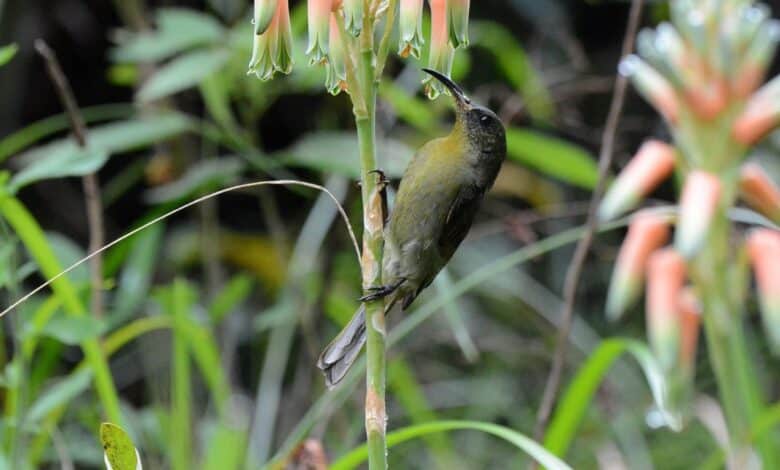
Description
A typical medium sized sunbird profile with uniform drab olive-green colouring. Male and females are very similar in colouration and are 12 to 15cm in length with a weight of approximately 12g – the male is marginally larger. Typical of most sunbirds they have pectoral tufts – yellow for this species – which are visible, particularly in males when they are displaying to attract females or defending their territory.
Distribution
The Olive Sunbird is found only in a relatively narrow strip on the eastern side of South Africa from East London to the Mozambique border.
Habitat
This is a forest dwelling species found primarily in evergreen coastal forest but in our area it has also adapted to well-treed urban gardens.
Feeding
The Olive Sunbird is primarily an insectivore feeding on ants, spiders and caterpillars. Like all sunbirds it has a very long curved beak which is designed to feed on nectar with wild banana and tree fuchsia among its favourite plants.
Breeding
This species is monogamous and pairs for life. The nest is an elongated, bag-shaped nest made of various plant materials as well as spider webs. The nest usually hangs from understory branches not far off the ground. The nest is built by the female only who lays one to three eggs anytime from spring to late summer. The feeding of the chick is done by both parents.
Predators and threats
Deforestation is the biggest threat to the Olive Sunbird and although currently listed as Least Concern by the The International Union for Conservation of Nature, the rapid rate of deforestation, particularly in the northern areas of its range, pose a threat.
Local information
You are most likely to find the Olive Sunbird in your garden if you have nectar-producing plants such as aloes, wild dagga and tree fuchsia. You may hear their beautiful song more often than see them as they are elusive and don’t stay still for very long!
Interesting facts
Olive sunbirds generally cannot hover when feeding on nectar, so they tend to “sit” on the plant they feed on. This results in their heads and beak area becoming dusted with pollen which they then spread, making them important pollinators for indigenous plants.
For more from the Highway Mail, follow us on Facebook , X and Instagram. You can also check out our videos on our YouTube channel or follow us on TikTok.
Click to subscribe to our newsletter here