
Mini maths mastermind smashes international abacus competitors
"I'm very grateful that my parents offered me the opportunity to be able to compete internationally."
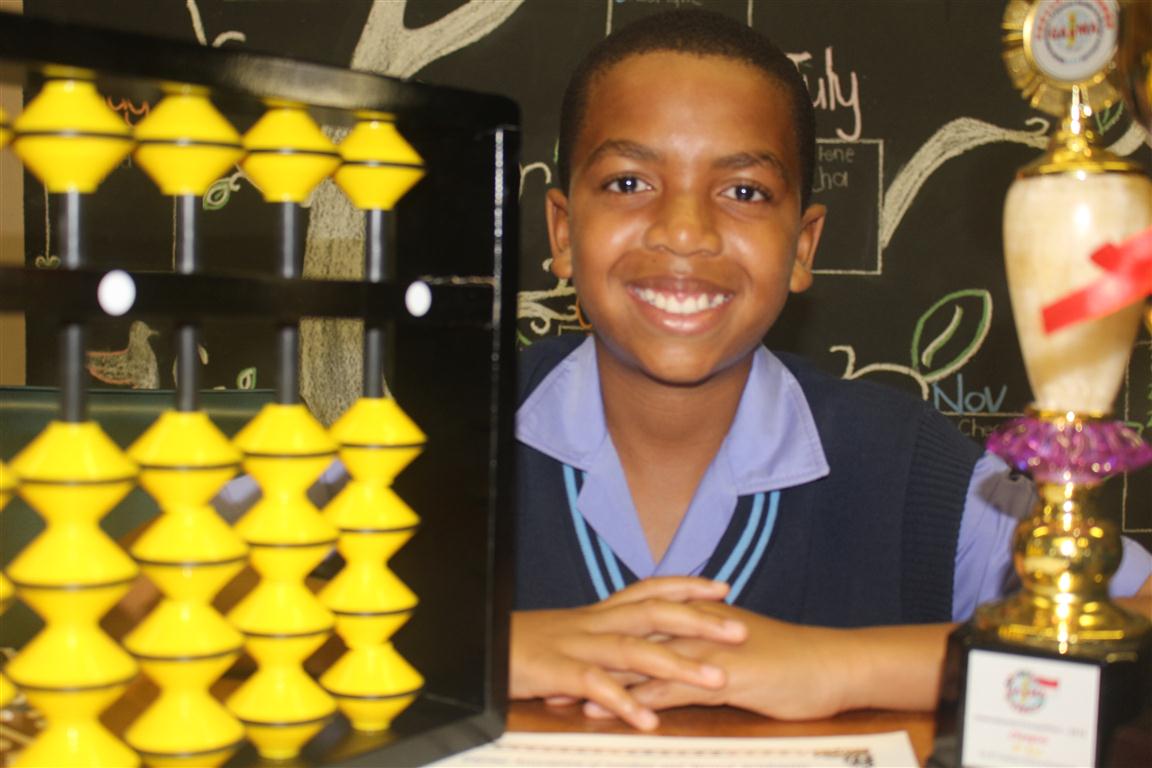
A young mathematics mastermind recently had the incredible opportunity to travel to Singapore to compete in the International Soroban and Mental Arithmetic competition.
Ofentse Diale, a Silverfields Primary School learner made headlines when he finished second in his category. He was awarded the second place champion trophy.
Ofentse represented South Africa and made his country proud by finishing the two- and six-minute abacus tests speedily and accurately.
He started abacus lessons from the age of four and has since become a pro at shifting the yellow beads up and down and creating a mental image of the numbers he counted together.
It was Ofentse’s first trip overseas and he said the flight was very long. “But I enjoyed it because it’s a very clean country and the people are very kind and helpful,” Ofentse said.
“I’m very grateful that my parents offered me the opportunity to compete internationally.”
When asked about his friends’ reaction to his mathematics abilities, Ofentse replied,
“They think it’s weird that I can do maths on a thing that doesn’t even have numbers”.
His teacher, Sharné Bresler, who is also the owner of Abacus Maths, said Ofentse has a lot of potential and has an incredible mathematics mind.
“Our motto is ‘Making children count’ and we believe teaching children how an abacus works contributes to their eventually figuring out things on their own,” Sharné said.
“We teach children the language of maths. Since maths is an abstract concept, we try to add understandable language to the abstract terms.”
There are about 1 500 pupils on the West Rand who practice abacus maths.
They are required to work on a Japanese abacus that has 57 concepts, which needs to be grasped before they are able to use them to their full potential. The competition ran over a period of a week.
Mental maths has grown in popularity over the past few years and many studies have shown that it improves pre- and primary school children’s mathematics skills by up to 40 per cent.
Twenty eight South Africans participated in this competition in Singapore and four of them achieved a first places in their respective categories.
Four contestants received gold medals, seven received silver, and two received bronze medals.
Also read:
From little ones to A-plus geniuses
Mathematician gives the gift of numbers
What happened before Alice fell down the rabbit hole?
Why do gold medalists bite their medals?