No bees, no food
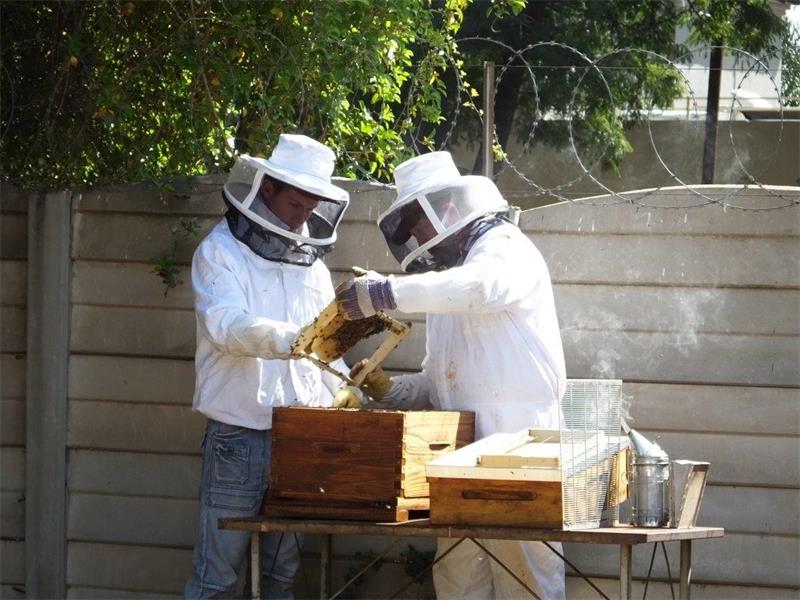
Johann founded the "Sponsor a bee-hive" project that enables community members to help sustain Krugersdorp's favourite 'food farmers'.
Recent research has shown that the worldwide bee population has declined by almost 70 per cent.
Considering that bees are responsible for pollinating crops that supply 80 per cent of the food we eat, this fact should shock consumers on a global scale.

Photo: supplied
Instead of sitting back and waiting until it is too late, Johann Marx, an Orion Apiary beekeeper, has started an initiative that teaches ordinary citizens from Krugersdorp and its surrounding areas about helping bees.
Johann founded the “Sponsor a bee-hive” project that enables community members to help sustain Krugersdorp’s favourite ‘food farmers’.
The bee hives are bought by the community. Once you have bought your own hive, Johann populates it, numbers it and puts it in a fixed hive site were the bees can produce honey and pollinate the environment around it. The bee-hive is yours for roughly 36 months and you can visit it at any time, with the beekeeper. After that period you have the option of selling your bee-hive to the project, or re-investing your ‘honey money’ by buying another hive. The project also has a donation option.
“As soon as this collective effort has enough hives, we will start providing pollination services,” Johann said.
“Some hive sponsors have already indicated that they want to become more involved and get ‘hands-on’ with the bees.”

Photo: Supplied
The project has been a success thus far and some of the hive sponsors have already started assisting with bee removals and relocations. However, as with any project, continuous support is always necessary.
Internationally, the majority of farmers understand the value of bees pollinating their crops and they have standing contracts with beekeepers to provide such services. In South Africa, however, it does not seem to be the same. The biggest problem seems to be vandalism of bee-hives.
“Poverty and unemployment causes destitute people to vandalise bee-hives for honey. Sometimes the entire hive is destroyed for firewood. This makes it very difficult for a beekeeper to place hives next to a farmer’s crops, only to find a number of hives stolen or destroyed soon after.”
The project is not just one man’s effort – it’s a collective effort by everyone who wants to help the bees to prosper, because if they do, so do we. A good example of this team effort orchestrated by Johann, is the Krugersdorp Lions Club, which has sponsored 15 hives. The hives are in the process of being populated.
“Our club chooses its own projects,” said Ivan du Plooy, the President of the Krugersdorp Lions Club.
“We help the blind, the youth, and the hungry. We plant trees and do fundraising to pay for our projects. The environment is one of our core projects and that is why we got involved with saving the bees. Saving the bees will be one of our main projects going forward.”
Michelle Kruger, a Miss South Africa semi-finalist, is also part of this effort to save the bees.
For more information or to sponsor a bee-hive, contact Johann Marx on 076 200 0771 or Lynette Visser on 079 459 7086 or visit the Sponsor a bee hive Facebook page at https://www.facebook.com/Orion-Apiary-Beekeeper-Byeboer-1565118990458004/

Photo: Supplied
Related articles
Bee disease threatens food production