
Today 72 years ago an atomic bomb was dropped
The bomb nicknamed Little Boy with about 64kg of uranium-235 produced a blast the equivalent of about 13 kilotons of TNT.
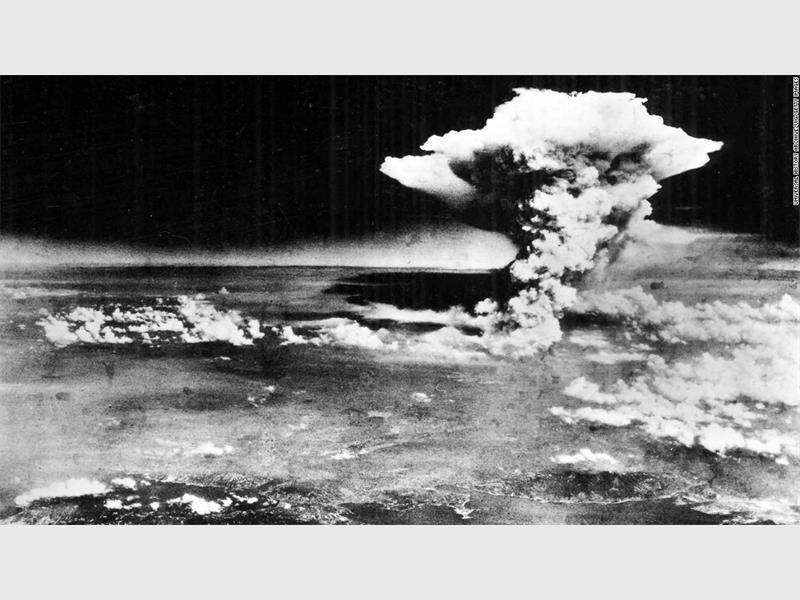
On 6 August, 1945, an atomic bomb containing more power than 12 000 tons of TNT and producing more than 2 000 times the blast of the most powerful bomb ever dropped before, was dropped on the city of Hiroshima, killing an estimated 140 000 people in the first use of a nuclear weapon in warfare. The bomb, nicknamed Little Boy, containing 130 pounds (about 64 kgs) of uranium-235 produced a blast equivalent to that of about 13 kilotons of TNT.
At the time of its bombing, Hiroshima was a city of both industrial and military significance. A number of military units were located nearby, the most important of which was the headquarters of Field Marshal Shunroku Hata’s Second General Army, which commanded the defence of all of southern Japan, and was located in Hiroshima Castle.
Hata’s command consisted of some 400 000 men, most of whom were on the island of Kyushu where an Allied invasion was correctly anticipated.
Hiroshima also housed the headquarters of the 59th Army, the 5th Division and the 224th Division, a recently formed mobile unit. The city was defended by five batteries of 7cm and 8cm (2,8 and 3,1 inch) anti-aircraft guns of the 3rd Anti-Aircraft Division, including units from the 121st and 122nd Anti-Aircraft Regiments and the 22nd and 45th Separate Anti-Aircraft Battalions.
In total, an estimated 40 000 Japanese military personnel were stationed in the city.
Hiroshima was the primary target of the first nuclear bombing mission on 6 August, with Kokura and Nagasaki as alternative targets. Having been fully briefed under the terms of Operations Order No 35, the 393d Bombardment Squadron’s Boeing B-29 Superfortress heavy bomber, named Enola Gay, and piloted by Colonel Paul W Tibbets, took off from North Field, on Tinian Island, about six hours’ flight time from Japan. The Enola Gay (named after Tibbets’ mother) was accompanied by two other B-29s. The Great Artiste, commanded by Major Charles Sweeney, carried instrumentation, and a then-nameless aircraft later called Necessary Evil, commanded by Captain George Marquardt, served as the photography aircraft.
At 8.09am, Tibbets started his bomb run and handed control over to his bombardier, Major Thomas Ferebee. The release at 8.15am (Hiroshima time) went as planned, and Little Boy, containing about 64kg of uranium-235 took 44,4 seconds to fall from the aircraft flying at about 9 400m to a detonation height of about 580m above the city. Enola Gay travelled 18,5km before it felt the shock waves from the blast.
The Enola Gay stayed over the target area for two minutes and was about 16km away when the bomb detonated. Only Tibbets and Ferebee knew the true nature of the weapon; the others on the bomber were only told to expect a blinding flash and given black goggles to protect their eyes.
“It was hard to believe what we saw,” Tibbets later told reporters.
On 9 August 1945, America dropped the second atom bomb on Nagasaki, effectively ending World War 2 as Japan announced its surrender.
Do you perhaps have more information pertaining to this story? Email us at krugersdorpnews@caxton.co.za or phone us on 011 955 1130.
For free daily local news on the West Rand, also visit our sister websites:
Remember to visit our Facebook, Twitter and Instagram pages to let your voice be heard!