
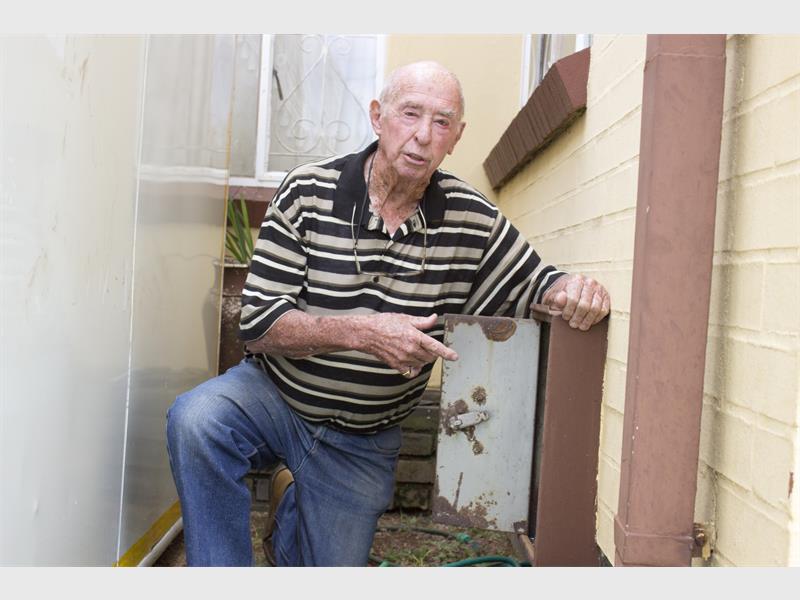
Many residents may have old and rusted electricity meters in their homes right now.
Billie Adlem, who calls himself a meter expert, spoke to the News about how most analogue electricity meters in homes use a magnet and spin wheel to measure the amount of electricity used per month. The faster the wheel spins, the more electricity is being consumed. In basic terms, the flow of electricity turns the wheel, and the magnet slows it down to provide an accurate reading.
“After about three years it starts losing its magnetism and the bottom bearing locks. Initially the bearing fits tightly, but if it begins to lock it starts loosening, causing the wheel to spin a lot faster than it should,” Billie explained.
Billie visited Emma (who preferred to use a pseudonym) one day and asked what was going on with her electricity bill. She had been paying about R7 000 a month on a premises with only four occupants. Billie checked the meter outside and noticed it was fairly old. The municipality reportedly quickly sent someone out to install a new meter.
Billie used to work for the municipality decades ago, replacing and refurbishing electricity meters every three to four years. He claimed that some of the meters in use in Krugersdorp hadn’t been changed in 20 years.
Also Read:
https://www.citizen.co.za/krugersdorp-news/405895/power-supply-termination-postponed-for-west-rand-power-distributors/
Emma noted that since she witched to a prepaid meter, her electricity bill has come down to about R2 500.
“Who in this country can’t do with an extra R4 000?”
Billie has now ordered the correct equipment to test these meters. He noted that it’s as simple as unplugging the stove, plugging in the instrument and taking a reading.
He has retired, but is willing to drive out to any home for a fee of between R200 and R500 to test a meter and give his opinion as to whether a new meter is needed. He will be able to estimate the amount the household may be paying unnecessarily. Billie can be contacted on 082 442 4576.