
Forgotten war memorial remembered
Heritage advocate Jaco Mattheyse revisits Krugersdorp’s forgotten war memorial and the remarkable individuals who helped create it.
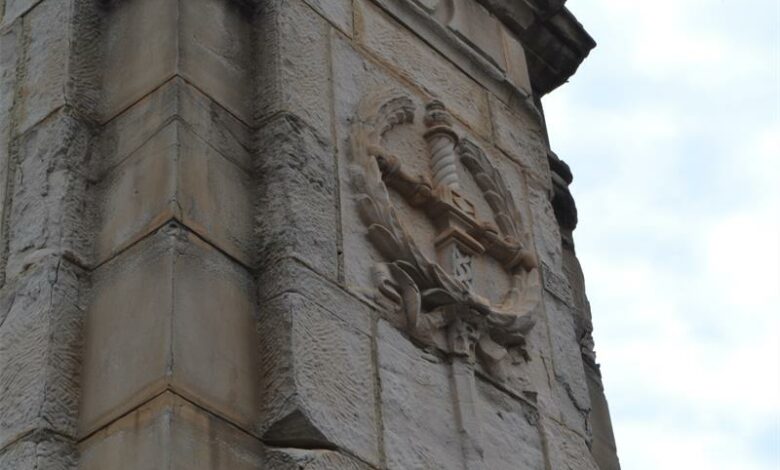
In the 16th edition of Echoes of Krugersdorp, produced in partnership with the Krugersdorp Heritage Association (KHA), we pause to honour the brave men who gave their lives during the First and Second World Wars.
Co-founder of the KHA, Jaco Mattheyse, said it is fitting to reflect on a war memorial in Krugersdorp that has sadly faded from public memory.
The end of the Great War
The First World War ended at 11:00 on November 11, 1918, after four years of unimaginable bloodshed. In its aftermath, the Union of South Africa mourned more than 19 000 casualties – over 7 000 dead and 12 000 wounded.
Jaco said eight South Africans were awarded the Victoria Cross for gallantry, the highest and most prestigious military honour of the British Empire.
• Also read: Die Herberg Hotel: A legacy that died in flames?
Krugersdorp’s tribute to the fallen
Following what was then called the Great War, many towns across South Africa, like communities around the world, chose to commemorate their fallen sons who went to war and never returned. Krugersdorp was no exception.
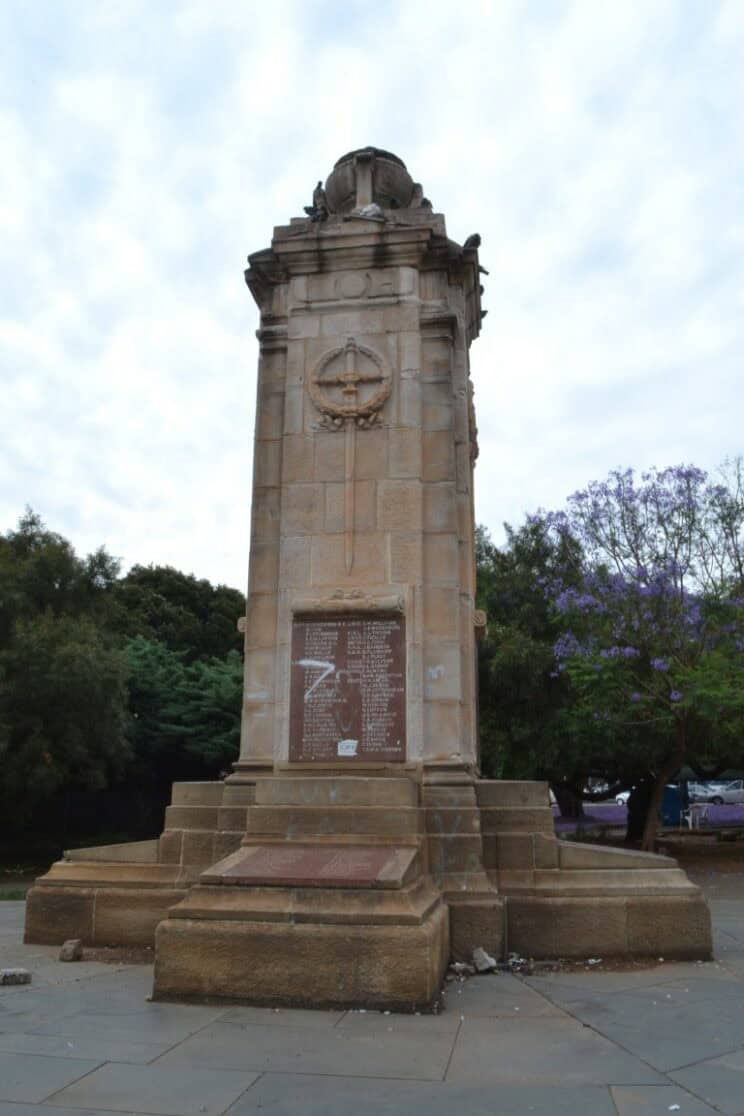
He explained that funds for a monument were raised through public subscription, and by the early 1920s, it was decided that the memorial would be erected in the park and gardens in front of Town Hall, built in 1908 on the Market Square. Positioned at the end of Monument Street, it formed a dignified focal point leading towards Town Hall.
• Also read: Echoes of Krugersdorp: More than a century of history at Monnas
The architects and builders
The architectural firm Solomon & Marshall was commissioned to design the monument, with Harold Wolseley Spicer responsible for the final design.
Jaco continued that work progressed rapidly, and the cornerstone was laid on May 6, 1922, by Lieutenant General Sir Jacob Louis van Deventer.
Who was Lieutenant General Sir Jacob Louis van Deventer?
Born in Ficksburg in 1877, Van Deventer began his military career in the South African Republic’s Army in 1896 and fought in the Second Boer War.
“Standing nearly two metres tall, he was a formidable man known for his skill in guerrilla warfare. Serving under General Jan Smuts, he was second in command during the Cape Colony invasion. A serious wartime injury affected his speech, but not his leadership,” Jaco said.
• Also read: Echoes of Krugersdorp: Exploring Saint Peter’s Church
During the First World War, Van Deventer returned to military service, commanding Union Defence Force units in the South West African campaign and later leading all British Imperial forces in East Africa from 1917 to 1918. Jaco believed that despite his limited English, he earned great respect and was twice knighted for his service.
“In 1921, he was made a Grand Officer of the Portuguese Order of Aviz and, the following year, led forces during the suppression of the Rand Rebellion on the Witwatersrand. After he laid the Krugersdorp War Memorial’s cornerstone, he sadly passed away just three months later, on August 17, 1922, in Pretoria.”
Sir Abraham “Abe” Bailey and the unveiling
The completed memorial was unveiled on July 15, 1922, by Sir Abraham ‘Abe’ Bailey, a well-known mining magnate and philanthropist.
Born in Cradock in 1864, Bailey rose to prominence as a mining pioneer, politician, and sportsman. After moving to Johannesburg in 1896, he joined the Reform Committee and was later arrested for high treason following the Jameson Raid, escaping execution by paying a fine of £2 000 (about £340 018 today, amounting to R7.73m). Jaco explained that during the Anglo-Boer War, he served as an intelligence officer under Lord Roberts and personally financed the formation of the South African Light Horse in 1900.
• Also read: Echoes of Krugersdorp: Discover the legacy of Fort Harlech
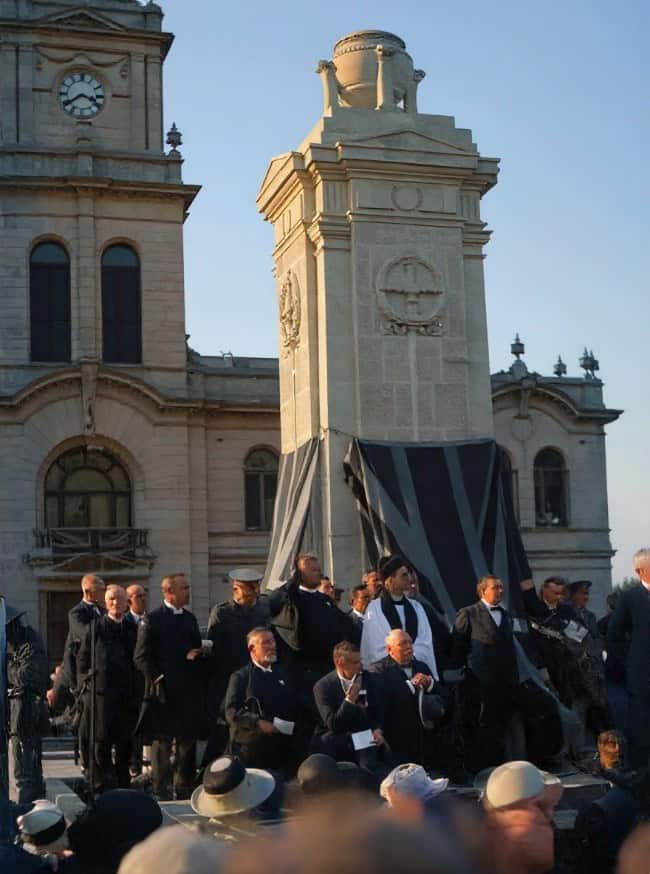
Bailey served in the Cape Legislative Assembly and later the Union Parliament, where Jaco described that he contributed generously to local causes. In Krugersdorp, his donations included the Town Hall clock (1908) and the new façade of the Methodist Church in Burger Street (1910). He died in Muizenberg in 1940.
The memorial and its meaning
The inscription on the Krugersdorp War Memorial reads:
“Sacred to the memory of our gallant dead who fell in the Great War 1914–1918.”
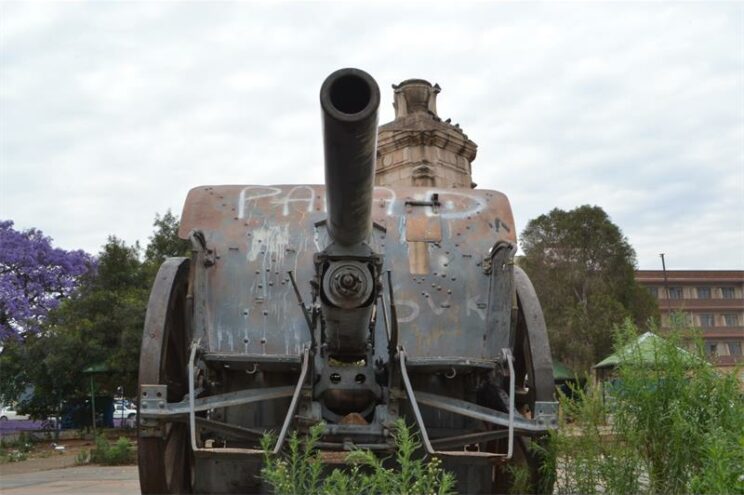
A 15-pounder cannon, captured from the Germans in Flanders in 1917, was also installed near the memorial. After the Second World War, the names of the soldiers who died were added to those from the First World War.
Relocation and decline
Jaco stated that during later urban redevelopment, a block of Monument Street was closed to traffic and transformed into a pedestrian park and car park adjacent to the Krugersdorp Public Library. The memorial and cannon were relocated to a new position at the upper end of the street.
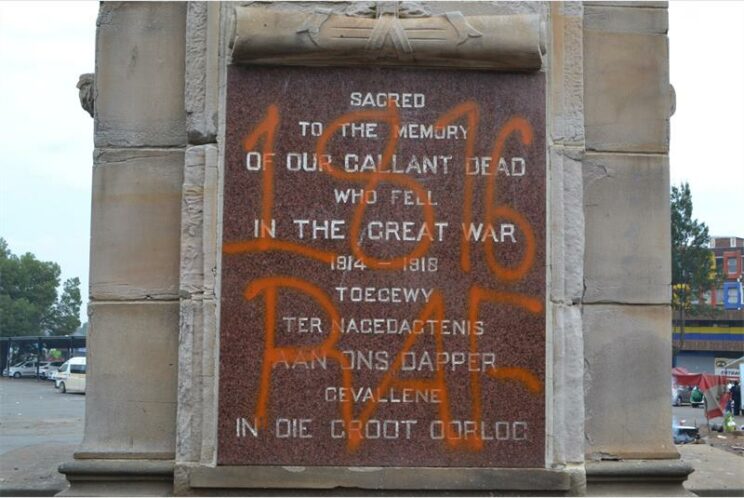
“Sadly, this once-proud monument now stands neglected and vandalised – a silent witness to the town’s fading memory of those who made the ultimate sacrifice. Although attempts have been made over the years, a restoration effort has yet to be forthcoming,” he concluded.