Die Herberg Hotel: A legacy that died in flames?
Remembering Die Herberg Hotel: A historic landmark lost to fire but not to history.
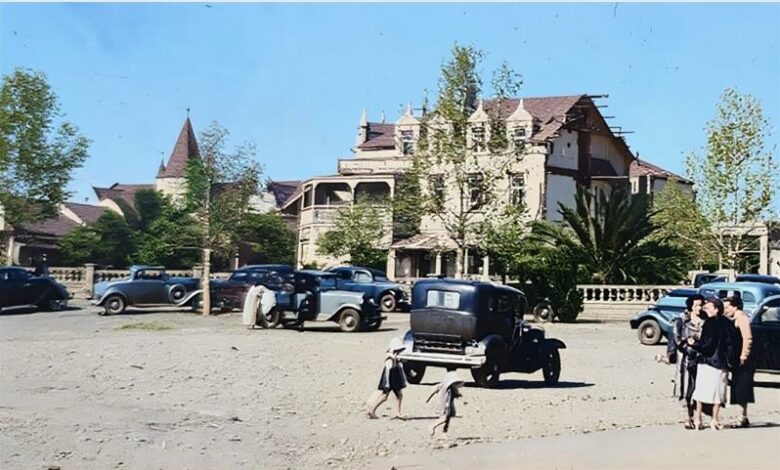
In the 15th edition of Echoes of Krugersdorp, produced in partnership with the Krugersdorp Heritage Association (KHA), we explore the history of Die Herberg Hotel to pay tribute to the building following the recent disaster.
Focus on Thomas Klonovski
KHA co-founder Jaco Mattheyse said the focus is on Waclaw Thomas von Klonovski, one of the most fascinating and controversial figures Krugersdorp has ever known, and his lasting contribution not only to the town but also to South Africa as a whole.
Widely known as Thomas Klonovski, Jaco said he arrived in the Transvaal Republic from Poland sometime during the 1880s and was a chemist by profession. His name first appeared in Pretoria, and after the discovery of gold on the Witwatersrand, he moved to the small but rapidly growing mining town of Krugersdorp.
• Also read: Fire-ravaged Die Herberg Hotel declared unsafe for use
Establishing Krugersdorp’s first pharmacy
Around 1888 to 1889, he established the town’s first pharmacy in Ockerse Street, and by the late 1890s, his business had become so successful that he commissioned one of the town’s leading building contractors, Robson & Holton (who later also constructed the Town Hall), to construct a grand new building in 1897. Jaco added that it cost about £12 000 back then to construct (around R23m in today’s money).

The chosen site was on the corner of Markt (now Market) and Kommisaris (now Commissioner) streets, overlooking the town square.
“This was one of the most desirable blocks in Krugersdorp at the time, as Ockerse Street was the town’s busiest commercial thoroughfare,” Jaco explained.
• Also read: Fire ravages Die Herberg Hotel in CBD – no casualties
The Klonovski building
“The Klonovski Building occupied roughly three stands, facing north. It was a three-storey structure, likely with a basement. The ground floor housed the pharmacy on the corner and several shops, the first floor was designed for office tenants, and the attic level, with its characteristic dormer windows, offered rooms for rent – probably used as accommodation,” he described.
When completed, the Klonovski Building was the largest in Krugersdorp. Together with the Macloskie & Te Water Building (where the wheel shop now stands) across the corner, it was among the tallest, offering sweeping views across the sandy open square toward the hills where the Paardekraal Monument stood. A photographer was employed soon after completion to climb onto the roof and photograph the town, one of our earliest records of Krugersdorp during the Second Anglo-Boer War.
@caxton.jhbwest Residents stand by while the historic Herberg Hotel, based on the corner of Market and Commissioner Street, burns. Firefighters work tirelessly into the night to extinguish the blaze. #fyp #fire #krugersdorp #firedepartment

Von Klonovski’s other roles
At this time, Von Klonovski also served as a member of the first Pharmaceutical Board in the Transvaal and was involved in the procurement of arms for the State Artillery. Jaco added that he appeared to have been a member at the outbreak of the Second Anglo-Boer War in 1899. Jaco believes there is some evidence suggesting questionable dealings, and it is likely that some of the weapons were stored in the building’s basement.
• Read the initial article here: Well-known hotel in Krugersdorp CBD ablaze
After the war ended in 1902, Jaco also believes that Von Klonovski decided not to return to Krugersdorp, possibly unwilling to swear an oath of allegiance to the new British government. The last known record of him appears in 1907, listing him as a pharmacist in Cleveland, USA.
However, his name also appeared in a Melbourne newspaper in 1903, which reported that he was summoned to South Africa after Robson & Holton sued him for an outstanding debt related to the construction of his building. The amount owed was £156, 7 Shillings, 6 Pence, (around R286 130 in today’s money), which a representative later settled in the Pietermaritzburg court in April 1904.
Changes to the building
“Afterwards, the building changed ownership and some alterations were made to the façade, like the construction of a cast-iron stoep wrapping around the corner on two floors, plastering the façade, and the removal of the original corner balcony and the tower. The well-known firm of Thompson and Calvert opened its own pharmacy on the corner. When the Victoria Hotel opened its doors in the 1930s, half of the Commissioner Street façade was demolished and replaced with a stylish Art Deco wing. This new addition complemented the contemporary facelift of the Macloskie & Te Water Building, undertaken by the Dadoo family.”
The hotel continued to flourish after Dr Pretorius purchased the building and renamed it Die Herberg during the later decades of the 20th century. The pharmacy was eventually replaced by other shops, and in more recent years, a takeaway store occupied the ground-floor corner.
Decline and recent disaster
“Sadly, in recent times, the building has fallen into disrepair and neglect, and the hotel’s reputation has become somewhat disreputable. The Krugersdorp Heritage Association mourns the decline of this once-proud landmark – a true icon of our town’s history,” he said.
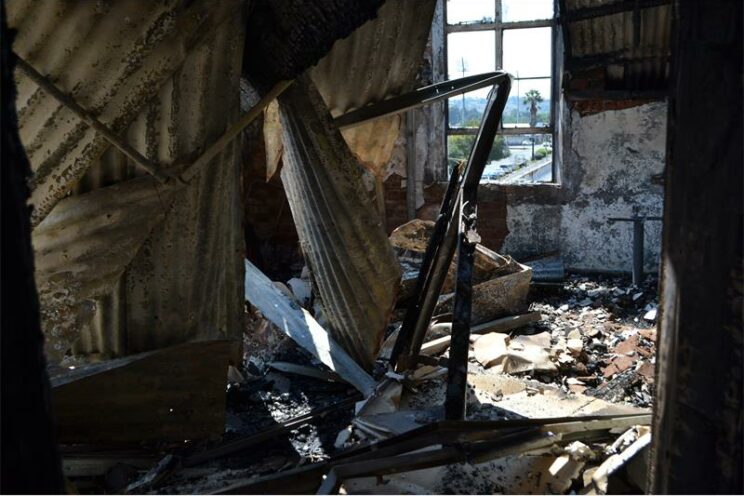
Unfortunately, on October 13, this historic building succumbed to a fire, destroying one of the town’s oldest standing buildings.