The smell fanning from Boskrans Sewage Plant that’s been making us gag and dry-heave collectively, will not disappear anytime soon.
The slight increase in the quality of water being released into the Klein Olifants River is, however, one debatably positive aspect to the ongoing upgrades at Boskrans, if “acceptable standards” are what the number one municipality in Mpumalanga settles for.
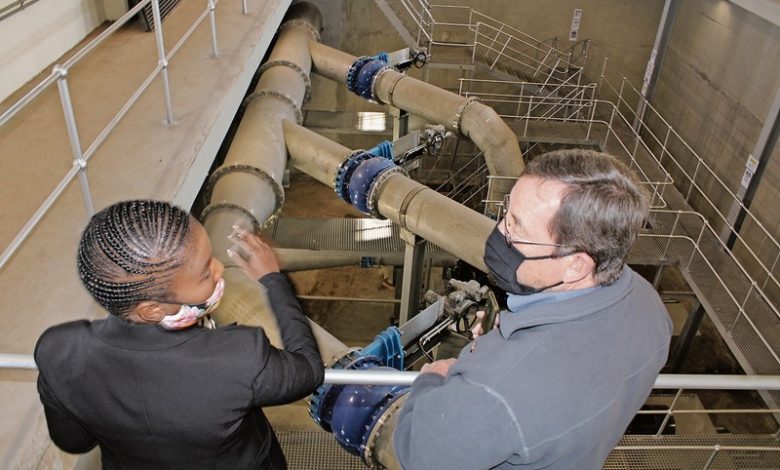
The fetid news was shared with the council’s Infrastructure Development Committee during a site visit to the sewage plant.
The unpleasant disclosure spurred committee chairman Cllr Bhekumuzi Marumo, who has an engineering background, to consider engaging with scientists and inventors from Middelburg “to think out of the box and come up with ideas to assist the municipality with tackling the problem innovatively”.
In answer to a question from the DA’s Jos Pretorius on how long it would take for the municipality to address the smell, Executive Director for Infrastructure Ms Lindiwe Silolo courteously answered “R340 million,” placing a damper on any quick-fix solutions.
The R40 million, on top of the R300 million needed for a second Biological Nutrient Remover (BNR), is an estimated amount needed for electrical generators to keep the plant running during load shedding and power outages.
Present BNR capacity stands at 20Ml, but with the commissioning of the new pump station this week, another 25Ml BNR unit is needed to enhance capacity.
The existing BNR also came with an upgraded sludge pond, which releases a much better quality outflow by mixing with and diluting aged sludge pond outflow to the Klein Olifants River.
After solids have been separated and hard-pressed, it gets ploughed into the ground around the plant. The problem remains in the open air aeration ponds, where chemicals can possibly help alleviate the stench but are currently unsuitable due to the killing effect it may have on biological breakdown organisms.
Also, inflation is not our friend when we’re R350 million in the red.
On Tuesday, the municipality did a final test run on the new pump station upgraded from 30Ml to 45Ml capacity.
Chairman Marumo responded that the municipality will have to engage with the Nkangala District Municipality, whom he believes have been “overlooking” Middelburg because of the municipality’s sterling financial and service delivery status.
For now, continued load shedding will have an ongoing effect on the smell, mostly affecting Mhluzi, Kanonkop and Dennesig.
More provisions will have to be made in future budgets to at least address the plant’s backup power generation capacity, “So that we can keep the chain strong, and not have a domino effect worsening the smell,” Ms Silolo said.
Do you have a news lead?
Contact our editorial office on 013 243 1434 or our standby number for emergencies on 072 248 3855 to share your story with us.
Follow us on the Middelburg Observer Facebook group or page or send a WhatsApp to 072 248 3855 with the words “add me” for the latest news.
Notice: Coronavirus reporting at Caxton Local Media aims to combat fake news
Dear reader,
As your local news provider, we have the duty of keeping you factually informed on Covid-19 developments. As you may have noticed, mis- and disinformation (also known as “fake news”) is circulating online.
Caxton Local Media is determined to filter through the masses of information doing the rounds and to separate truth from untruth in order to keep you adequately informed. Local newsrooms follow a strict pre-publication fact-checking protocol.
A national task team has been established to assist in bringing you credible news reports on Covid-19. Readers with any comments or queries may contact National Group Editor Irma Green (irma@caxton.co.za) or Legal Adviser Helene Eloff (helene@caxton.co.za).