• South Africa’s first world champion was crowned in 1893 when Laurens Meintjes won the 50-mile (80km) bicycle race in Chicago. He went on to set 16 new world records. He was also South Africa’s first world champion in any sport.
• Jack Rose was South Africa’s second world record holder; he set the record in 1897 in the 25-mile (40km) race.
• At the 1912 Summer Olympics in Stockholm, Rudolph ‘Okey’ Lewis won South Africa’s first-ever gold medal for cycling in the 320km time trial. His time was 10 hours, 42 minutes, 39 seconds.
Who remembers the feverish interest in the Rapport Tour?
There was a near-fist fight between Robbie McIntosh and Alan van Heerden’s supporters.
You were either a McIntosh or a Van Heerden man.
Almost like Kallie Knoetze and Gerrie Coetzee. There was a group of Kallie men, and in the other corner, Gerrie men.
Italy’s Pierre-Luigi Tagliavini won the first tour in 1973, and then Portuguese riders were unstoppable, until McIntosh was crowned champion in 1977.
He did it again in 1981 with Van Heerden winning in 1982 and his arch-rival, McIntosh, winning again in 1983.
The year after that, it was Ertjies Bezuidenhout’s turn.
McIntosh was a cyclist who did not ask for mercy and could hand it out. He won the tour again in 1986, and Van Heerden won in 1987. The tour ended in 2000.
South Africa is a country with talented cyclists.
Turn the clock back to 2001, with Robbie Hunter becoming the first South African to compete in the Tour de France and also the first South African to win a stage during the 2007 Tour de France. Daryl Impey is the first South African to wear the yellow jersey during the 2013 Tour de France.
Now, it is the year 2026.
At Mapleton, of all places, the provincial championships were held.
Mapleton is near Boksburg.
Five provinces, Limpopo, Mpumalanga, Gauteng, North West and the Free State, were present.
The area is a crime hotspot.
The roads are unsafe.
Two cyclists were injured in accidents.
According to onlookers, one of them broke a leg and was taken to the hospital by ambulance.
Cyclists warming up in the area were confronted by half-naked women.
Some walked around in just their underwear, and men picked them up at 07:30 in the morning and went into the bushes.
When cyclists avoided the prostitutes and rode another route, the road was littered with broken glass opposite a drinking place.
At one of the points on the route, a kombi stopped, and a group of drunk men got out and started assaulting one of the commuters with a stone, right in front of police and traffic officers.
There were no provincial traffic officers at two points, according to traffic controllers.
Some of the women who helped with traffic control at one of the points were threatened with being shot, they allege.
After the championships, a representative of Caxton newspapers received several complaints, including:
- The grass next to the road, where spectators and cyclists had to park, was not cut.
- There was no toilet paper in the ladies’ toilets for two days.
- There were no signs on the route warning motorists of cyclists using the road.
- It is alleged that race organisers were warned that the area was not safe, especially for children.
- A provincial chairman also expressed his displeasure with the way the championships were held, and where.
National championships:
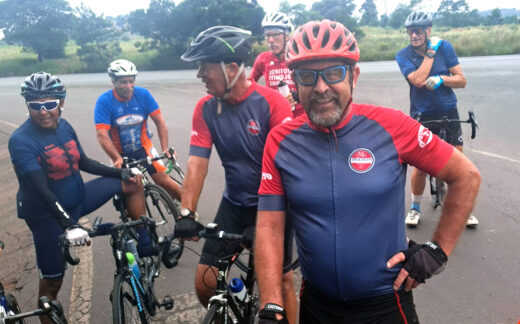
Cyclists such as those in the older age groups prepared according to the distances on the SA Cycling website, and as of late last week, it had not changed.
Older participants’ distances suddenly changed from 43km to 86km for the 70+ category and 100km for the 65 to 69 category.
An experienced marathon runner who swapped his running shoes for a bicycle said, “You don’t prepare for a half-marathon, and when you get to the start, they tell you to run a full marathon.”
Another veteran cyclist cried out, “They’re killing the sport.”
Ironically, when Gerrit Pfahl was appointed Road Director for Cycling SA, he said that as a dedicated father, he would work hard to ensure the future of cycling.
Several questions have been sent to him, which we address on this website.
The most important question is: Don’t cyclists in South Africa deserve better?