
MIDDELBURG HERITAGE: This week in Middelburg’s History
The Coat of Arms of the Municipality of Middelburg, Transvaal.
This week, 122 years ago, on Thursday, March 31, 1904, the first City Council of Middelburg approved a Coat of Arms for the town of Middelburg.
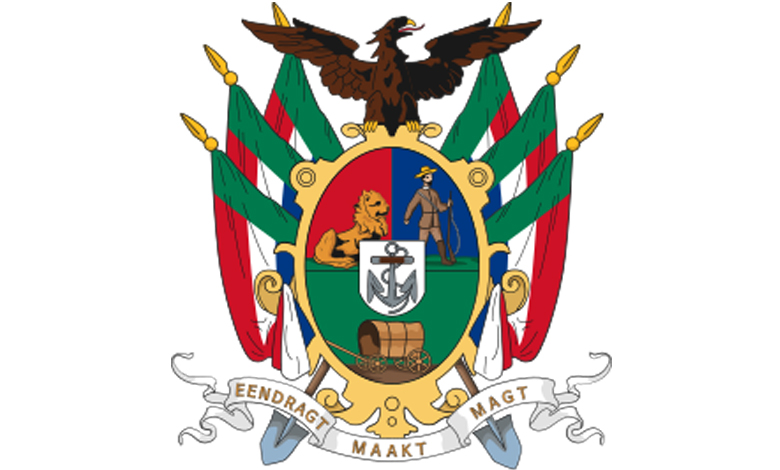
The coat of arms contains several elements that also appeared in the Coat of Arms of the, at the time, Zuid-Afrikaanse Republiek.
Transvaal
The coat of arms was the official heraldic symbol of the Zuid-Afrikaanse Republiek from 1866 to 1877 and again from 1881 to 1902, and later, in a simplified form, the symbol of the Transvaal Province from 1954 to 1994.
History
The Zuid-Afrikaanse Republiek was founded in 1857. On February 18, 1858, the Volksraad (legislative body) determined that the new state should have the following coat of arms.
- On the silver field, an ox wagon and a golden anchor should be placed, while an eagle rests on the coat of arms.
- On the right side of the coat of arms is a man in traditional dress with a gun and accessories.
- On the left, a lion.
The earliest known appearance of this coat of arms was on banknotes issued in 1866. The only crudely drawn coat of arms was depicted as a shield with a lion, an anchor and a man in the upper half, an ox wagon in the lower half, and the motto Eendragt maakt magt – meaning ‘unity brings strength’ – on a ribbon across the top. This version also appeared in the Staatscourant (government newspaper) from 1867.
A redesigned shield, featuring sections, an eagle perched above, and three flags draped on either side, debuted on postage stamps in 1869 and quickly became the favoured design. From 1871, it also appeared on banknotes and from 1872 it appeared on the main heading of the Staatscourant. In 1881, after the First War of Independence, the version was revived and again became obsolete when the Zuid-Afrikaanse Republiek ceased to exist in 1902 after the Anglo-Boer War.
In 1950, the Transvaal Provincial Administration decided to adopt the old coat of arms as the Provincial Coat of Arms and appointed Chief Archivist Dr Coenraad Beyers to investigate and report on the most suitable version. The coat of arms was reportedly adopted as the Provincial Coat of Arms in 1954, remaining in use until the province was dissolved in 1994.
The Coat of Arms of the Municipality of Middelburg, Transvaal – 1904 to 1994
History
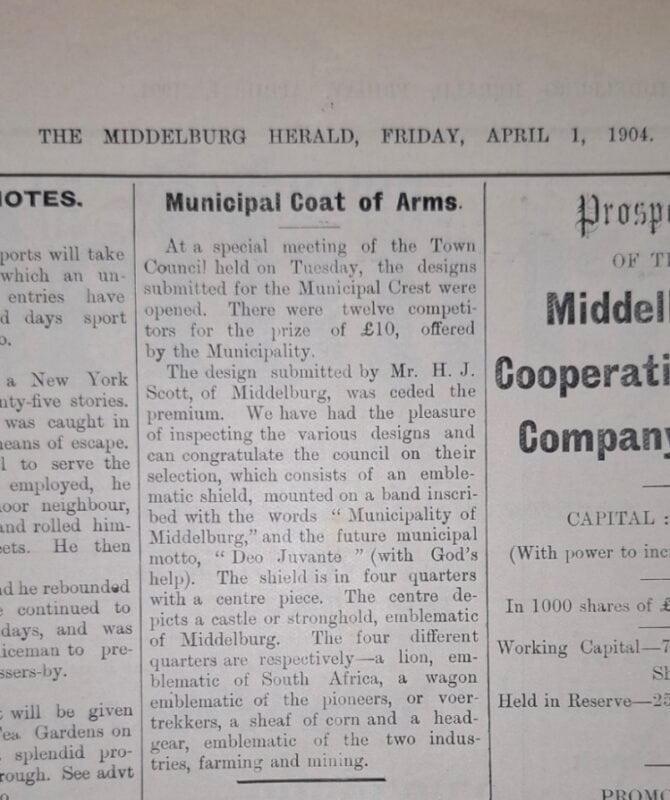
During a special meeting convened by the Middelburg City Council, it was decided that the town deserved a coat of arms. A reward of £10 (10 pounds) was offered for the person with the most suitable design.
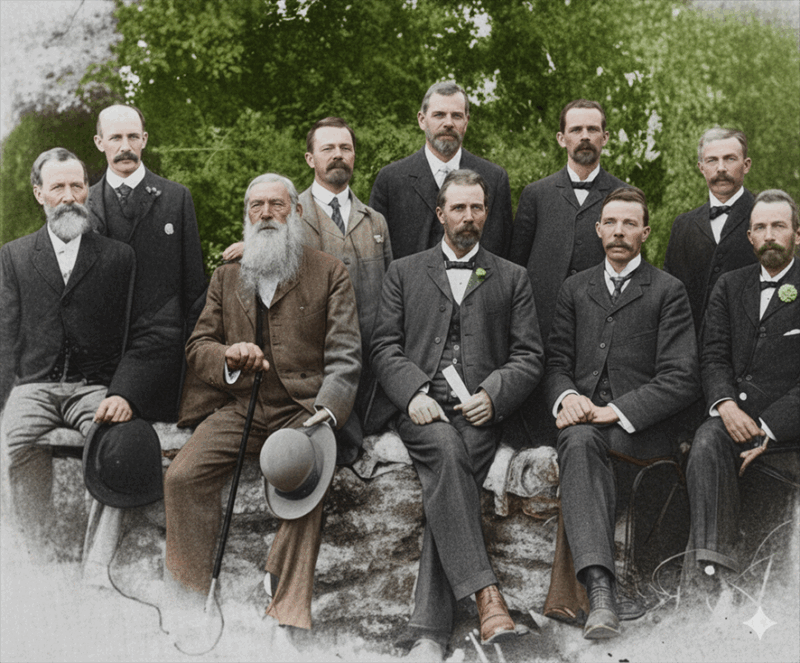
Tenders were invited by the first City Council for designs for a coat of arms, and from the seven sketches received, the council selected the sketch of Mr Hugh J Scott, an architect, in Middelburg. A committee consisting of Councillors CP Allaart, J Campbell, and JJ Trichardt recommended minor alterations to the order of Scott’s design. This was approved, and the town’s coat of arms was adopted.
The town Coat of Arms for the Municipality of Middelburg, Transvaal, was approved and adopted by the first City Council on March 31, 1904, as the official heraldic symbol of Middelburg.
The Design
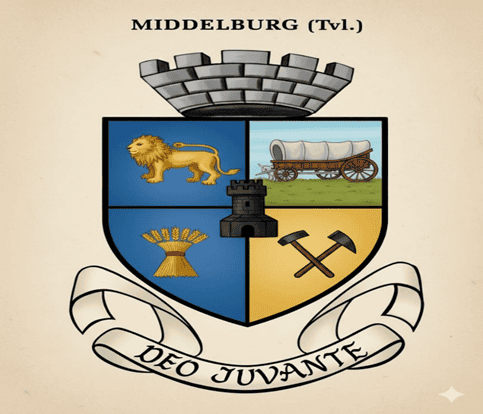
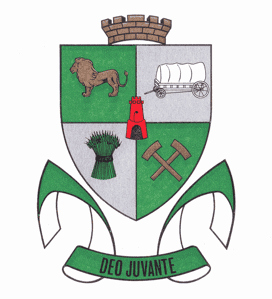
The coat of arms designed by Hugh J Scott, composed of:
- The details appear on a green field.
- In the top left corner is a lion in an open field. This represents South Africa in its uninhabited or natural state.
- Top right corner, an old Voortrekker ox wagon. This represents the occupation of the land by the Voortrekkers.
- In the bottom left corner, a sheaf of wheat and a sickle. This represents the development in the agricultural field.
- Bottom right corner, a mine in operation. This explains that the mines followed agriculture.
In the middle of the shield is a castle. The term ‘Burg’ refers to a town or city, since ancient towns were typically surrounded by fortifications. Its central position relates to the Dutch word ‘middel’, meaning centre, which explains the name Middelburg.
The shield is encircled by the words, ‘Municipality of Middelburg, Transvaal’, with the motto Deo Juvante – meaning ‘With God’s help’– displayed at the bottom.
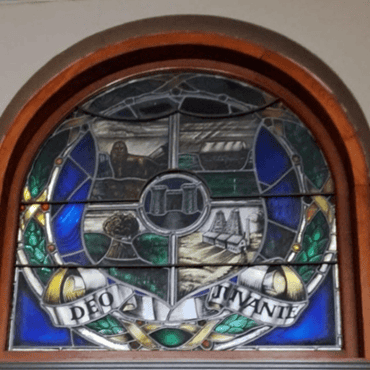
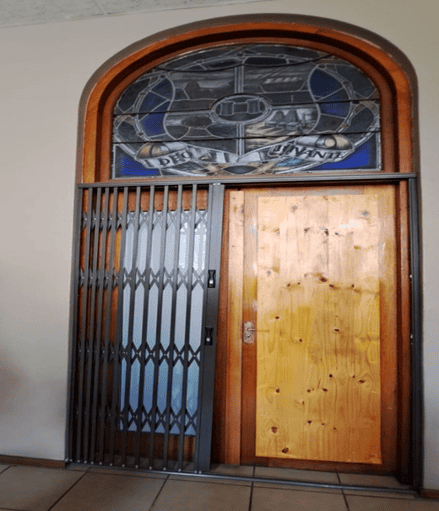
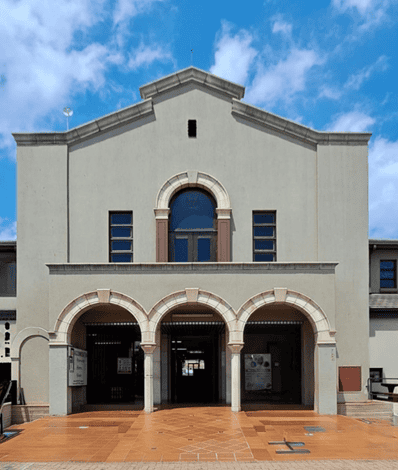
In 1941, the new municipal offices building in Eksteen Street was opened. The Council Chamber of the City Council was on the top floor, directly above the main entrance. A stained-glass rendering of the town’s coat of arms was placed above the door to the Council Chamber. Middelburg Heritage is campaigning for this unique stained-glass coat of arms to be declared a local heritage conservation point.
Interestingly, the design reproduced in the stained-glass coat of arms contains the original design of a sickle at the sheaf of wheat and mining buildings with headgear towers. The 1903 description also refers to a working shaft tower. The coat of arms was subsequently given a heraldic touch with various symbols; the sickle was eliminated, and instead of a working mine, two crossed mining picks were added as mining symbols. By 1964, when Middelburg celebrated its centenary, the design featured two crossed mining picks and a simplified colour scheme.
The Coat of Arms of the Municipality of Middelburg, Transvaal, after 1994
Following 1994, symbols at the national, provincial, and local levels were updated, and a new town coat of arms received approval. The Steve Tshwete Local Municipality was established.
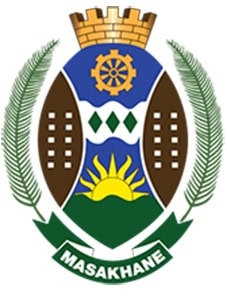
This coat of arms was adopted by the Steve Tshwete Local Municipality in April 2001.
It depicts an African shield, with the castle at the top, indicating that Middelburg is a municipality.
- The rising sun refers to Mpumalanga.
- The blue depicts water resources while the green, black diamonds and the wheel at the top refer to the main economic activities, namely agriculture, coal mining and industry, respectively.
- The leaves on the sides are from a Cycad species, found only in the Middelburg area.
The motto Masakhane – meaning ‘let’s build together’ – which appears at the bottom, was specifically chosen because it clearly summarises the way in which challenges are addressed by all role players within the municipality.
The coat of arms illustrates the key features and activities of the town, from the design created in 1904 to the present-day version.