
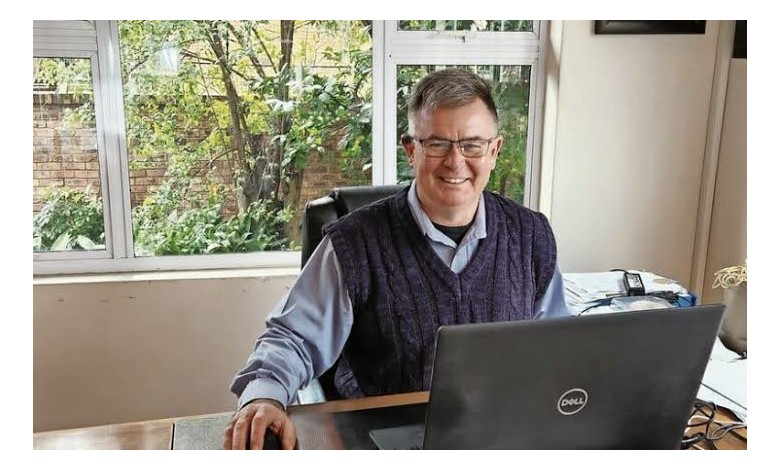
Residents have had enough of poor or no municipal services, a town that is going backwards and striking municipal workers. Local attorney and campaigner for Middelburg, André Brandmuller, said that ‘when unlawful strikes go unanswered, the whole town pays the price’.
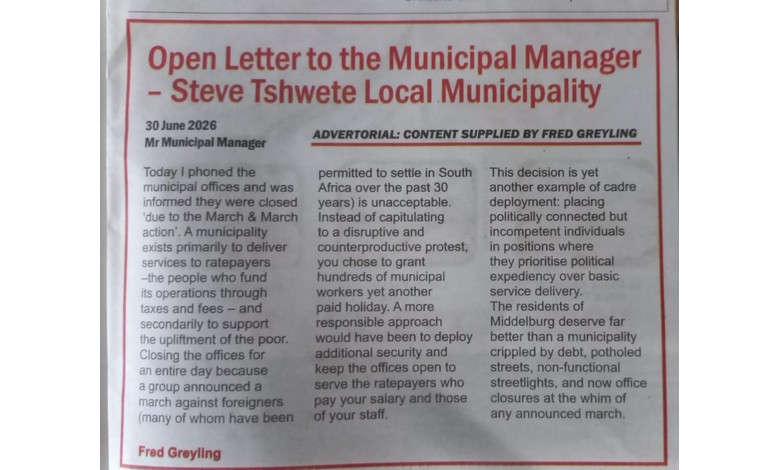
This follows a letter placed in the Middelburg Observer printed editionby businessman Fred Greyling, who also railed against poor municipal service delivery. “Middelburg deserves far better than a municipality crippled by debt, potholed streets, non-functional streetlights, and now office closures,” Greyling said in the letter to Municipal Manager Mandla Mnguni.
“There are moments in the life of a town when silence becomes complicity. When municipal workers embark on unlawful and unprotected strike action and face no meaningful consequences, residents are entitled to feel more than inconvenience. They are entitled to feel betrayed,” Brandmuller said.
“That sense of betrayal deepens when the executive of a town council appears to condone such conduct by conceding to demands born from unlawful action. If those entrusted with leadership reward disorder instead of upholding the law, what message is being sent to every resident, worker and ratepayer?
“As residents and ratepayers, we elected councillors to act in the best interests of their constituencies. We did not elect them to be spectators. We did not elect them to surrender at the first sign of pressure. We elected them because we expected them to do what is right, even when doing so is difficult.”
According to Brandmuller, whose father, Peter, was a mayor of the town, at the very least, we should be able to expect our leaders not to tolerate unlawful conduct. We should expect them to take every lawful step available to protect the interests of the town, ensure services continue, and defend the principle that rules matter.
“We should also expect them not to be bullied into submission by an undisciplined and ill-tempered workforce. Leadership that yields to intimidation does not buy peace; it merely postpones the next crisis and teaches the public that unlawful pressure works.
“This local failure is a microcosm of the wider world we now inhabit. We live in a society where corruption and crime are too often accepted with a shrug. Many people no longer report crime because experience has taught them that the police may not investigate properly, or at all. Even where investigations do happen, confidence in successful prosecution and conviction is painfully low.
Yet we cannot pretend that we do not know the difference between right and wrong. We are shaped by our upbringing, education, environment and experiences, but we are not helpless products of them. We still have the ability and the responsibility to choose how we respond.
“This is especially clear in everyday conversations: around the braai, in the hairdresser’s chair, in queues, offices and shops. We are very good at naming what is wrong with society. We speak freely about poor leadership, declining standards, lawlessness and the erosion of shared values.”
He said the real problem is not that good people fail to see the problem.
“The real problem is that too many good people stop at complaint. Their views remain unchanged from day to day and year to year, but their actions do not follow their convictions.”
Edmund Burke is often credited with the warning, “The only thing necessary for the triumph of evil is for good men to do nothing.” “Whether one calls it evil, decay or simple neglect, the principle holds true. A community declines not only because bad decisions are made, but because decent people decide that resistance is someone else’s responsibility.
“The challenge before us is therefore simple, but not easy: we must find the courage to do something. Not merely to complain. Not merely to shake our heads. Not merely to say, once again, that ‘something must be done’.
“We must choose not to vote for people who have held power for years while our society, services and values deteriorated under their watch. “We must choose not to place people in positions of representation when they are driven only by selfish or personal goals”.
“We must choose, every day, to address what is wrong in whatever small way is available to us. We cannot keep walking by on the other side of the road as if we did not see. “We must choose leaders who will stand up for our values, defend the rule of law, and understand that public office is a duty, not a reward”.
“Above all, we must become uncompromising in our pursuit of a town and a country in which neighbours can still love one another because they share more than a street address: they share a dream of accountability, decency and justice. “I have decided that I am going to do something. The question is: will you?”