
COVID-19 masks add to SA’s pollution crisis
According to Brendon Jewaskiewitz, president of the Institute of Waste Management of Southern Africa (IWMSA), the problem is snowballing.
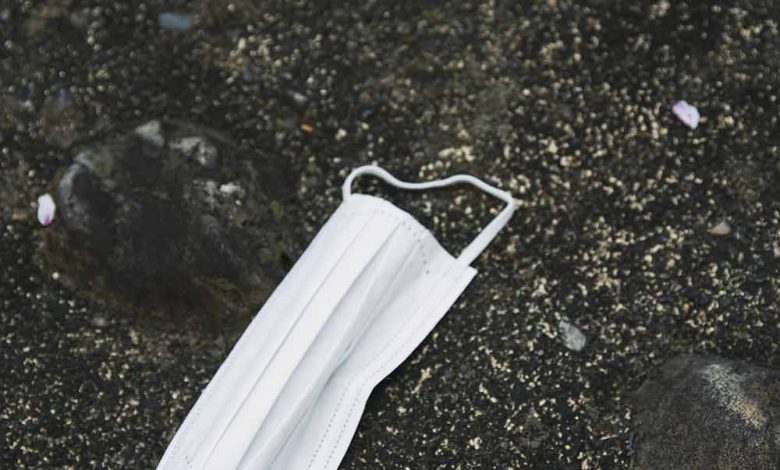
The ‘usual suspects’ of plastic pollution by individuals- plastic bags and straws- now have company. Since the start of the COVID-19 pandemic, disposable masks are lying discarded all over the country. And according to Brendon Jewaskiewitz, president of Institute of Waste Management of Southern Africa (IWMSA), the problem is snowballing.
“Studies have shown that globally, about 130 billion disposable masks are being used per month. That equates to an astounding three million per minute. Although we don’t have exact figures for South Africa, as a nation, we are rather careless about single-use plastics and masks are no exception. With our population of more that 58 million people, we will most certainly be in line with these shocking global statistics,” he pointed out.
Not a waste problem- a human problem
Jewaskiewitz emphasises the issue of single-use masks and their disposal can’t be addressed without acknowledging that it is part of a bigger plastic pollution problem, and that human behaviour is at the core of it.
“These masks are not biodegradable. When they are exposed to the elements, like sunlight, they break down and fragment into micro- and nanoplastics. It is then spread into our ecosystems and consumed by animals and fish,” he added.
He says there has even been instances where small animals have been found entangled in the ‘ear bands’ of discarded masks. Users are therefore advised to snip these ear bands before putting their masks in a PPE-bin.
“Many of these issues can be completely avoided by steering clear of single use masks in the first place. Opt for a reusable mask whenever it’s possible,” he suggested.
He says single-use masks are often chosen because of convenience.
“It’s the same argument we hear with plastic bags. People will say they packed shopping bags, but are too lazy to walk back to their car and fetch it, so they buy a plastic bag instead. Similarly, people now keep a bunch of disposable masks in their car,” he continued.
Education and awareness is key
Simply putting items in a rubbish bin, waiting for it to be discarded by authorities, is also no longer good enough. “In South Africa, local municipalities are tasked with waste management. But with so many elements of service delivery taking strain, waste management is often shifted to the bottom of the pile when it comes to allocating resources,” Jewaskiewitz mentioned.
The result is that about 90 percent of local waste is landfilled, and only a very small portion is recycled or reused.
“Companies can make a difference by emphasising the importance of reusable masks, as well as the correct disposal of single-use masks. It should be as important in their communications as the COVID-19 safety protocols,” he advised.
He says looking at the bigger picture is crucial.
“People often think that the one disposable mask they throw away, makes no impact. But if every South African does that every single day, it very quickly turns into a massive problem. Likewise, if everyone makes an effort to reduce and recycle, it also makes a huge positive difference,” Jewaskiewitz concluded.
Read original story on northcoastrisingsun.co.za

