
Is trophy hunting damaging South Africa’s reputation as a wildlife destination?
New studies question whether trophy hunting meaningfully contributes to SA tourism – or if it has the potential to keep visitors away.
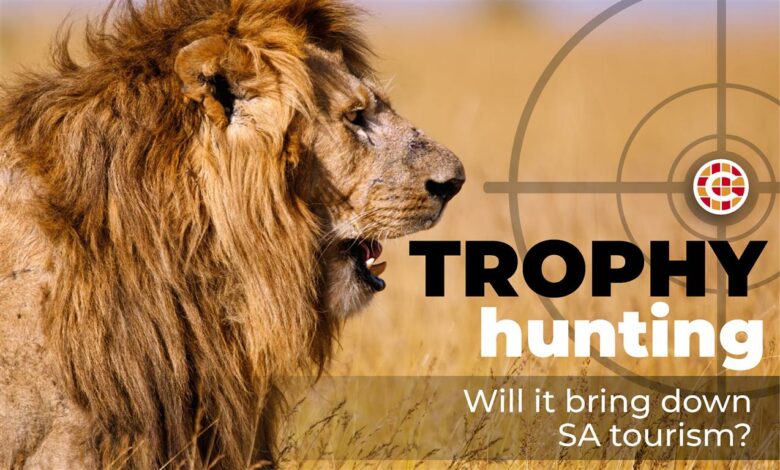
Each year, millions of international visitors and local citizens pass through the gates of South Africa’s national and provincial parks and private game reserves.
And now there seems to be growing opposition among these wildlife enthusiasts and nature lovers to the country’s trophy hunting industry. This is evident in two recently released surveys, one by the Humane Society International (HSI) and the other by World Animal Protection (WAP).
South Africa accounts for 16% of the total global exports of hunting trophies, is the second-largest exporter of hunting trophies of mammals listed by the Convention on International Trade in Endangered Species and exports 50% more hunting trophies than Namibia, Africa’s second-largest exporter.
The 2022 survey done by research company IPSOS on behalf of the HSI was conducted among 3 599 South Africans from all demographics in all nine provinces:
- 68% are fully opposed to or to some extent opposed to the practice of trophy hunting.
- 65% are fully opposed to or to some extent opposed to the practice of canned lion hunting.
- 63% disagree with the trophy hunting of lions.
- 64% disagree with the trophy hunting of elephants, rhinos and leopards.
WAP surveyed 10 900 people across the world, including international tourists who frequently visit South Africa and local citizens, for its research into perceptions about trophy hunting:
- 74% of international tourists agreed that making trophy hunting a key pillar of policy will damage South Africa’s reputation.
- 72% of international tourists indicated they would be put off from visiting South Africa altogether over trophy hunting.
- 84% of international tourists agreed the South African government should prioritise wildlife-friendly tourism over trophy hunting.
- 7 out of 10 South Africans agreed the country would be a more attractive tourist destination if trophy hunting was banned.
Research organisation Good Governance Africa also recently conducted an extensive study about what it calls the ‘faulty economics’ of trophy hunting in South Africa:
- The trophy hunting industry supports around 15 000 jobs.
- Biodiversity tourism supports at least 90 000 jobs.
- Trophy hunting in the Associated Private Nature Reserves (Balule, Klaserie, Timbavati, Umbabat) in 2019 generated R45.8m. Only R17m went back into conservation, with less than 10% of this allocated to community outreach.
Caxton Local Media spoke to the relevant parties for comment.
Dr Matthew Schurch: Wildlife specialist for HSI/Africa:
“The survey was released at a particularly important time as the topic of how sustainable use of the environment is managed is currently under review by the Department of Forestry, Fisheries and Environment in its White Paper on Conservation and Sustainable Use of South Africa’s Biodiversity. We hope that the department uses this opportunity to reflect on all the submissions it has received from the public and acts to stop these unacceptable practices.
“Trophy hunting is often touted as a way of providing funds for conservation due to the large sums of money that it generates. However, as Good Governance Africa has pointed out, this claim is based on ‘extremely little evidence’. This report also highlights that the trophy hunting industry as an economic generator is dwarfed by the tourism sector, and so any conservation needs could be more than met through expanded non-consumptive tourism.”
Maya Pastakia: WAP campaign manager
“There are specific concerns over the negative consequences of trophy hunting on species populations, biodiversity and wildlife conservation. The loss of iconic animals because of trophy hunting is a high ecological and environmental price to pay. Support for wildlife-friendly tourism is proliferating throughout the international travel sector.
“Essentially, we want the South African government to reject cruel consumptive practices, such as trophy hunting, as a default approach to sustainable development and conservation, make a public commitment to end trophy hunting and instead invest in other non-consumptive economic alternatives, including wildlife-friendly tourism.”
Dilys Roe: Chair of the IUCN Species Survival Commission’s Sustainable Use and Livelihoods Specialist Group:
“An analysis of the International Union for Conservation of Nature (IUCN) Red List of Threatened Species is currently underway and reveals that trophy hunting is not listed as a key threat to either the most hunted species or the most threatened species. It is listed as a threat to some populations of lions and some populations of leopards, but not to the species as a whole.”
Dries van Coller: Consulting executive officer of the Professional Hunters’ Association of South Africa:
“To be honest the [HSI] survey has been seen as a joke and far removed from the truth. The people who work daily within rural economies and support livelihoods do not even consider taking the survey seriously as it is ambiguous and far removed from the real affected parties.
“South Africa, with a population in excess of 60 million, cannot give credence to the assumptions and conclusions drawn from the survey sample. Not a single hunting association or pro-sustainable use organisation was consulted.
“There is only one word to describe it [the HSI survey]… Ludicrous, to say the least.”
Read original story on eyethunews.co.za

