
Plan to combat Hartebeespoort Dam hyacinth problem
Chemical control and composting as well as the breeding and releasing of insects will be utilised to combat the invasive species.
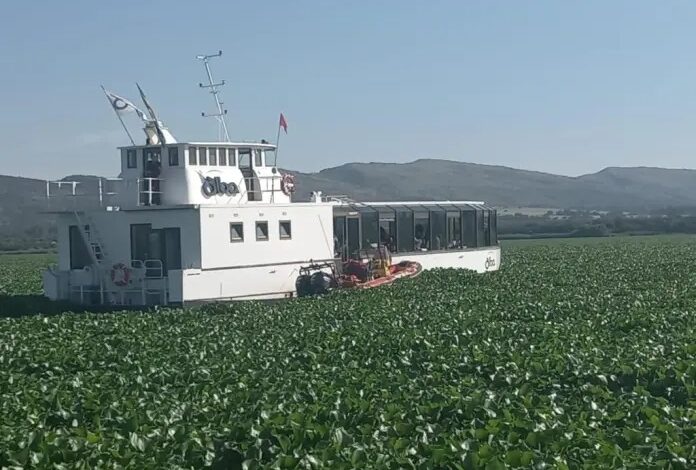
An integrated biological remedial programme to combat they hyacinth at Hartebeespoort Dam is in the process of being reinstated after 50% of the dam is currently covered by the plant species. Recently, 82 people had to be rescued off a restaurant barge after it was trapped in hyacinth on the dam.
Department of Water and Sanitation spokesperson Wisane Mavana says the hyacinth has spread its coverage of the dam from 5% to 45% in less than two months.
“The Department of Water and Sanitation is in the process to reinstate the Hartbeespoort dam integrated biological remedial program to deal with the hyacinth that has grown excessively after the intense rainfall and flooding at the catchments since November 2022.
“The program will be implemented through a newly instituted model that will incorporate more public and corporate involvement and support.”
Mavana says the department has seen an improvement in the dam’s condition after a Rand Water and Metsi a me Programme was implemented from 2006 to 2016.
“The remediation programme consists of interdependent modules including water quality management, and catchment management and control (harvesting and chemical control) of invasive species, intended to ensure that the department meets the objective of changing the state of the Hartbeespoort Dam,” she says.The Centre for Biological Control which tries to fight the hyacinth with biological control agents will also be involved.
“In parallel with Metsi a me, the insect breeding and release program through the Centre for Biological Control (Rhodes University) that worked very effectively, will continue together with the Metsi a me programme.”
The DWS has also issued a water use authorisation for the Harties Foundation for the removal and composting of hyacinth and has assisted in providing cables and rope to assist in the trapping of these plants together with a lease agreement to compost the removed material.
“The current environmental legislation prohibits the live transportation of these species to prevent further invasion in other areas.
“We are currently working on further interventions that would see short-term improvement of the dam and will engage the stakeholders around the dam for further suggestions and possible partnerships as well as a phased approach to reinstate most of the aspects as was done with the Metsi a me Programme in parallel with DFFEs biological control programme.”
• On Saturday, the Alba cruise barge’s motors failed 30 minutes into the cruise shortly before 14:00 when the propellers got entangled in an old mattress and entangled fishing nets submerged in the water.
Hyacinth surrounding the barge prevented a simple tow to shore.
Using the NSRI rescue craft and the SRU rescue craft, in nine relays, all 72 passengers and 10 crew were transferred onto the rescue craft and safely evacuated to shore.
Read original story on kormorant.co.za

