
Post-mortem, witness evidence tested in Mpumalanga farm murder trial
The state argued that the post-mortem findings and witness accounts contradict alibi claims in the murder trial of eight accused.
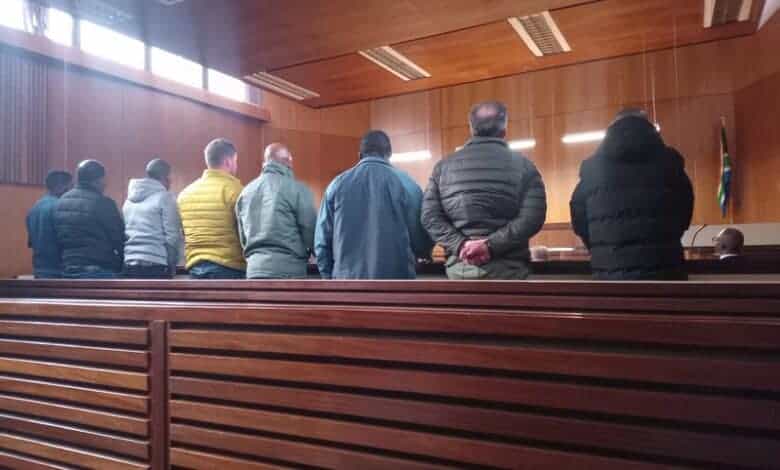
The case against the Pampoenkraal farm eight murder accused continued in the Middelburg High Court yesterday.
According to Middelburg Observer, the defence had previously closed its case, and the matter was scheduled for arguments by both parties.
Zenzele Mzikayise Yende (48), Werner Potgieter (48), Moses Dlamini (59), Masodeni Elliot Msongelwa Dlamini (61), Cornelius Lourens Greyling (26), Sikhumbuzo Zikalala Nhlabathi (25), Mzwakhe Dlamini (48) and Nkosinathi Msibi (26) are accused of the murder of Sifiso Thwala and Musa Nene, and the alleged attempted murder of Sthembiso Thwala on August 9, 2020. They are also facing charges of kidnapping and defeating the ends of justice.
The state called 11 witnesses, including Zenzele Coka, Sibonelo Vilakazi and Sthembiso Thwala, who gave extensive testimony into the events of that night.
State arguments presented
The state, represented by Advocate Themba Lusenga, told the court that witnesses placed all the accused on the scene, with Vilakazi providing detailed accounts of their roles. He said Vilakazi’s evidence was extensively corroborated by Coka and supported by Thwala’s testimony.
Lusenga added that Potgieter was not only identified in court by Thwala, but also by Constable Msibi, who was at the scene on August 10, 2020.
The defence had argued that five initial statements made by some of the accused to their lawyer should be accepted as the true version of events.
Post-mortem report examined
Lusenga countered that the statements do not explain the extensive injuries detailed in the post-mortem reports.
According to the report, Sfiso Thwala’s body showed multiple bruises and a subdural haemorrhage, with injuries caused by different objects. Lusenga argued that this contradicted the defence’s version, which accounted only for the use of a stick.
The court asked whether the bruises could have been caused by a fall against a fence, but Lusenga said this was not possible, as the injuries were consistent with blunt force trauma across the whole body.
He submitted that it would be disingenuous to confine the subdural haemorrhage to a fall, as testimony indicated blunt force trauma. He also argued that Vilakazi’s testimony about fabricated statements was supported by Potgieter’s alleged actions in preventing co-accused from speaking to police the next day.
Alibi defences disputed
Several of the accused argued that they had alibis. Greyling and Moses Dlamini both claimed not to have been present, but witnesses placed them on the scene and described their participation in the assaults.
Msongelwa Dlamini was identified as the one who retrieved a cloth and Vaseline to bathe the victims, with fractures allegedly caused during his assault.
Mzwakhe Dlamini was placed on the scene as the person who allegedly brought a cattle prodder used to shock the victims. Lusenga argued that by remaining on the scene and not dissociating himself, Mzwakhe aligned himself with the assaults.
Breaking news at your fingertips… Follow Caxton Network News on Facebook and join our WhatsApp channel.
Nuus wat saakmaak. Volg Caxton Netwerk-nuus op Facebook en sluit aan by ons WhatsApp-kanaal.
Read original story on www.citizen.co.za